
Before you can file for divorce in The Woodlands, Texas has a few ground rules. The most important one is proving you have the right to file here. Under the Texas Family Code, you must have lived in Texas for at least the last six months and, more specifically, in Montgomery County for the last 90 days.
These residency rules are the first legal checkpoint. If you don't meet them, a Montgomery County court cannot handle your case.
Understanding Your First Steps Before Filing For Divorce
Starting a divorce can feel overwhelming. Before getting lost in legal forms, it’s vital to understand the basics. For anyone living in The Woodlands, Conroe, or nearby communities, this starts with confirming your eligibility and figuring out what kind of divorce you’re facing.
The Texas Family Code, Section 6.301, is very clear on this. To file for divorce, at least one spouse must have lived in Texas for the last six months and in the county of filing—in our case, Montgomery County—for the 90 days just before you file. This is the first box you must check.
Uncontested vs. Contested Divorce: What To Expect
Once you've confirmed residency, the next big question is whether your divorce will be uncontested or contested. This single factor will define the timeline, cost, and emotional strain of the process.
An uncontested divorce means you and your spouse agree on all major issues: property division, child custody, and support. A contested divorce means you disagree on at least one of these points, requiring the court to intervene.
Many couples hope for an uncontested path, but disagreements can quickly turn it into a contested matter. Understanding where you stand early is a huge advantage.
Real-World Scenario: A Residency Check in Alden Bridge
Imagine Sarah and Tom, a couple living in the Alden Bridge village of The Woodlands. Sarah moved to their home from Louisiana eight months ago, while Tom is a lifelong Texan. They've decided to divorce.
Because Sarah has lived in Texas for more than six months and in their Montgomery County home for more than 90 days, she meets the residency requirements. She can legally file for divorce in the Montgomery County District Court. If, however, she had only moved to The Woodlands four months ago, she would need to wait another two months to satisfy the state's residency rule before the court would accept her petition.
Uncontested vs Contested Divorce in Montgomery County
| Factor | Uncontested Divorce | Contested Divorce |
|---|---|---|
| Agreement | You and your spouse agree on all issues (property, custody, support). | You and your spouse disagree on one or more major issues. |
| Timeline | Can be finalized in as little as 61 days (Texas's mandatory waiting period). | Can take many months, or even over a year, to resolve. |
| Cost | Significantly lower. Fewer attorney hours and court fees. | Much more expensive due to legal fees, mediation costs, and potential trial expenses. |
| Process | Involves drafting and signing an agreed-upon Final Decree of Divorce. | Requires hearings, mediation, discovery (exchanging information), and possibly a trial. |
| Emotional Strain | Less stressful and more amicable. | Often high-conflict, emotionally draining, and adversarial. |
As you can see, the path you take has massive implications. If you and your spouse are on reasonably good terms, you might be able to pursue a simpler, agreed-upon divorce. If not, preparing for a contested case is essential. For a deeper look, you can learn more about what a Woodlands divorce lawyer can do for you.
The "No-Fault" Standard in Texas
Texas is a "no-fault" divorce state. The legal ground for this is "insupportability," which means the marriage has broken down and there's no reasonable chance of getting back together. You don't have to prove someone did something wrong to get a divorce.
Of course, before the legal process even begins, you might be dealing with personal issues. This can include trying to find out if your spouse has been unfaithful and looking for information on how to catch a cheater. While Texas is a no-fault state, proof of adultery can sometimes play a role in how a judge divides community property.
It's also interesting to note that divorce rates in Texas have been trending downward. Rates dropped from 4.1 per 1,000 people in 1990 to just 1.3-1.5 by 2024. In Montgomery County, the divorced population is around 9.5%, which aligns with this statewide trend. You can find more on Texas divorce statistics and what they mean for families here.
What to do next:
- Confirm Residency: Check your lease or utility bills to confirm you meet the 6-month state and 90-day Montgomery County residency rules.
- Assess the Situation: Be honest about whether you and your spouse can agree on property, debts, and kids.
- Gather Documents: Start collecting basic financial paperwork, like recent pay stubs and bank statements.
- Consult an Attorney: Speak with a divorce lawyer to understand your rights and options before you file.
Disclaimer: This article provides general information and is not a substitute for legal advice. Family law is complex, and you should always consult with a qualified attorney to discuss your specific situation.
Facing a divorce is tough, but you don't have to figure it all out alone. If you're ready to understand your rights and get a clear picture of your options, our team is here to help. We invite you to schedule a consultation to discuss your case.
Tackling the Divorce Paperwork in Montgomery County
Alright, you've confirmed you can file for divorce in Montgomery County. What's next? It’s time for the paperwork. This part can feel intimidating, but it all starts with one key document: the Original Petition for Divorce.
This isn't just a form; it's a legal document that officially starts your divorce case. Knowing how to file court documents correctly is key. You can find state-approved forms at TexasLawHelp.org, or an attorney can draft and file them for you.
The First Steps: Filing and Service
Once the Original Petition for Divorce is complete, you’ll file it with the Montgomery County District Clerk. This is usually done electronically. At filing, you'll pay a court fee, which is typically a few hundred dollars.
Filing the petition is only the first step. The next, called service of process, is just as important. This is how you formally notify your spouse that a divorce has been filed. Texas law requires that your spouse receive official notice and a chance to respond.
The path your divorce takes from here depends on whether you and your spouse are in agreement.
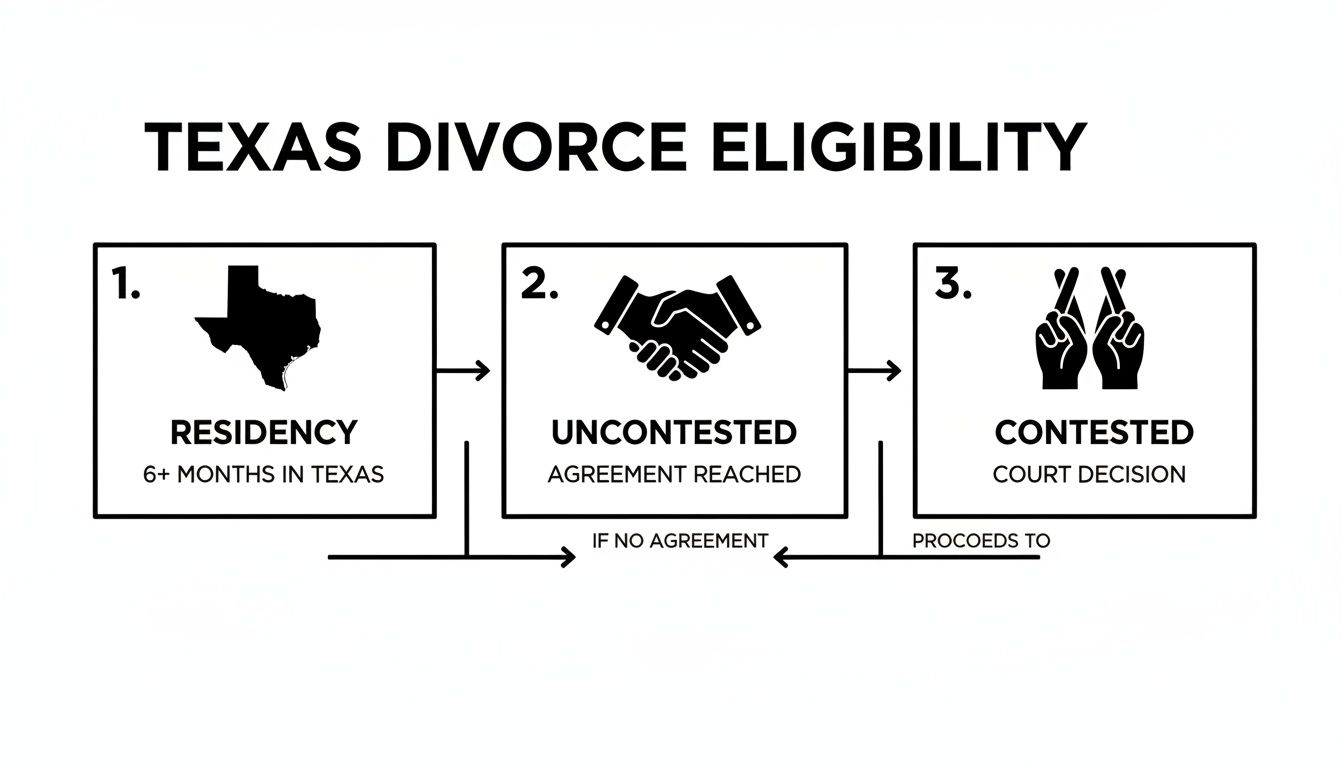
As you can see, once residency is met, the case either proceeds on an uncontested track if you agree, or a contested one if you don't. This choice dramatically impacts the complexity of the filings ahead.
Real-World Scenario: Serving Papers in Sterling Ridge
Here’s a practical example. Imagine Mark, who lives in Sterling Ridge, is ready to file for divorce. His wife, Lisa, agrees the marriage is over but refuses to sign any paperwork. Mark hoped she'd sign a Waiver of Service to keep things simple, but she refused.
So, Mark had to hire a professional process server. The server tried to deliver the papers to Lisa at their home three times without success. Finally, knowing her routine, the server waited outside a local grocery store and legally handed her the documents as she was leaving. This shows that even with a difficult spouse, the law has procedures to keep your case moving.
What is a Waiver of Service?
In an amicable divorce, your spouse can sign a Waiver of Service. This document, once signed and filed with the court, confirms they've received the petition. It saves you the time, expense, and potential awkwardness of having a constable or process server show up at their home or work. It's a hallmark of a smooth uncontested divorce in The Woodlands, Texas.
Of course, not every case is simple. The very issues that end a marriage—like infidelity or constant fighting—are often the same things that fuel a high-conflict divorce.
The Mandatory 60-Day Waiting Period
Once the petition is filed and served, a mandatory 60-day waiting period begins. This is a statewide rule from the Texas Family Code that applies to every divorce, except in rare cases involving documented family violence.
This is often called a "cooling-off" period. You can’t get your divorce finalized by a judge until at least day 61. But that doesn't mean nothing happens. This 60-day window is a productive time to negotiate, attend mediation, or ask the court for temporary orders.
What to do next:
- Complete the Petition: Accurately fill out the "Original Petition for Divorce."
- File with the Clerk: Submit the petition to the Montgomery County District Clerk and pay the filing fee.
- Handle Service: Decide on your service method. Will your spouse sign a Waiver, or will you need a process server?
- Mark Your Calendar: Find the date your petition was filed and count forward 61 days. That’s the first day your divorce can be finalized.
Disclaimer: This article provides general information and is not a substitute for legal advice. Family law is complex, and you should always consult with a qualified attorney to discuss your specific situation.
Navigating this initial paperwork correctly sets the foundation for your case. If you have questions or want to ensure your divorce starts on the right foot, we invite you to schedule a consultation with our experienced team.
Protecting Your Family and Assets with Temporary Orders
Once you’ve filed for divorce, Texas law imposes a 60-day waiting period before it can be finalized. But what happens to your family and finances during those two months—or longer? Life doesn’t just hit pause.
This is where Temporary Orders come in. Think of them as the official rulebook for your family while the divorce is in progress. These court orders create a stable, legally enforceable plan for everything from child custody to who pays the mortgage.

What Can Temporary Orders Accomplish?
A Montgomery County judge has the authority to establish immediate ground rules. These orders address critical issues that can't wait months for a final resolution.
Common issues addressed in Temporary Orders include:
- Child Custody & Visitation: Who the children live with and the possession schedule for the other parent.
- Child Support: An order for one parent to begin making monthly child support payments.
- Spousal Support: Temporary financial support for a qualifying spouse.
- Use of Property: Who gets to live in the family home while the divorce is pending.
- Paying Bills: Who is responsible for paying the mortgage, car notes, and other monthly bills.
While these orders are temporary, they are fully enforceable. Violating them can lead to serious legal consequences.
Real-World Scenario: A Panther Creek Parent's Financial Fears
Here’s a situation we often see. A couple in Panther Creek decides to divorce. The wife, a stay-at-home parent, notices her husband making large, unusual cash withdrawals from their joint savings account. She's worried he's trying to drain their funds.
In this case, an attorney would immediately file a motion for a Temporary Restraining Order (TRO). A TRO is an emergency order that acts like a financial freeze, preventing either spouse from selling assets or taking on new debt. A judge can grant it quickly. This single action is often the most critical step in preserving the marital estate for a fair division.
Key Takeaway: The Power of a TRO
A Temporary Restraining Order is a powerful step to stop destructive behavior. Under the Texas Family Code, a TRO can prohibit a spouse from taking actions that would harm you or the community estate. It’s an emergency brake on financial misconduct.
How to Get Temporary Orders
The process starts when one spouse's attorney files a motion asking for a hearing. You and your spouse will then go before a judge. In many cases, attorneys can negotiate the terms of the Temporary Orders beforehand. Presenting an "Agreed Temporary Order" to the judge saves time, money, and stress.
What to do next:
- List Financial Worries: Write down specific concerns, like a spouse running up credit card debt or draining a 401(k).
- Outline a Custody Schedule: Think through a stable, realistic schedule for your kids.
- Draft a Temporary Budget: Create a simple list of your monthly income and essential expenses.
- Gather Proof: Collect documents that support your case, like bank statements, pay stubs, or emails.
Disclaimer: This article provides general information and is not a substitute for legal advice. Family law is complex, and you should always consult with a qualified attorney to discuss your specific situation.
Establishing clear rules from the beginning can make the divorce process more manageable. If you are filing for divorce in The Woodlands and need to protect your family and assets, Contact us to learn how Temporary Orders can provide the stability you need.
What Happens to Our Property and Kids?
When you’re facing a divorce, two things usually keep you up at night: your property and your kids. Understanding how Texas law handles these critical issues is the first step toward finding a fair resolution.
For most of our clients in The Woodlands, these are the two biggest questions.

Dividing Your Assets: The "Just and Right" Rule in Texas
Texas is a community property state. This means almost everything you or your spouse earned or acquired during the marriage is presumed to belong to both of you. This is the "community estate." A judge's job is to divide it in a way that is "just and right."
"Just and right" doesn't always mean a 50/50 split. A Montgomery County judge can award one spouse a larger share based on factors like fault in the divorce (like adultery), differences in earning power, or if one spouse tries to hide assets.
The Critical Difference: Community vs. Separate Property
Your separate property is yours alone and is not divided. This includes things you owned before marriage, gifts given only to you, or an inheritance you received. The catch? The Texas Family Code requires you to prove an asset is separate with "clear and convincing evidence." The burden of proof is on you.
This distinction is often a major battleground in divorce cases. You can read more about the complexities of a high-asset divorce in The Woodlands to see how detailed this process can become.
Real-World Scenario: Dividing Property in Carlton Woods
Let's imagine a couple living in Carlton Woods. Before the wedding, the husband owned a stock portfolio. Five years into the marriage, the wife received a large inheritance. During their marriage, they bought their family home.
When they divorce, here’s how it breaks down:
- The stocks the husband owned before marriage are his separate property.
- The wife's inheritance is her separate property.
- The home they bought together is community property and must be divided.
This is why documenting the source of every asset is so crucial. Good paperwork is your best tool for protecting what is yours.
Deciding Child Custody and Support: The "Best Interest" Standard
When it comes to your children, the court’s only focus is the best interest of the child. This standard from the Texas Family Code governs every decision a judge makes about custody, visitation, and financial support.
Here’s what the legal terms mean in plain English:
- Conservatorship: This is "custody." It outlines your rights and duties as a parent, like making decisions about school and medical care.
- Possession and Access: This is the visitation schedule, a detailed calendar of when the children will be with each parent.
- Child Support: This is money paid by one parent to the other to help cover the costs of raising the children.
In most cases, a judge will name both parents "Joint Managing Conservators," meaning you share in decision-making. However, one parent is usually named the "primary" conservator. This parent determines where the children live (often within a specific area like Montgomery County) and receives child support.
What to do next:
- Make an Inventory: List your major assets and debts. Note when you got each one and its approximate value.
- Gather Proof: Find documents that prove an asset is separate property, like old bank statements or gift letters.
- Draft a Custody Schedule: Think realistically about a visitation schedule that puts your kids first.
- Create a Budget: List all your monthly child-related expenses to help calculate child support.
Disclaimer: This article provides general information and is not a substitute for legal advice. Family law is complex, and you should always consult with a qualified attorney to discuss your specific situation.
Finding a Resolution and Finalizing Your Divorce
Most people picture divorce as a courtroom battle. The reality in Montgomery County is that most cases never go to trial. Judges expect you to try to resolve things on your own first.
This is where methods like mediation come in. They shift the focus from "winning" to finding practical solutions, which is especially valuable for parents who need to build a healthy co-parenting relationship.
The Two Main Paths to a Final Agreement
Your divorce will be finalized either by a judge's ruling after a trial or by a settlement agreement you create. While a trial is always an option, most courts in The Woodlands will require you to try mediation first.
In mediation, you, your spouse, and your attorneys meet with a neutral third-party mediator. The mediator’s job is to help you find common ground and reach a settlement. It's a structured negotiation in a private setting.
The benefits of mediation are significant:
- You Keep Control: You craft the terms, allowing for creative solutions a court couldn't order.
- It’s Private: Negotiations happen in a private office, not a public courtroom.
- It Saves Money and Time: Reaching an agreement through mediation is almost always faster and cheaper than a trial.
Real-World Scenario: A Custom Possession Schedule
I once worked with a couple from Creekside Park whose children were elite athletes with demanding schedules. A standard court possession order would have been a disaster.
Through mediation, we built a completely custom possession schedule around the sports seasons. The parents agreed to trade weekends based on the tournament calendar. It ensured both parents could be present and the kids' routines weren't disrupted. That's the kind of tailored solution a judge can't always provide.
The Most Important Document: Your Final Decree of Divorce
Your divorce ends with one crucial document: the Final Decree of Divorce. This legally binding order contains every detail of your settlement—property division, custody, visitation, and child support. It is the single most important document in your case.
Once you have a signed agreement, you just have one last, simple court appearance.
The "Prove-Up": Making it Official in Montgomery County
To finalize the divorce, one of you and your attorney will go to the courthouse for a "prove-up" hearing. This isn't a trial; it's a short, simple formality.
Your attorney will ask you a series of scripted questions. The judge will quickly review your Final Decree to ensure it's legal and in the best interest of the child as defined by the Texas Family Code. Once the judge signs the decree, you are officially divorced.
What to do next:
- Discuss Mediation: Talk to your attorney about whether mediation is the right move for your situation.
- Know Your Priorities: Before negotiating, figure out what you must have and where you can compromise.
- Scrutinize the Decree: Read every line of your proposed Final Decree of Divorce before you sign it. Make sure it says exactly what you agreed to.
- Prepare for the Prove-Up: Your attorney will walk you through the simple questions you'll be asked in front of the judge.
Disclaimer: This article provides general information and is not a substitute for legal advice. Family law is complex, and you should always consult with a qualified attorney to discuss your specific situation.
Reaching a final resolution is the last big hurdle. If you're ready to build a strategy for settling your case, schedule a consultation with our team.
Common Questions We Hear About Divorce in The Woodlands
When you're facing a divorce, your mind is probably racing with questions. Getting straightforward answers is the first step toward finding your footing. Here are the answers to some of the most common questions we hear from families across Montgomery County.
What Are the Very First Things I Should Do to Prepare for a Divorce?
What you do before you file can have a massive impact. Your first priority should be to get organized and protect yourself.
Here's a practical checklist:
- Check Your Residency: You must have lived in Texas for at least six months and in Montgomery County for the last 90 days. This is a non-negotiable first step.
- Gather Financial Documents: Collect recent bank statements, tax returns, pay stubs, and property deeds.
- Build a Personal Budget: Get a clear picture of your monthly income and expenses. This is essential for any discussion about support.
- Go Dark on Social Media. Do not post anything about your spouse, your separation, or your social life. The opposing attorney will look for your posts and can use them against you.
- Talk to an Attorney. A consultation will clarify your rights and give you a realistic game plan.
How Much Will a Divorce Cost in Montgomery County?
The cost can vary dramatically. It starts with court filing fees, which are usually a few hundred dollars. From there, the final price depends on whether your divorce is contested or uncontested.
If you and your spouse agree on everything, the divorce will be far less expensive. If you are fighting over a business, property, or child custody, the costs can climb into the thousands. Contested cases require more attorney time and may involve hiring experts like forensic accountants.
Do I Actually Have to Go to Court for a Texas Divorce?
You won't necessarily have to go through a full trial. However, even in a 100% amicable divorce, Texas law requires one spouse to make a brief court appearance for a "prove-up" hearing.
A "prove-up" is a short, informal meeting with a judge, often lasting just five minutes. Your attorney will ask you simple questions to confirm the details in your Final Decree of Divorce. The judge then signs the decree, and your divorce is official.
If you and your spouse cannot agree on the terms of your divorce through negotiation or mediation, then you will have to go to court for more formal hearings and, potentially, a trial where a judge will make the final decisions.
Can I File for Divorce Here if My Spouse Lives in Another State?
Yes. The key is that you must meet the Texas residency requirements. To file in The Woodlands, you need to have lived in Texas for the past six months and in Montgomery County for the 90 days just before filing.
Where your spouse lives doesn't stop you from starting the case here. The process of "serving" them with the divorce papers just becomes more complicated, as it involves following specific rules for out-of-state service. An experienced attorney can manage this process to make sure it's done correctly.
What to do next:
- Gather Your Documents: Start organizing your financial records now.
- Make a Budget: Understand your income and expenses to prepare for discussions about support.
- Clean Up Social Media: Review your online profiles and avoid posting about your personal life.
- Schedule a Consultation: Get legal advice tailored to your specific situation before you make any decisions.
Disclaimer: This article provides general information and is not a substitute for legal advice. Family law is complex, and you should always consult with a qualified attorney to discuss your specific situation.
Going through a divorce can feel like navigating a storm, but you don't have to do it alone. If you're ready to get clarity on your situation and understand the best path forward, our team is here to help. Schedule a consultation with us today.