
If you're a father in The Woodlands facing a custody dispute, it’s easy to feel like the deck is stacked against you. But let’s get one thing straight: Texas law is neutral. Courts do not automatically favor mothers. Every decision boils down to one guiding principle: the best interest of the child. That standard applies equally to you and the child's mother.
Understanding Your Rights as a Father in The Woodlands

Many fathers I talk to in Montgomery County worry they're starting from a disadvantage. It’s a common misconception, often born from outdated ideas about parenting roles. The reality is, the Texas Family Code flat-out prohibits judges from making custody decisions based on gender. Your rights as a father are just as strong as the mother's.
The court’s entire focus is on ensuring your child has a stable and loving life. To figure that out, they look at two main pieces of the custody puzzle:
- Conservatorship: This is your legal power to make major decisions for your child, like where they go to school, what medical treatments they get, and their religious upbringing.
- Possession and Access: This is the parenting schedule—the calendar that dictates when your child is in your care and when they are with the other parent.
For fathers in communities from Panther Creek to Alden Bridge, showing your consistent involvement is what makes the difference. A judge in Conroe isn't looking at stereotypes; they're looking at your history as a hands-on parent, your ability to provide a safe home, and your willingness to work with the other parent for the child's sake.
The Presumption of Joint Custody
Here’s something that might surprise you: Texas law actually presumes it's best for a child if both parents are named Joint Managing Conservators (JMC). This is the most common outcome in Montgomery County custody cases.
Being a JMC means you and the other parent share the rights and responsibilities of raising your child. Even if one parent gets to decide where the child lives most of the time, you both have a say in the big decisions.
The core of Texas family law is that kids do better when both parents are actively and meaningfully involved. The court wants to see fathers stepping up, not stepping aside.
What to Do Next: A Checklist for Fathers
Getting started can feel overwhelming, but a few key steps can put you on the right track. Here’s a quick checklist to get you moving:
- Document Your Involvement: Start a log or journal of your parenting activities. Note every doctor's visit, school event, and homework session.
- Gather Important Records: Pull together school report cards, medical records, and photos of you and your child together.
- Establish a Stable Home: Make sure your home is a safe and welcoming place for your child with a dedicated space for them.
- Stay Positive: Never bad-mouth the other parent where your child can hear. Montgomery County judges value parents who can cooperate.
- Establish Paternity: If you weren't married when your child was born, your first legal task is to establish paternity. Nothing else can happen until you are legally recognized as the father.
Disclaimer: The information provided in this article is for informational purposes only and does not constitute legal advice. You should consult with a qualified attorney for advice regarding your individual situation.
Protecting your relationship with your child is the most important job you'll ever have. As a father in The Woodlands navigating a custody case, understanding these concepts is the first step toward securing your role in your child's life. To go over the specifics of your situation, schedule a consultation with an experienced local family law attorney.
Establishing Paternity: The First Step for Unmarried Fathers in The Woodlands
If you and your child's mother were not married when your child was born, there’s a critical reality you need to understand: in the eyes of Texas law, you don't have any parental rights yet.
I can't stress this enough to fathers. Until the law formally recognizes you as the legal father, you have no standing to ask a Montgomery County judge for custody or visitation. It’s the key that unlocks every single right you have as a dad.
So, how do you get that key? The Texas Family Code provides two clear pathways.
The Easy Road: Acknowledgment of Paternity (AOP)
The most straightforward route is signing a legal document called an Acknowledgment of Paternity (AOP). This is something both you and the mother can sign, often right at the hospital after the baby is born.
Think of the AOP as a sworn statement where you both agree that you are the child’s legal father. Once signed and filed, it has the full force of a court order. It makes you the legal father, allows you to be on the birth certificate, and gives you the right to file for a custody order. It also establishes your responsibility for child support.
The Necessary Detour: Filing a Suit to Adjudicate Parentage
What happens if the mother won't sign an AOP? Or maybe there's a question about who the biological father is. In these situations, your next move is to file a Suit to Adjudicate Parentage.
This is a formal lawsuit you file in a Montgomery County court, asking a judge to legally establish you as the father. The court will almost certainly order a DNA test. If the test confirms you are the father, the judge will issue an official order declaring your parentage. This court order gives you the same rights and responsibilities as an AOP.
Real-World Scenario: A Father’s Fight for Legal Rights
A father I worked with, Mark from Creekside Park, had a son with his girlfriend. After they broke up, she refused to sign the AOP and started making it difficult for him to see their boy, even though he was helping out financially. Mark felt powerless because, legally, he was. He had no rights.
We immediately filed a Suit to Adjudicate Parentage. The court ordered a DNA test, which came back positive. Armed with that court order, he was finally able to get a formal possession schedule, securing his time and ensuring he would always be a part of his son's life.
Mark's story hits on a vital truth: In Texas, being a biological father and a legal father are two entirely different things. Until you take that formal step, your access to your own child depends entirely on the mother’s goodwill.
The data shows why this is so important. Fathers now make up about 20% of all custodial parents, according to family law statistics. But you have to take action to secure your rights.
What to Do Next: A Paternity Action Plan
If you’re an unmarried father in The Woodlands, here’s what you need to do:
- Try the AOP First. If you and the mother are on good terms, ask her to sign an Acknowledgment of Paternity. It's the simplest and fastest way.
- Don't Wait. If she refuses or is hesitant, don't let weeks turn into months.
- File the Suit. Your next step is to file a Suit to Adjudicate Parentage with the court.
- Complete the DNA Test. Cooperate fully and quickly with any court-ordered genetic testing.
- Get a Custody Order. As soon as paternity is established, you must get a legally enforceable order that spells out your custody and visitation rights.
Disclaimer: The information provided in this article is for informational purposes only and does not constitute legal advice. You should consult with a qualified attorney for advice regarding your individual situation.
Establishing paternity is the foundation for any unmarried father fighting for his rights in The Woodlands. If this is your situation, speaking with a local family law attorney can give you a clear path forward.
Decoding Texas Conservatorship and Possession Orders
Once you've established paternity, the next step is getting a formal custody order from a Montgomery County court. This document is the official rulebook for your co-parenting life, and knowing how to read it is critical for protecting your rights.
Here in Texas, we don't use the single term "custody." Instead, the law splits it into two key ideas: conservatorship and possession.
Think of it this way: Conservatorship is your legal authority to make major decisions. Possession and Access is the actual parenting schedule. For a dad in The Woodlands, this means the court order will define your decision-making rights and the specific days you have your child.
Joint vs. Sole Managing Conservatorship
In most cases, the court will name both parents Joint Managing Conservators (JMC). This is the default position under the Texas Family Code. The law starts with the belief that it’s best for a child to have both parents actively involved.
As a JMC, you share the rights and responsibilities of being a parent. One of you will likely be named the "primary" parent, who gets to decide where the child lives, but both of you typically get a say in big decisions.
The most important thing for fathers to grasp is that JMC is the standard, not a prize you have to win. The court begins with the expectation that you will be an active co-parent.
Sole Managing Conservatorship (SMC) is rare and usually only happens when there are serious issues, like a history of family violence, substance abuse, or if one parent has been completely absent. An SMC parent has the exclusive right to make most decisions without consulting the other.
Joint vs. Sole Managing Conservatorship Rights for Fathers
This table breaks down the typical rights a father has under the standard Joint Managing Conservatorship (JMC) versus the much more restrictive Sole Managing Conservatorship (SMC).
| Parental Right | Joint Managing Conservator (JMC) | Sole Managing Conservator (SMC) |
|---|---|---|
| Deciding Residence | The "primary" parent typically has this right exclusively, often limited to a specific geographic area (e.g., Montgomery County). | You have the exclusive right to determine where the child lives, with no geographic restrictions unless ordered by the court. |
| Medical/Dental Decisions | Shared right, but the primary parent may have the final say after consultation. In emergencies, the parent with the child decides. | You have the exclusive right to make all non-emergency medical and dental decisions for the child. |
| Educational Decisions | Shared right. Both parents can access records and consult with the school. The primary parent often has the tie-breaking vote. | You have the exclusive right to make all decisions regarding the child's education. |
| Legal Decisions | Shared right to consent to legal actions on behalf of the child. | You have the exclusive right to represent the child in legal actions and make other legal decisions. |
| Child's Services | Shared right to consent to things like counseling, marriage, or enlistment in the armed forces. | You have the exclusive right to consent to marriage, military enlistment, and psychological/psychiatric treatment. |
| Access to Information | Both parents have the right to access all medical, dental, psychological, and educational records. | You have full access, while the other parent's access might be restricted by the court order. |
The Standard Possession Order Explained
The second part of your order—"possession and access"—is the actual parenting calendar. When parents live within 100 miles of each other, Texas courts almost always use the Standard Possession Order (SPO). The SPO is the minimum time the non-primary parent is entitled to.
For a father here in The Woodlands who isn't the primary parent, a basic SPO schedule includes:
- Weekends: You get the kids on the first, third, and fifth weekends of a month.
- Holidays: You and the other parent alternate major holidays like Thanksgiving and Christmas year to year.
- Summer: You get 30 days of possession during the summer.
If you live more than 100 miles away, the SPO is adjusted for travel. You might get every spring break and a longer chunk of the summer instead of frequent weekend visits.
Real-World Scenario: A Father’s Modified Schedule
Let me give you an example. I worked with a dad, James, living in Sterling Ridge. The SPO was the starting point, but his daughter played soccer every Saturday, even on weekends her mom was scheduled to have her. Sticking rigidly to the SPO meant he couldn't coach and his daughter might miss out.
We worked out a simple modification: James would pick up his daughter for her games every Saturday morning, and then she'd go back to her mom for the rest of the day. They agreed, we got it formalized by the court, and it worked perfectly. Their daughter kept her routine, and James stayed involved in her favorite activity.
What to Do Next: A Checklist
- Review the SPO Calendar: Find the Texas Standard Possession Order calendar online. It will show you exactly which weekends are the 1st, 3rd, and 5th.
- Assess Your Proximity: Map the distance between your home and the other parent’s home. This determines which version of the SPO applies.
- Identify Potential Conflicts: Does your child's life clash with the standard schedule? Make a list.
- Propose Custom Solutions: Remember, the SPO is just the default. You and the other parent can agree to almost any schedule that is in your child’s best interest.
Disclaimer: The information provided in this article is for informational purposes only and does not constitute legal advice. You should consult with a qualified attorney for advice regarding your individual situation.
Understanding the parts of a Texas custody order gives you the power to advocate for a schedule and set of rights that work for your family. To discuss creating a custom-fit possession order in The Woodlands, schedule a consultation.
Proving Your Child's Best Interest in Montgomery County
In any custody case before a judge in Montgomery County, from Conroe to Magnolia, every decision is guided by one principle: the "best interest of the child."
That phrase is the legal standard that governs every order a judge makes. It’s not about which parent is "better." It’s about which parent’s involvement and home environment will best help the child thrive.
Texas judges rely on a set of criteria known as the "Holley Factors" to get a full picture of the family's situation. For a father fighting for his rights, understanding these factors is key. Your job is to show the judge, with clear evidence, that you meet your child's day-to-day needs.
The Holley Factors In Action for The Woodlands Fathers
The "Holley Factors" are a practical checklist. Let’s translate them into what they mean for a dad in The Woodlands.
- Emotional & Physical Needs: Can you prove you provide a safe, nurturing home? A judge wants to see that you make meals, help with homework for their Conroe ISD school, and handle bedtime routines.
- Parental Abilities: Are you an engaged father? Your history of attending parent-teacher conferences, taking your child to the doctor, or coaching their local team speaks volumes.
- Stability of the Home: Is your home a consistent and stable place? A steady job, a safe and clean home, and a predictable daily schedule are powerful evidence.
- Child's Desires: For children aged 12 or older, the judge may interview them to hear their preference. This is just one factor among many.
- Acts or Omissions by a Parent: A judge will look at how each parent behaves. Are you willing to cooperate? That's a huge plus. Do you bad-mouth the other parent? That's a major red flag.
A judge is far more impressed by a father who can name his child's best friend and teacher than one who only talks about his financial contributions. Consistent, positive engagement is the most compelling evidence.
The Financial Side of Custody
While your hands-on involvement is the priority, your financial stability is also a critical piece of the puzzle. A judge needs to see that you have the means to provide for your child.
Data from child support statistics from the Annie E. Casey Foundation shows that custodial fathers have historically been less likely to receive the child support they are owed compared to mothers. This can add stress for dads trying to secure their rights. Proving you can provide a stable home, regardless of the child support situation, is vital in any Montgomery County child custody case.
Real-World Scenario: The Documented Dad
Think of a client, Mike, from the Indian Springs village. His ex-wife argued that he was an uninvolved parent. Mike knew this wasn't true, but he had to prove it.
We built a simple evidence binder. It wasn't fancy, but it was powerful. Inside, he put copies of emails he sent to teachers, photos from the school's father-daughter dance, receipts for sports fees, and a calendar detailing his time with the kids. In court, he didn't just tell the judge he was an involved dad; he showed him. That organized proof was the key to securing a joint custody order.
What to Do Next: A Checklist
To start building your "best interest" case, you can take action right now.
- Start a Parenting Journal: Get a notebook or use an app to document your daily involvement. Log school pickups, homework sessions, and doctor's visits. Be specific.
- Gather Your "Proof" Binder: Collect evidence like photos, report cards, and emails with teachers or coaches that show you as an active, engaged father.
- Ensure a Child-Friendly Home: Take pictures of your child's bedroom and play areas to demonstrate you provide a safe and welcoming environment.
- Keep Communication Civil: Save all texts and emails with the other parent. Always remain polite and focused on the children. This communication can become evidence.
Disclaimer: This article provides general information and does not constitute legal advice. You should consult with a qualified attorney to discuss the specifics of your individual situation.
The heart of any successful custody strategy is demonstrating that you are essential to your child's happiness. To discuss how we can build the strongest possible case for your family in The Woodlands, schedule a consultation.
A Step-by-Step Guide to the Custody Process in Montgomery County
Walking into the Montgomery County Courthouse in Conroe can feel overwhelming. But the family court system isn't as mysterious as it seems once you understand the roadmap. For a father in The Woodlands, knowing the path from start to finish is your biggest asset.
The process officially kicks off when one parent files an Original Petition in Suit Affecting the Parent-Child Relationship (SAPCR). This asks a judge to make legal orders about your child's custody.
Once the petition is filed, the other parent must be officially notified. This step, known as service of process, ensures everyone is aware that a lawsuit has begun.
The Key Stages of a Custody Case
After the initial paperwork, your case moves through several phases. Some cases settle quickly, but most follow a path designed to give both parents a fair chance to be heard.
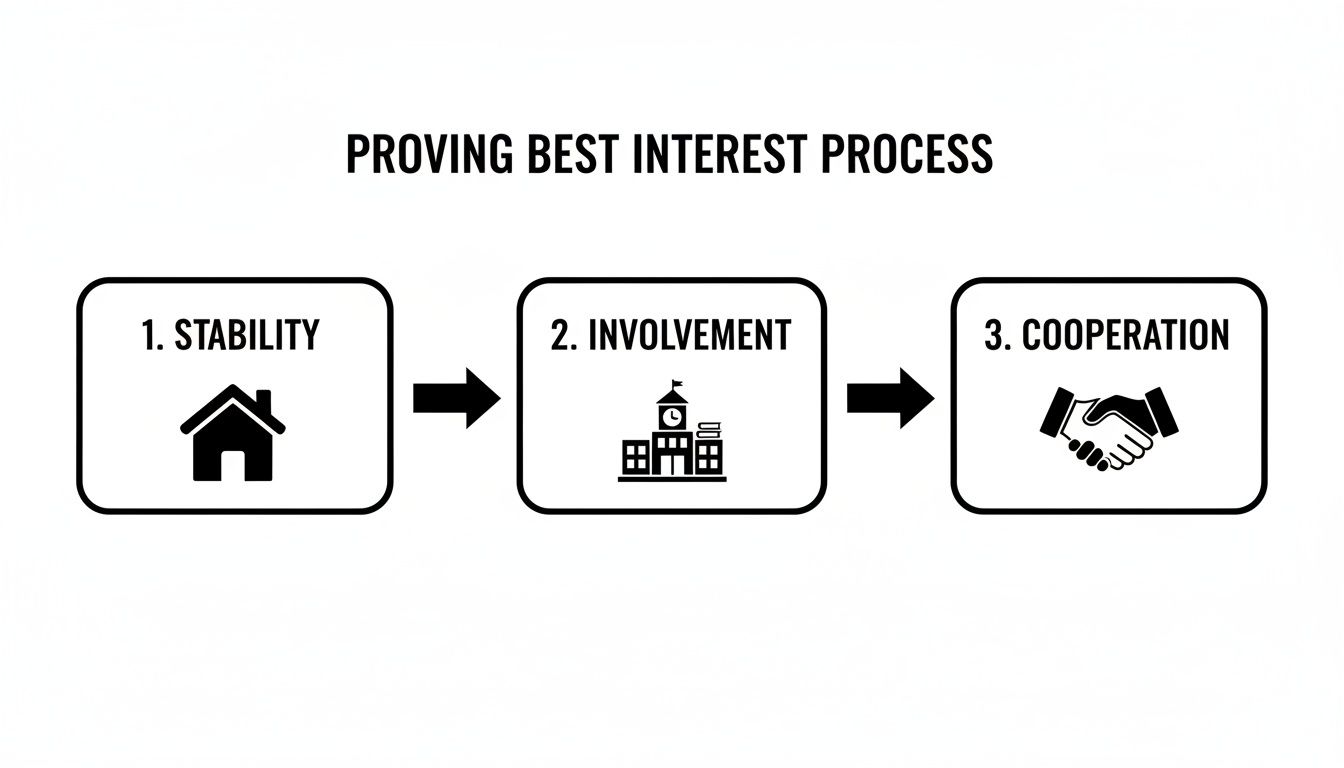
This chart breaks it down. Every step you take to show you provide a stable home, are involved in your child's life, and can cooperate builds a powerful case.
One of the first, most critical hearings is the Temporary Orders Hearing. A judge will listen to both sides and set the ground rules for how things will work while the case is pending. This includes a temporary possession schedule and child support. These orders aren't permanent, but they often set the "status quo" for the rest of the case.
A judge can issue a Temporary Restraining Order (TRO) very quickly, but only if there is a real, immediate threat of harm. The standard is high, and you must prove a clear and present danger to your child.
Mediation: The Path to Resolution
Before a final trial, Montgomery County judges will require you and the other parent to try mediation. This is a confidential process where a neutral third-party mediator helps you work toward a settlement. The vast majority of custody cases are resolved here, saving time, money, and emotional strain.
If you can't reach an agreement in mediation, your case will be scheduled for a final trial. Here, both sides present all their evidence to a judge, who then makes a final, legally binding decision. This is the most complex and expensive part of the process, which is why mediation is so valuable.
Real-World Scenario: A Father’s Hearing Prep
Let me tell you about a client, Mark, a dad from The Woodlands. His temporary orders hearing was two weeks after he filed. Instead of panicking, we got to work. He spent that time gathering his child’s report cards and printing out calm text exchanges with the mother. He walked into that courthouse organized and prepared, which made it easy to paint a clear picture of him as a stable, hands-on father.
What to Do Next: A Court Preparation Checklist
- File the Original Petition: This is the first official move to protect your rights.
- Organize Your Evidence: Get a binder. Fill it with your parenting journal, school records, photos, and communications.
- Prepare for Temporary Orders: Work with your lawyer to define what you need right now—a workable temporary schedule and key decision-making rights.
- Go to Mediation with a Plan: Be ready to negotiate, but know your non-negotiables for protecting your relationship with your child.
- Never Miss a Deadline: The court system runs on strict timelines. Missing a deadline can seriously damage your case.
As you move through this process, you’ll be sharing sensitive information. It’s a good idea to ask about a law firm's cybersecurity practices to ensure your personal data is safe. Custody issues often overlap with other matters, like a divorce case in The Woodlands.
Disclaimer: The information in this section is for informational purposes only and is not legal advice. You should consult a qualified attorney for advice about your individual situation.
When you know the steps involved, the Montgomery County court process becomes far more manageable. With solid preparation, you can present your case with confidence. To talk about the specifics of your situation, schedule a consultation with our team.
Modifying or Enforcing Your Custody Order
A court order might feel permanent, but it's really just a snapshot in time. The custody arrangement that worked for your two-year-old won't likely fit a 14-year-old in high school. Life happens—jobs change, parents move, or a child's needs evolve.
Texas law is built to accommodate this reality. You can ask a Montgomery County judge to update your custody order. And if the other parent is ignoring the current order, you can ask the court to enforce it. These two processes are called Modification and Enforcement.
Changing the Order: The Modification Process
You can't go back to court just because you're unhappy. You must first prove a "material and substantial change in circumstances" since your last order. This has to be a significant life event that affects your child.
Common examples we see include:
- A parent is moving. If the primary parent plans to move out of The Woodlands, the old schedule becomes unworkable.
- A parent's lifestyle has changed. This could be a new work schedule or a remarriage that introduces new family dynamics.
- Your child's wishes have changed. Once a child is 12, they can speak to the judge about where they want to live. A mature child’s preference is a compelling factor.
- The order just isn't working. Sometimes, high-conflict co-parenting makes the order impossible to follow, and a judge will agree a new plan is needed.
The key is proving to the judge that the old order no longer serves your child's best interest. You must show that a new arrangement would be a genuine improvement.
Holding Them Accountable: The Enforcement Process
If the other parent consistently violates the court order—like denying you your scheduled time—you can file a Petition for Enforcement. You will need to show the judge a clear pattern of violations.
Real-World Scenario: A Father Fights Back
I worked with a father, David, living in Panther Creek. His order stated he got his daughter on the first, third, and fifth weekends of every month. For months, the mother found last-minute excuses to cancel his third-weekend visits. David documented everything—dates, times, and the excuses he was given. We filed a Petition for Enforcement.
In the hearing, the pattern of denial was undeniable. The judge ordered the mother to provide David with "make-up" visitation for every day he had lost and warned her that future violations could lead to fines or even jail time.
What to Do Next: A Checklist
- Document Everything. Keep a detailed journal and calendar. Log every missed visit, every late exchange, and every important conversation.
- Try to Resolve It First. Before going to court, send a polite but firm text or email. State the problem and propose a solution. This is a key principle in processes like divorce mediation in The Woodlands, Texas, and it shows you tried to resolve it peacefully.
- File the Right Paperwork. You’ll need to file either a Petition to Modify or a Petition for Enforcement. Getting guidance here is crucial.
- Prepare Your Case. Organize your documentation and be ready to calmly explain to the judge how circumstances have changed or how the other parent has violated the order.
Disclaimer: This article provides general information and does not constitute legal advice. You should consult with a qualified attorney to discuss the specifics of your individual situation.
Whether you need to adapt your custody order or hold the other parent accountable, the law provides pathways to protect your rights as a father. To understand your options, schedule a consultation with our team.
Common Questions from Dads in The Woodlands
When you're a father facing a custody situation in Montgomery County, questions race through your mind. Here are straightforward answers to the questions we hear most often.
Can a Father Really Get 50/50 Custody in Texas?
Yes. In fact, Texas law starts with the assumption that keeping both parents involved is best. This is called Joint Managing Conservatorship.
This doesn't mean a true 50/50 possession schedule is automatic, but it's becoming more common. To get a 50/50 schedule, you’ll need to show a Montgomery County judge that it’s a stable, workable plan that benefits your child. Your proximity to the other parent, work flexibility, and ability to co-parent peacefully are huge factors.
At What Age Does My Child Get to Decide Who to Live With?
Once a child in Texas turns 12, they have the right to speak with the judge in private about their preference. It’s important to understand this isn't the final word. The judge will listen carefully, but that preference is just one piece of the puzzle. A judge in the Conroe courthouse is still required to weigh it against all other evidence to determine the child’s overall best interest.
If I Have Joint Custody, Do I Still Have to Pay Child Support?
More than likely, yes. Even with a 50/50 split of time, one parent is usually designated to pay child support. The court's goal is to ensure the child experiences a similar standard of living in both homes. The calculation is based on the paying parent's income and the child's needs.
Real-World Scenario: A Father’s First Step
I worked with a dad in Sterling Ridge who was overwhelmed by a sudden separation. He started a journal in his phone's notes app. He logged every school pickup, every dinner he made, and every bedtime story. Later, when the mother tried to paint him as an uninvolved parent, this simple, consistent log was undeniable proof of his commitment.
What to Do Next: A Checklist
- Start a Parenting Journal: Today. Document your daily involvement. Be specific with dates, times, and activities.
- Gather Your Documents: Pull together important records like school report cards, doctor visit receipts, and your pay stubs.
- Talk to an Attorney: Get a clear, honest assessment of your situation and understand the legal road ahead in Montgomery County.
- Focus on Your Child: No matter how frustrated you get, keep your communication with the other parent civil and focused on the kids.
Disclaimer: This article provides general information and is not a substitute for legal advice. You should consult a qualified attorney for advice regarding your individual situation.
Protecting your relationship with your child is the most important thing you'll ever do. For personalized guidance on securing your father custody rights in The Woodlands, our team is here to help. Schedule a consultation today.