
If you're a parent in The Woodlands or anywhere in Montgomery County trying to figure out your custody schedule, you need to know about the Expanded Possession Order (EPO). Under the Texas Family Code, this is now the go-to schedule for judges when parents live close to each other. It’s designed to give the non-primary parent significantly more time with their child.
The goal is to shift that parent's role from just a weekend visitor to a truly active co-parent. It's the standard schedule for parents who live within 50 miles of each other, making you a key part of your child's weekly routine.
What Is an Expanded Possession Order in Montgomery County?

If you're going through a divorce or custody case in Conroe, The Woodlands, or anywhere in Montgomery County, you’ll hear lawyers and judges talk about the "Expanded Possession Order." Let's break down what this actually means for you and your kids in plain English.
Think of it this way: a traditional Standard Possession Order (SPO) is like a guest pass. It gives the non-primary parent specific, limited visiting times, like every other weekend. The Expanded Possession Order, on the other hand, is more like a co-manager’s key. It deeply weaves that parent into the child's daily and weekly school-year routines.
Key Differences in Time
So what does this extra time actually look like? The differences between the Standard and Expanded orders really come down to weekends and one key weekday during the school year.
- Weekend Possession: With an EPO, your weekend starts when school lets out on Friday and ends when school starts back up on Monday morning. You get to keep the kids Sunday night.
- Thursday Possession: The EPO also gives you an overnight visit every Thursday during the school year. Your time begins at school dismissal and ends when you drop the child off at school on Friday morning.
This isn't just about tallying up more days on the calendar. It’s about being involved in a more meaningful way—helping with homework on a school night, handling the Monday morning rush, and being part of the ordinary, everyday moments of your child’s life. You can learn more about child custody arrangements in our detailed article.
The New Standard in Texas Law
This isn't a minor tweak; it's a major shift in how Texas family courts operate. A change to the Texas Family Code on September 1, 2021, flipped the script for parents living within 50 miles of each other. The law now presumes an Expanded Possession Order is in the child's best interest.
What this legal shift means is that the burden of proof has changed. Instead of the non-primary parent having to fight for more time, the other parent now has to convince a judge why the expanded schedule isn't in the child's best interest. For parents here in our local communities from Conroe to Magnolia, that’s a powerful starting position.
Standard vs Expanded Possession Order Comparison (Under 50 Miles)
| Possession Period | Standard Possession Order (SPO) | Expanded Possession Order (EPO) |
|---|---|---|
| Weekend Start | Friday at 6:00 PM | When school is dismissed on Friday |
| Weekend End | Sunday at 6:00 PM | When school resumes on Monday |
| Thursday Possession | 6:00 PM to 8:00 PM (no overnight) | When school is dismissed until school resumes Friday (overnight) |
| Sunday Overnight | No | Yes |
As you can see, the Expanded Possession Order adds two crucial overnights during a typical two-week period: every other Sunday and every Thursday during the school term. This additional time transforms the non-primary parent's role from a visitor to an integral part of the child's weekly life.
What to Do Next Checklist
- Review Your Current Order: First, figure out if you have a Standard or an Expanded Possession Order.
- Document Your Location: Confirm that you and the other parent live 50 miles or less from each other.
- Assess Your Work Schedule: Be realistic. Can your job accommodate Thursday overnights and the school runs on Friday and Monday mornings?
- Gather Your Child’s School Calendar: Grab the official school district calendar so you can see exactly how it will line up with the new possession schedule.
Disclaimer: This article provides general information and does not constitute legal advice. You should consult with an attorney for advice regarding your specific situation.
How the Expanded Order Changes Your Daily Parenting Role
An Expanded Possession Order does more than just add extra days to your calendar—it changes how you parent day-to-day. It shifts you from being a "weekend parent" to being a key part of your child's weekly routine. It’s the difference between feeling like a visitor in your child's life and being a constant, reliable presence.
The real magic of parenting happens in the small, ordinary moments. It's helping with homework on a Thursday night, making pancakes on a Friday morning before school, or being there to calm their nerves before a big test. The Texas Family Code encourages this consistent contact, and the Expanded Possession Order is the legal tool that makes it possible for parents right here in Montgomery County.
From Weekend Visitor to Weekday Parent
The biggest change you'll feel comes from that Thursday overnight and the extended Sunday. A Standard Possession Order can unintentionally box you into the role of the "fun weekend parent." While those weekends are precious, you can feel disconnected from the day-to-day realities of your child's school life.
The Expanded Possession Order closes that gap. With a Thursday overnight, you’re no longer just asking "how was school?" at 6 PM. You're living it with them. You get to help them navigate the pre-weekend rush, finish up a project, and make sure they get a good night's sleep before Friday.
This consistency is incredibly grounding for a child. It reinforces your role as a stable, dependable figure and shows your child that both parents are a team when it comes to the school week, which can significantly reduce their stress.
Creating Stability Through Routine
That Monday morning drop-off is another seemingly small detail with a huge impact. Instead of a hurried, often sad Sunday evening exchange, your weekend now flows smoothly through Sunday night. This means you can have a relaxed family dinner, stick to normal bedtime routines, and start the new week on a calm note.
This simple change transforms Sunday from a dreaded ending into just another part of the week. You’re the one waking them up, making sure their backpack is ready, and driving them to school on Monday morning. This routine involvement provides a sense of normalcy and stability that is crucial for kids who split their time between two homes.
Here’s how those extra overnights translate into real, meaningful parenting time:
- Homework and School Prep: Being there on a Thursday night means you can actively help with homework, study for tests, and get everything ready for the next school day.
- Morning Routines: You get to manage breakfast, the "get dressed" chaos, and the school drop-off on both Friday and Monday mornings.
- After-School Activities: An expanded schedule gives you the flexibility to handle and attend after-school sports, clubs, or appointments that fall on your days.
At the end of the day, an expanded possession order in Montgomery County is designed to make sure you're more than just a face on a video call during the school week. It empowers you to be present, involved, and absolutely essential.
What to Do Next Checklist
- Review Your Current Order: First, figure out if you have a Standard or an Expanded Possession Order.
- Document Your Location: Confirm that you and the other parent live 50 miles or less from each other.
- Assess Your Work Schedule: Be realistic. Can your job accommodate Thursday overnights and the school runs on Friday and Monday mornings?
- Gather Your Child’s School Calendar: Grab the official school district calendar so you can see exactly how it will line up with the new possession schedule.
Disclaimer: This article provides general information and does not constitute legal advice. You should consult with an attorney for advice regarding your specific situation.
Qualifying for an Expanded Possession Order in Montgomery County
While Texas law now leans heavily in favor of an Expanded Possession Order, getting one isn't a rubber-stamp process. It all starts with a simple, but crucial, geographic rule set by the Texas Family Code.
The main requirement is straightforward: the parents must live 50 miles or less from each other. This distance is measured "as the crow flies," meaning a straight line on a map, not the actual driving distance. If your home and the other parent’s home fall within this radius—say, one of you is in The Woodlands and the other is in Conroe—the court will automatically presume the expanded schedule is in your child's best interest.
When the Presumption Can Be Challenged
Even if you live well within the 50-mile radius, a judge can still deny the expanded schedule. This happens if the other parent successfully convinces the court it’s not in the child’s best interest. This is known as "rebutting the presumption," and it's where the specific facts of your case become critical.
A Montgomery County judge might stick with a Standard Possession Order if they see evidence that the expanded schedule would be impractical, disruptive, or even harmful to the child. Common arguments that can successfully challenge an EPO include:
- A Parent's Work Schedule: If a parent works unpredictable hours, night shifts, or has a job that requires frequent overtime, it can be tough to manage a Thursday overnight and get the child to school on time Friday morning.
- History of Substance Abuse or Neglect: If there's credible evidence of substance abuse or neglect that could put the child at risk, a court will almost always prioritize the child’s safety over granting more time.
- A Child with Special Needs: For some children with significant developmental or medical needs, consistency is everything. The back-and-forth nature of an expanded schedule might disrupt a vital routine.
- A History of Not Using Their Time: If a parent has a track record of consistently missing their scheduled visits under a previous order, a judge will be reluctant to award them more possession time.
When you're trying to prove your case—either for or against an EPO—organizing your facts clearly is key. A well-prepared notarized sworn statement can be a powerful tool for presenting your evidence to the court.
Real-World Scenario: A Challenge in Conroe
A mother in Conroe was faced with an EPO request from her child's father. They lived only 15 miles apart, easily meeting the distance rule. However, the father worked unpredictable night shifts as a security guard.
The mother argued that his demanding schedule made it impossible for him to provide the stable environment needed for a Thursday overnight. She showed that the child would either be left with a sitter all night or face a chaotic, rushed Friday morning. The judge agreed this wasn't in the child's best interest, denied the EPO, and instead ordered a Standard Possession Order.
The extra time an expanded schedule provides is meant for deeper parental involvement in daily life, like helping with homework or sharing family meals.
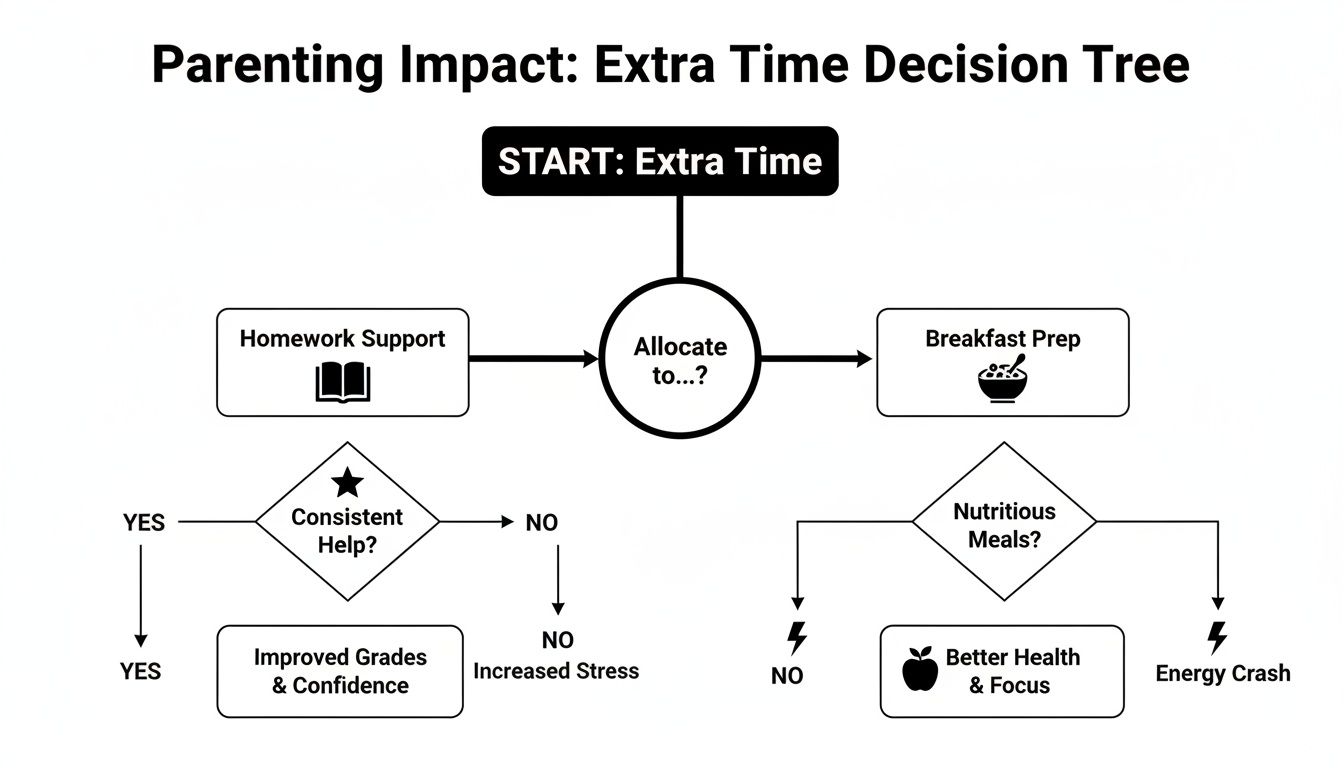
As this shows, those extra hours from an EPO are designed to give parents more opportunities for the small but essential moments that build a strong parent-child bond.
At the end of the day, the court's decision isn't about what's convenient for the parents. The primary focus is, and always will be, the child's well-being. Any argument you make for or against an expanded possession order in Montgomery County must be centered on how it affects the child's physical and emotional stability.
What to Do Next Checklist
- Measure the Distance: Use a map tool to check the straight-line ("as the crow flies") distance between your home and the other parent's.
- Document Your Work Schedule: Collect proof of your work hours, like pay stubs, emails from a supervisor, or an official letter from HR.
- Gather Your Evidence: Pull together any documents, text messages, or emails that support your argument for (or against) the expanded schedule.
- Consider the Child's Reality: Think honestly about how the proposed schedule would affect your child's schooling, extracurriculars, sleep, and overall emotional state.
Disclaimer: This article provides general information and does not constitute legal advice. You should consult with an attorney for advice regarding your specific situation.
How to Request an Expanded Possession Order

If you've decided an Expanded Possession Order is the right move for your family, the next question is: "How do I actually get one?" The answer involves a formal request to the court, but don't let the legal process intimidate you. Knowing the path forward makes all the difference.
Whether you're at the beginning of a divorce or need to update an old custody order, the procedure in Montgomery County is straightforward once you understand the key steps. Your initial paperwork gets the ball rolling.
Filing the Right Paperwork
The journey toward an Expanded Possession Order in Montgomery County starts with a legal document called a Petition. This is your official, written request to the judge. The type of petition you file depends on your situation.
- For New Cases: If you're just starting a divorce or custody case, you'll file either an Original Petition for Divorce or an Original Petition in Suit Affecting the Parent-Child Relationship (SAPCR).
- For Existing Orders: If a custody order is already in place, you'll need to file a Petition to Modify the Parent-Child Relationship. This requires you to prove that a material and substantial change has occurred in the lives of the parents or child since the last order was signed.
No matter which petition you file, the words you use are important. You have to explicitly ask the court for the expanded possession schedule. Since the Texas Family Code presumes this schedule is in the child's best interest when parents live within 50 miles, making this request puts the court and the other parent on notice about what you're seeking.
Navigating the Montgomery County Court System
Once your petition is drafted, you'll file it with the Montgomery County District Clerk’s office in Conroe. After filing, the other parent must be officially notified of the lawsuit through a formal delivery process called "service." This triggers a legal deadline for them to file a response with the court.
Your case will then land in one of Montgomery County's family law courts. While each judge has their own way of doing things, almost every case will be sent to mediation before a full hearing. Mediation is a confidential meeting where you, the other parent, and your lawyers sit down with a neutral mediator to try and reach an agreement yourselves.
If you can't agree in mediation, your case will continue toward a hearing or trial. This is where you'll present your evidence and arguments to the judge, who will then make a final decision based on the child's best interest. Understanding the general flow of a Montgomery County divorce case can give you a much better grasp of what to expect along the way.
What to Do Next Checklist
- Draft the Petition: Work with an attorney to prepare the correct legal petition that specifically asks the court to grant the "presumed expanded possession order."
- Gather Proof of Residence: Find documents like utility bills or lease agreements for both you and the other parent to prove you live within the 50-mile radius.
- Document Your Work Schedule: Get a letter from your employer or print out schedules showing your hours are compatible with the EPO.
- Get the School Calendar: Have a copy of your child's official school calendar on hand. This is the official map the court will use.
- Log Your Communications: Keep a simple, factual record of conversations with the other parent about scheduling. This can be valuable evidence if disagreements arise.
Disclaimer: This article provides general information and does not constitute legal advice. You should consult with an attorney for advice regarding your specific situation.
Modifying or Enforcing Your Possession Order

Getting an Expanded Possession Order signed by a judge feels like a huge win. But a court order is only a piece of paper until both parents follow it. Life happens, and sometimes the schedule you fought for no longer fits your family's reality.
This is a common hurdle for families here in Montgomery County, from The Woodlands to Magnolia. You need to know your rights when circumstances change or when the other parent simply refuses to play by the rules.
When Life Changes: Modifying Your Possession Order
Life is anything but static, and Texas law gets that. Your possession order isn't set in stone forever. If the schedule has become truly unworkable, you can ask the court to change it.
To do this, you’ll file a Petition to Modify. But you can't just ask for a change because you want one. Under the Texas Family Code, you have to prove there has been a "material and substantial change in circumstances" since your last order was put in place. It's a specific legal standard, and the change has to be significant.
Common examples include:
- A Parent Moves: One parent takes a job and moves from Conroe to Houston, which is outside the 50-mile radius that makes an EPO practical.
- A Child's Life Evolves: Your teenager gets a part-time job or makes a competitive sports team, making the Thursday overnight a logistical nightmare.
- Work Schedules Shift: A parent who worked a 9-to-5 now works the night shift, making it impossible to care for the child during their scheduled time.
A Montgomery County judge will look at what’s changed and, most importantly, decide if adjusting the schedule is truly in your child's best interest.
What to Do When the Other Parent Breaks the Rules
It’s one of the most frustrating experiences a parent can go through: the other parent consistently disregards the court order. Maybe they're always late for exchanges, "forget" your Thursday overnight, or simply refuse to hand over the child for your weekend.
If this is your reality, you have power. You can file a Motion for Enforcement with the same Montgomery County court that issued your original order. This asks the judge to force the other parent to follow the order and to impose consequences for failing to do so.
Real-World Scenario: Enforcing an Order in The Woodlands
A dad in The Woodlands has an Expanded Possession Order. For weeks, the mom has an excuse for why their son can't come over for the Thursday overnight—usually "he's swamped with homework." The dad keeps a log of every missed visit, saving the texts. After documenting six straight missed Thursdays, he files a Motion for Enforcement. The judge not only orders the mom to pay his attorney's fees but also gives the dad six extra weekend days to make up for the time he lost.
Documentation is everything in an enforcement case. Keep a meticulous log of every violation: dates, times, excuses, and screenshots of texts or emails. This evidence is what gives your motion teeth. A good overview of family law matters can help you understand how enforcement actions fit into the bigger picture.
What to Do Next Checklist
- Document Everything: Start a calendar or journal immediately. Note every single late exchange, missed visit, or other violation.
- Keep Communication in Writing: When discussing schedule issues, use text or email. This creates a clear, written record.
- Define the "Change": If you're seeking a modification, get crystal clear on what has materially and substantially changed since the order was signed.
- Collect Your Evidence: Gather proof to back up your claim. This could be a new job offer, a signed lease in another city, or your child's new activity schedule.
Disclaimer: This article provides general information and does not constitute legal advice. You should consult with an attorney for advice regarding your specific situation.
Common Questions About Expanded Possession Orders
When it comes to custody schedules in Montgomery County, the details matter. Let's tackle some of the most common questions parents ask about Expanded Possession Orders (EPOs), cutting through the legal jargon to give you practical, straightforward answers.
Does the Expanded Possession Order Change My Child Support Obligation?
This is easily one of the most frequent—and important—questions we hear. The short answer is: it absolutely can. While it's not an automatic discount, having an EPO is a powerful tool for arguing that the standard child support calculation isn't fair in your situation.
Texas child support is typically based on a percentage of the paying parent's income. However, the Texas Family Code gives judges the authority to deviate from that formula if sticking to it would be unjust. When an EPO gives you possession time that's much closer to a 50/50 split, you have a solid foundation to argue that paying the full guideline amount is no longer appropriate. You'll have to formally request this "deviation" and be prepared to show the court how the expanded schedule directly increases your costs for caring for the children.
What Happens to the Expanded Possession Order During Summer and Holidays?
This is a major point of confusion. The Expanded Possession Order specifically changes your schedule during the regular school year. It does not automatically override the standard holiday and summer schedules.
Your final court order is like a book with different chapters. One chapter details the school-year schedule (the EPO), while separate chapters cover major holidays and summer break. Those sections will spell out:
- Alternating Holidays: How you and the other parent will split or alternate holidays like Thanksgiving and Christmas.
- Summer Possession: The non-primary parent's right to a 30-day period in the summer (or 42 days if they live over 100 miles away).
It is crucial that your Final Decree of Divorce or Custody Order clearly explains how these different schedules fit together. Any ambiguity is a recipe for future conflict.
What If My Work Schedule Conflicts with the Thursday Overnight?
This is a big one. A judge's primary duty under the Texas Family Code is to protect a child's best interest, which almost always means prioritizing stability and routine. A schedule that creates constant chaos simply won't fly.
If your job requires night shifts, unpredictable travel, or a demanding schedule that makes it impossible to reliably handle a Thursday overnight and get your child to school on Friday morning, that can be a deal-breaker. A Montgomery County judge may decide that the disruption caused by your schedule outweighs the benefit of the expanded time and order a Standard Possession Order instead.
Can I Get an Expanded Possession Order If I Live More Than 50 Miles Away?
It's highly unlikely. The legal presumption that an EPO is in a child's best interest is specifically tied to the parents living 50 miles apart or less. The logic is purely practical. The frequent travel for a Thursday overnight and an early start to the weekend often becomes unmanageable and disruptive for a school-aged child.
For parents who live farther apart, the law presumes a different schedule is better. The court will almost certainly order a standard possession schedule tailored for long-distance parenting. This usually means trading frequent weekday visits for longer blocks of time, like getting the entire Spring Break holiday every year. While you and the other parent can always agree to a custom schedule, you won't have the law on your side to compel an expanded possession order in Montgomery County if the distance makes it impractical for your child.
What to Do Next Checklist
- Review Your Child Support Order: If you have an EPO, check if your child support was calculated with the standard formula or if a deviation was granted.
- Check Your Holiday Schedule: Read the holiday and summer sections of your decree carefully to see how they interact with your school-year schedule.
- Evaluate Your Schedule Honestly: If you want an EPO, be realistic. Can your work and life commitments truly support the added responsibility?
- Map the Distance: If a move is on the horizon, use a tool like Google Maps to see if it will put you outside the 50-mile radius.
Understanding the nuances of possession orders is complex, but you don't have to navigate it alone. If you are a parent in The Woodlands, Conroe, or anywhere in Montgomery County with questions about your custody schedule, our team can provide the clear, strategic guidance you need. Schedule a consultation with our experienced family law team today.