
When your child's safety is on the line, every second counts. An emergency custody order in The Woodlands is a powerful legal tool designed for immediate intervention in a crisis. These orders, often part of a Temporary Restraining Order (TRO), are meant to protect a child from imminent physical or emotional harm.
This is not a tool for typical co-parenting disagreements. A Montgomery County judge will only grant this relief in the most severe circumstances. Understanding when and how to seek an emergency order is critical for protecting your child.
What Justifies an Emergency Custody Order in The Woodlands?
Many parents in Montgomery County struggle to know if their situation qualifies as a true emergency. The legal standard is intentionally high to prevent misuse. An emergency order is for a genuine crisis, not for frustration over a late pickup or a dispute about extracurriculars.
Under the Texas Family Code, a judge must be convinced that a child faces an "imminent danger of physical or emotional harm." The key word is imminent. The threat must be happening now or be about to happen, not a potential problem down the road.
Differentiating Crisis from Conflict
Montgomery County judges are skilled at telling the difference between a crisis and a conflict. A standard custody modification is the correct path if you and the other parent consistently disagree on parenting time or school choices. An emergency order is reserved for situations that put a child's immediate well-being at risk.
Situations that could justify an emergency order often include:
- Physical or sexual abuse of the child.
- A parent's substance abuse (drugs or alcohol) that endangers the child.
- Serious neglect, such as failing to provide food, shelter, or critical medical care.
- Credible threats of parental kidnapping or plans to flee The Woodlands area.
- Exposing the child to family violence.
Real-World Scenario: Imagine a father in Sterling Ridge discovers texts on a family iPad showing that the mother’s new boyfriend, who has a history of violence, is moving into her home over the weekend. This isn't just a disagreement; it's a clear and immediate threat to the child's safety. A judge in Conroe would likely grant an emergency order to prevent the child from being in that dangerous situation.
Emergency Grounds vs. Standard Custody Modification
This table breaks down the critical differences between situations that demand an emergency order and those better suited for a standard custody modification in Montgomery County.
| Situation | Requires Emergency Order? | Reasoning Under Texas Law |
|---|---|---|
| A parent makes credible threats to take the child and leave the country. | Yes | This presents an imminent risk of abduction, justifying immediate court intervention to protect the child. |
| The other parent is consistently 30 minutes late for custody exchanges. | No | While frustrating, this is a violation of the possession order, not a direct threat to the child's physical or emotional safety. It should be addressed through a standard enforcement action. |
| The child has unexplained bruises and alleges the other parent's partner hit them. | Yes | This is a clear allegation of physical abuse, creating an immediate danger to the child's well-being. |
| You and the other parent disagree on which school the child should attend. | No | This is a common co-parenting conflict that should be resolved through mediation or a standard modification hearing. |
Filing for an emergency order without sufficient grounds can damage your credibility with the court. It's vital to understand these distinctions.
What to Do Next Checklist
If you believe your child is in immediate danger, your actions in the next few hours are critical.
- Secure the Child: Your absolute first priority is your child's safety. If you can legally and safely remove your child from the dangerous environment, do so.
- Document Everything: Start gathering proof. Save text messages, screenshot social media posts, take photos of any injuries or unsafe conditions, and write down a detailed timeline of events.
- Do Not Confront the Other Parent: A heated argument can escalate the situation and may be used against you in court. Let your attorney handle communication.
- Call an Experienced Attorney: You need someone who knows the ins and outs of emergency orders in Montgomery County. An attorney can quickly assess your evidence and file the correct paperwork.
Getting an emergency custody order in The Woodlands requires meeting a high standard of proof. For a broader look at custody matters, you can learn more about our approach to child custody cases in The Woodlands.
Disclaimer: This article provides general information and does not constitute legal advice. You should consult with a qualified attorney for advice regarding your individual situation.
Facing an urgent custody crisis is incredibly stressful. If your child's safety is at risk, our team can help you understand your options and take swift, decisive action. Schedule a consultation to discuss your case and learn how we can protect your family.
Your First 48 Hours: Filing for an Emergency Order
When you realize your child is in immediate danger, the next 48 hours are crucial. What you do in this short window can make all the difference in getting a Montgomery County judge to sign an order that protects your child. Your first move is always to get your child to a safe place.
Once they are secure, the focus must shift to legal action. Obtaining an emergency custody order in The Woodlands is not a simple form; it's about building a powerful case for why a judge must intervene right now.
Immediately Secure Your Child and Gather Evidence
Before you think about the courthouse, your child's safety is the only thing that matters. If you can legally and safely remove your child from a dangerous situation, do it.
With your child out of harm's way, you must become an evidence collector. Your word alone isn't enough; you need tangible proof.
- Preserve Communications: Screenshot every text message, email, and social media post that shows the danger. Do not edit them—just capture the evidence.
- Document the Scene: If you can safely take photos or videos of an unsafe environment—like drugs left out or accessible weapons—do so. Ensure your phone's date and time stamps are enabled.
- Create a Timeline: Write down a detailed chronology of events. Be specific: dates, times, what was said or done, and who else saw or heard it.
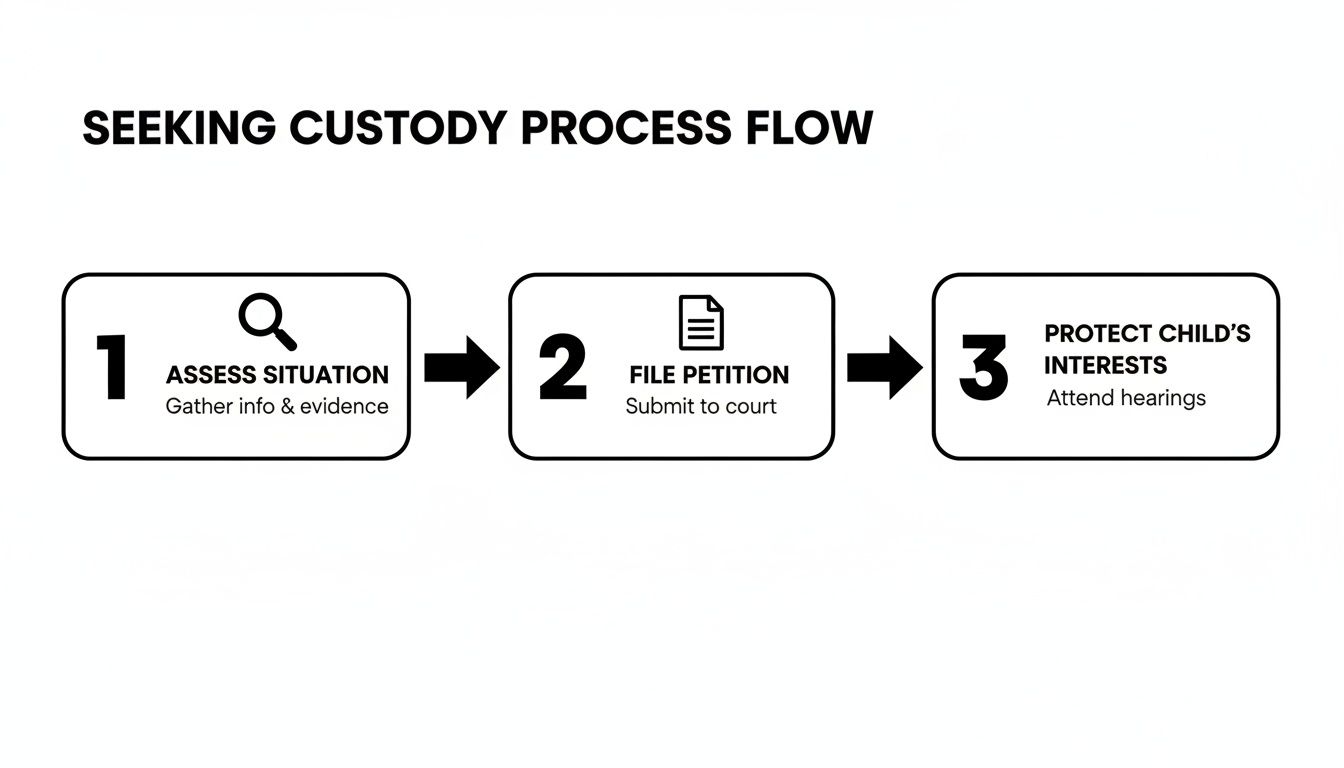
Filing the Correct Paperwork in Montgomery County
Armed with your initial evidence, the next step is filing the correct legal documents at the Montgomery County courthouse in Conroe. To get an emergency hearing, you must file a lawsuit that includes a request for a Temporary Restraining Order (TRO) with emergency custody provisions.
The most critical document you'll prepare is your sworn affidavit. This is your sworn testimony to the judge, where you lay out exactly why your child faces imminent harm. Be specific. For example: "On Friday, May 15, at 6:30 p.m., I arrived for the custody exchange and found our five-year-old son alone and crying by the front door. The father was nowhere to be found." This is much more effective than saying "he is a neglectful parent."
The Role of the Temporary Restraining Order (TRO)
The TRO is your immediate shield. A judge can grant one based only on the strength of your affidavit, without the other parent present. This is called an ex parte hearing. The order can immediately name you the temporary primary parent and forbid the other parent from contacting you or your child.
Montgomery County judges do not grant these lightly. They are reserved for true emergencies where there's clear evidence of imminent danger, as defined by the Texas Family Code. Vague fears won't cut it. You can explore the legal grounds courts consider for these protective orders.
After a judge signs the TRO, it must be personally served on the other parent. The court will then set a follow-up hearing, typically within 14 days, where both sides will appear before the judge.
What to Do Next Checklist
The first 48 hours are a blur. Use this checklist to stay focused.
- Confirm Child's Safety: First and always, make sure your child is in a secure location.
- Organize Your Proof: Create a dedicated folder for all screenshots, photos, and your written timeline.
- Contact a Family Law Attorney: Find an attorney with experience in emergency custody cases in Montgomery County. Their guidance is the fastest way to get your paperwork filed correctly.
- Draft a Compelling Affidavit: Work with your lawyer to craft a sworn affidavit that is factual, precise, and communicates the "imminent danger" required by Texas law.
- File at the Courthouse: Get your Petition, TRO application, and affidavit filed with the Montgomery County District Clerk as quickly as possible.
Disclaimer: This article provides general information and does not constitute legal advice. You should consult with a qualified attorney for advice regarding your individual situation.
Nothing is more important than protecting your child. If you believe they are in immediate danger, you must act decisively. Contact us to schedule a consultation and learn how we can help you file for an emergency custody order in The Woodlands.
Gathering Evidence for a Montgomery County Court

When you ask a Montgomery County judge for an emergency custody order in The Woodlands, the strength of your case depends entirely on your evidence. A judge will not take the extreme step of separating a child from a parent based on your word alone. You must prove your child is in immediate physical or emotional danger, the high standard set by the Texas Family Code.
Documenting Digital Communications
Much of our lives happen on phones and computers, and this is often where you will find your most powerful evidence. Text messages, emails, and social media posts can tell a story, but you must present them correctly.
- Take Complete Screenshots: Capture the entire screen, including the date, time, and contact information. Context is everything.
- Print Everything: Judges need to review physical documents. Print every screenshot and organize them by date in a binder to make your evidence easy to follow.
- Transcribe Voicemails: If you have threatening voicemails, type them out word-for-word. Note the date and time of the call.
The Power of Official Reports
Official records from law enforcement or Child Protective Services (CPS) add tremendous credibility to your case. These documents provide a neutral, third-party assessment of the situation. If police were ever called for a domestic disturbance, get a copy of the police report. If CPS conducted an investigation, those records are invaluable for showing a pattern of risk or neglect.
Real-World Scenario: We represented a mother in Creekside Park who was terrified after her child's father was arrested for a DWI in Montgomery County. Though the child was not in the car, she worried about his judgment. She obtained a copy of his arrest record from the Sheriff's Office. That official document, paired with her sworn statement, was enough for a judge to grant an emergency order requiring the father to install an ignition interlock device on his car before he could have possession of their child.
Witness Testimony and Physical Proof
Sometimes, what other people have seen is the most compelling evidence. Your testimony is critical, but it is magnified when supported by others.
Ask teachers, neighbors, or relatives who have direct knowledge of the danger if they would be willing to sign a sworn statement, known as an affidavit. A teacher who noticed unexplained bruises or a neighbor who overheard violent arguments can provide objective testimony that is hard to refute.
Physical evidence is also key. Document everything with:
- Date-stamped photos: Take pictures of injuries, unsafe living conditions (like drug paraphernalia left out), or a filthy home.
- Medical records: If your child needed medical care due to neglect or an injury, those records are vital.
- School records: A sudden drop in grades or a spike in absences can be a sign that something is seriously wrong at home.
The more layers of proof you provide, the stronger your case for an emergency custody order in The Woodlands will be.
What to Do Next Checklist
Collecting evidence is an active process. Use this checklist to stay focused.
- Start an Evidence Log: Get a notebook and list every piece of evidence. Note what it is, when you got it, and what it helps prove.
- Organize Digital Evidence: Screenshot every relevant text, email, or social media post. Save them securely and print hard copies for court.
- Request Official Records: Formally request any police or CPS reports related to your family.
- Identify Witnesses: List everyone with firsthand knowledge who can support your case. Ask if they are willing to sign a sworn affidavit.
- Speak with an Attorney: An experienced lawyer can tell you which evidence is most effective and ensure it is filed correctly with the Montgomery County court.
Disclaimer: This article provides general information and does not constitute legal advice. You should consult with a qualified attorney for advice regarding your individual situation.
Trying to build a strong case in a crisis is stressful. If you need to protect your child, our team can guide you in gathering the right evidence and acting swiftly. Schedule a consultation with us to discuss your urgent legal needs.
Stepping into the Courtroom for Your Emergency Hearing

The emergency hearing is where you stand before a Montgomery County judge and explain why your child's safety is at immediate risk. This is not a full trial. It is a fast-paced hearing focused on one thing: determining if there is a clear and present danger to your child that requires the court's immediate intervention.
Who is in the Courtroom
When you walk into the courtroom in Conroe, you'll see several key people.
- The Judge: The person in charge who listens to both sides, reviews the evidence, and makes the final decision on the emergency custody order The Woodlands parents are seeking.
- The Attorneys: Each parent will have an attorney to present evidence, make legal arguments, and question the other side.
- The Parents: You and the other parent will be present and will likely be called to testify under oath.
- An Amicus Attorney (Sometimes): In complex cases, the judge might appoint a neutral third-party lawyer to investigate and report back on what is in the child's best interests.
How to Present Your Case to the Judge
Your testimony is the core of your case. The goal is to be clear, factual, and calm. Stick to what you personally saw and heard. Avoid guessing or relying on hearsay ("my friend told me that…"). A judge is moved by facts, not just emotions.
Real-World Scenario: We represented a mother from Alden Bridge whose child's father had violent outbursts. Instead of saying, "He's an angry person," she testified with specifics: "On Tuesday at 6 p.m., he threw a lamp against the wall, two feet from where our daughter was playing. She started screaming, and I grabbed her and ran out of the house." This kind of factual testimony paints a clear picture of immediate danger.
Courtroom Etiquette
Simple etiquette shows respect for the process. Dress professionally, silence your phone, and never interrupt the judge. Always address the judge as "Your Honor." When answering questions, listen to the entire question, give a direct answer, and then stop. It is okay to say, "I don't know" or "I don't recall." Never guess.
Everything you say must tie back to the "best interest of the child" standard, which is the bedrock of the Texas Family Code. You must show that the child's well-being is genuinely at risk. For more on these legal standards, review our family law services.
What to Do Next Checklist
After the hearing, the judge will make a ruling. Your next moves are critical.
- Understand the Order: Pay close attention as the judge explains the ruling. Understand every detail—new schedules, communication rules, or required actions like counseling.
- Prepare for the Next Hearing: An emergency order is temporary. The judge will schedule a follow-up hearing. Start preparing for it immediately with your attorney.
- Follow the Order Perfectly: You must comply with the judge's orders to the letter. Any violation can bring serious legal consequences.
- Strategize with Your Attorney: Immediately after the hearing, meet with your lawyer to discuss the outcome and plan your strategy for the next hearing and your long-term custody case.
Disclaimer: This article provides general information and does not constitute legal advice. You should consult with a qualified attorney for advice regarding your individual situation.
The court hearing is a pivotal moment. Being prepared can give you the confidence you need. If you are facing an urgent custody emergency in The Woodlands, Schedule a consultation with our team. We are here to advocate for your family's safety.
Life After the Emergency Order: What Comes Next
Walking out of the Montgomery County courthouse with an emergency order brings profound relief. You have taken a critical step to protect your child. But this is just the beginning.
An emergency order, or Temporary Restraining Order (TRO), is a short-term fix. Under the Texas Family Code, these orders are brief, usually lasting only 14 days. Their purpose is to create a safe space for your child while the court prepares for a more in-depth hearing.
Your First Priority: Strict Compliance
Once a judge signs that order, you must follow it perfectly. This is a direct command from the court. If the order says no contact with the other parent, that means no calls, texts, or social media messages. If it mandates supervised visitation, you must facilitate it exactly as ordered. Following these rules shows the judge that you are the responsible, stable parent.
Real-World Scenario: We worked with a mother in Panther Creek who secured an emergency order after discovering the father’s substance abuse. The order gave her sole custody and required him to undergo weekly drug tests. She documented every on-time exchange and followed the order without fail. Her meticulous compliance gave her immense credibility with the judge at the next hearing, which made all the difference in the final orders.
Preparing for the Next Hearing
The moment the emergency order is granted, a new clock starts. The court will set a follow-up hearing—a temporary orders hearing—within a couple of weeks. This is where both parents present a fuller case with more evidence.
Work closely with your attorney to build on your initial case. We will:
- Gather More Evidence: We can send formal legal requests (discovery) for documents and information to the other parent.
- Take Testimony: We may need to schedule depositions to question the other parent or key witnesses under oath.
- Involve Experts: In some cases, a child psychologist or custody evaluator can provide the court with a crucial, unbiased professional opinion.
This next hearing is your chance to show the judge why the emergency protections should be extended. Texas courts operate under the "best interest of the child" standard. This often means ensuring the child has a safe relationship with both parents. Modern courts focus on facts and safety, not gender stereotypes. You can dig deeper into Texas custody trends and statistics to see how courts approach these cases.
What to Do Next Checklist
- Review the Order Immediately: Sit down with your attorney and go through every line of the signed order.
- Document Your Compliance: Keep a log of visitation exchanges and any communications that occur through approved channels.
- Continue Building Your Case: Work with your legal team to gather the evidence you'll need for the upcoming temporary orders hearing.
- Create a Calm Environment: Your child has been through enough. Use this time to provide a calm, loving home, keeping them away from legal details.
Disclaimer: This article provides general information and does not constitute legal advice. You should consult with a qualified attorney for advice regarding your individual situation.
An emergency order is a short-term victory. The next phase is your opportunity to turn that protection into a lasting plan. If you need a strategic partner for this critical phase, schedule a consultation with our team. We know what it takes to protect your child's future.
Answering Your Most Pressing Questions
When facing a child custody crisis, your mind races with questions. It's normal to feel overwhelmed. Here are straightforward answers to some of the most common concerns we hear from parents in The Woodlands and Montgomery County.
How quickly can I get an emergency order?
The process is designed to be fast. A judge can often sign a Temporary Restraining Order (TRO) on the same day you file your paperwork, providing an instant shield for your child.
The Texas Family Code requires that a full hearing be held within 14 days. This timeline allows the court to act on credible threats right away while giving the other parent a chance to respond. The key to moving quickly is filing the correct documents with compelling evidence from the start.
What if I don’t have a police report?
You don't need a police or CPS report to get an emergency order. While official reports are strong evidence, Montgomery County judges know many dangerous situations happen behind closed doors.
Evidence that can be just as powerful includes:
- Threatening text messages, voicemails, or emails.
- Photos or videos showing a dangerous home environment, substance abuse, or neglect.
- Testimony from credible witnesses like a teacher, neighbor, or family member.
Your own sworn affidavit—a detailed, written account of what’s happening—is often the most critical piece of evidence. A good attorney can help you organize your story and present the proof you have in the most impactful way.
Will filing for an emergency order hurt my final custody case?
No, as long as your request is based on a genuine, immediate threat. Texas courts are legally bound to prioritize the safety and well-being of the child. When you file a legitimate emergency order, you show the judge you are a protective parent who acts decisively.
Real-World Scenario: We helped a mother in The Woodlands whose ex-husband, a pilot, was arrested for DWI. The child was not in the car, but the mother feared his reckless judgment. She filed for an emergency order, and the judge agreed, seeing the arrest as a sign of behavior that could put the child at future risk. This action strengthened her position for becoming the primary parent in the final custody agreement.
However, filing a baseless claim can destroy your credibility and backfire spectacularly. How a parent acts during a crisis can impact the broader aspects of a divorce in The Woodlands.
What is the difference between a TRO and an emergency custody order?
A Temporary Restraining Order (TRO) is the immediate first step. A judge can grant it ex parte (without the other parent present) to put instant rules in place, like prohibiting the other parent from taking the child.
An emergency custody order typically comes after a formal court hearing where both parents present evidence. This is the order that temporarily changes who has the legal right to have the child. The TRO is the emergency stop-gap; the emergency custody order is the first official change in custody.
What to Do Next Checklist
- Assess the Danger: Is the threat to your child's physical or emotional well-being truly imminent? This is the core legal standard.
- Gather Your Proof: Immediately screenshot texts, download photos, and write down the names of any potential witnesses.
- Secure Your Child: First and foremost, make sure your child is in a safe place.
- Call an Attorney: This is not a DIY project. Speak with a family law attorney immediately to get the paperwork filed correctly and navigate the Montgomery County court system.
Disclaimer: This article provides general information and does not constitute legal advice. You should consult with a qualified attorney for advice regarding your individual situation.
When your child's safety is on the line, you need a legal team that acts with urgency. We have guided countless parents in The Woodlands through this exact process. Schedule a consultation today to get the immediate help you need.