
Facing a divorce in The Woodlands means making choices that will shape your family’s future and finances. Instead of a public, often messy court battle, divorce mediation offers a private, cooperative alternative. It empowers you and your spouse to design a custom blueprint for your new lives, rather than having a judge impose one on you.
This guide uses plain English to explain how mediation works right here in Montgomery County, helping you decide if it's the right path for your family.
Why Choose Mediation for Your Woodlands Divorce?
Deciding to divorce is tough. Deciding how to do it can make all the difference. For many families in Montgomery County, a traditional court battle—with its public hearings and adversarial nature—feels like pouring salt on a wound. This is why divorce mediation has become a popular choice in The Woodlands for couples seeking a respectful and efficient end to their marriage.
Think of it this way: a court battle is like hiring a demolition crew. Their job is to tear the house down, often leaving a lot of collateral damage and debris behind.
Mediation, on the other hand, is like bringing in a team of architects. They work with both of you to carefully deconstruct the old structure, preserving what's valuable so you can each build a new, stable home. The goal isn't to reconcile; it's to find a fair and dignified way to move forward separately.
Divorce Mediation vs. Court Litigation in Montgomery County
To understand the difference, it helps to see the two paths side-by-side. The choice you make at the start of your divorce has a ripple effect on everything from your privacy to your bank account.
| Factor | Divorce Mediation | Traditional Litigation (Court) |
|---|---|---|
| Control | You and your spouse make the final decisions. | A judge makes the final decisions for you. |
| Privacy | Completely confidential and private. | A matter of public record. |
| Pace | Moves at your pace. Can be much faster. | Dictated by the court's crowded schedule. |
| Cost | Almost always significantly less expensive. | Can become extremely expensive with legal fees. |
| Atmosphere | Cooperative, problem-solving environment. | Adversarial "us vs. them" dynamic. |
| Outcome | Creative, customized solutions are possible. | Limited to what the law and a judge will allow. |
Ultimately, mediation puts the power back in your hands. It's about finding common ground and crafting an agreement that works for your unique family, rather than rolling the dice in a courtroom.
Control, Privacy, and Peace of Mind
One of the biggest draws of mediation is control. You and your spouse, with the help of a neutral third-party mediator, are in the driver's seat. You decide what happens to your property, your finances, and most importantly, your children.
The entire process is also completely confidential. Unlike court proceedings, which are public record, everything said in mediation stays behind closed doors. For residents in close-knit communities like Sterling Ridge or Alden Bridge who value their privacy, this is a massive advantage.
On top of that, mediation is almost always less stressful. By sidestepping the combative nature of a courtroom, you focus on workable solutions instead of "winning" arguments. This is critical for parents who need to co-parent effectively for years to come. A smoother divorce process lays the foundation for a healthier co-parenting relationship—one of the greatest gifts you can give your kids.
For couples who already agree on most issues, it's also worth exploring an uncontested divorce in The Woodlands, Texas, as it can be an even more streamlined path.
Real-World Scenario: A Shared Business in Panther Creek
Imagine a couple in Panther Creek who built a successful local business together from the ground up. Taking their divorce to a Montgomery County court could have forced a fire sale of the company. A judge with zero business experience would have been making decisions about its future.
Instead, they chose mediation. Working with a mediator and a financial neutral, they crafted a creative multi-year buyout plan. This allowed one spouse to keep running the business they both loved while the other received their fair share of the value over time. It was a win-win solution that simply wouldn't have been on the table in a rigid courtroom setting.
What to Do Next: A Quick Checklist
If this approach sounds right for you, here are a few practical first steps:
- Assess Your Situation: Honestly evaluate if you and your spouse can communicate, even if it's difficult, to work toward a common goal.
- Gather Initial Documents: Start pulling together basic financial paperwork like recent tax returns, pay stubs, and bank statements.
- Research Your Options: Understand the fundamental differences between mediation and litigation so you can make an informed choice.
- Consult an Attorney: An experienced family law attorney can explain your rights, help you prepare, and guide you through the process.
Disclaimer: This article is for informational purposes only and does not constitute legal advice. You should consult with a qualified attorney for advice regarding your individual situation.
Ready to explore a more constructive path for your divorce? Schedule a consultation to discuss how mediation can work for your family.
The Montgomery County Mediation Process Step by Step
Knowing what to expect in divorce mediation can take a huge weight off your shoulders. The process here in Montgomery County isn't a free-for-all; it follows a well-defined path guided by a neutral professional to help you and your spouse find a way forward.
Think of the mediator as a facilitator, not a judge. Their job is to help you communicate and negotiate. They don't take sides, offer legal advice, or force decisions on you. Instead, they create a controlled, respectful environment where you can build an agreement piece by piece.
Stage 1: The Initial Joint Session and Setting the Agenda
The day usually starts with everyone together: you, your spouse, your attorneys, and the mediator. This first meeting is about orientation. The mediator will lay out the ground rules, explain their neutral role, and ensure everyone understands the goal is a voluntary agreement.
From there, you’ll create an agenda—a list of every issue that needs to be resolved before your divorce can be finalized. This becomes your roadmap for the day.
Typically, this list includes:
- Property and Debt Division: How will you handle assets like the house, retirement accounts, and vehicles, as well as liabilities like the mortgage or credit card balances?
- Child Custody and Visitation: You'll need to agree on a possession schedule and decide which parent has the right to determine the child's primary residence.
- Child Support and Medical Support: This covers the financial obligations for raising your children, calculated based on state guidelines.
- Spousal Maintenance (Alimony): Will one spouse need temporary financial support from the other after the divorce?
Getting all issues on the table from the start ensures nothing gets missed and gives structure to the negotiations.
Stage 2: Information Gathering and Caucusing
Once the agenda is set, the negotiation begins. Often, the mediator will move you and your spouse into separate rooms. This technique is called caucusing, and it's where most progress is made.
In these private sessions, you can have frank conversations with your attorney and the mediator. You can talk freely about your priorities and concerns without the tension of your spouse being present. The mediator acts as a go-between, relaying offers, exploring ideas, and helping you see the issues from different angles. Caucusing dials down emotion and allows for more practical, honest problem-solving.
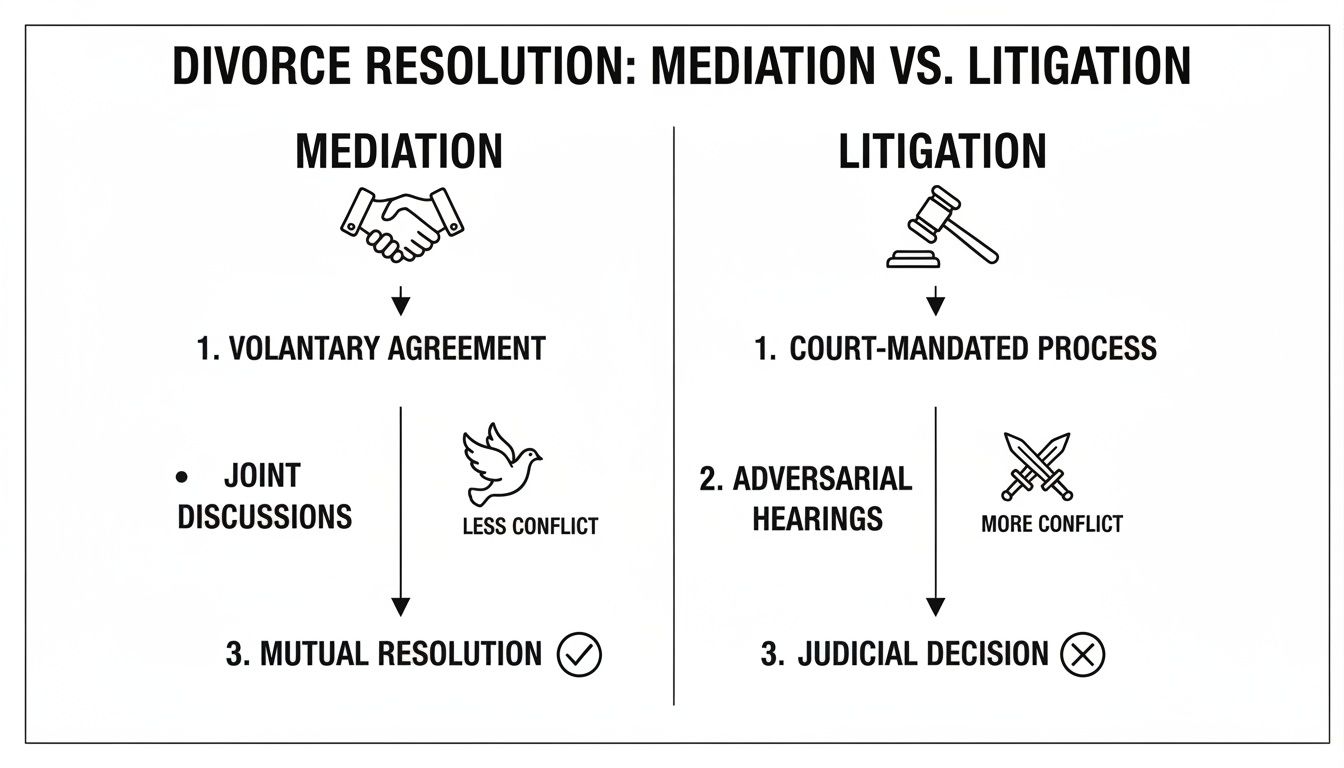
As the graphic shows, mediation is built on communication and finding common ground. Litigation is an adversarial system that forces a decision upon you, often at a much higher emotional and financial cost.
Stage 3: Finalizing Your Mediated Settlement Agreement (MSA)
After several hours of negotiation, the goal is to have a deal on every item. When that happens, the mediator drafts a Mediated Settlement Agreement (MSA). This document spells out every detail you and your spouse have agreed to.
You and your attorney will read the MSA line by line to confirm it matches your agreement. Once satisfied, you and your spouse will sign it. At that moment, the MSA becomes a powerful contract.
Under Section 6.602 of the Texas Family Code, a signed MSA that meets a few basic requirements is irrevocable. This is critical. Once signed, you cannot simply change your mind. The agreement is binding, and a judge can sign an order that reflects its terms. This finality provides certainty and a clear end to the conflict. From there, your attorney drafts the Final Decree of Divorce based on the MSA and presents it to a Montgomery County judge to be signed.
What to Do Next: A Quick Checklist
Understanding these steps is the first part of preparing for a successful mediation.
- Gather Your Financials: Start pulling together key documents like bank and retirement statements, recent tax returns, and property deeds.
- Define Your Goals: Before the pressure of the day, think hard about what a good outcome looks like for you regarding custody, property, and support.
- Consult Your Attorney: Work closely with your lawyer to form a solid negotiation strategy before you ever walk into the mediator's office.
Disclaimer: This article is for informational purposes only and does not constitute legal advice. You should consult with a qualified attorney for advice regarding your individual situation.
Knowing the roadmap is essential, but having an experienced guide is even better. Schedule a consultation to discuss how we can help you prepare for a successful divorce mediation in The Woodlands, Texas.
The Financial Impact of Divorce in The Woodlands
When you're facing a divorce, the financial side can feel overwhelming. But the process you choose has a massive impact on your financial well-being. For folks here in The Woodlands, the difference between a court battle and a structured mediation isn't just a few dollars—it can be staggering. Litigation can feel like writing a blank check, while mediation offers a more predictable, contained cost.
The simple truth is that in a divorce, time is money. The longer your case drags on, the more you’ll pay in legal fees. A traditional contested divorce in Montgomery County can easily stretch for 9 to 18 months. Mediation, on the other hand, is designed for efficiency. Most mediated cases wrap up in just 3 to 5 months, a timeline that translates into significant savings.

Comparing the Costs in Montgomery County
Let's put some numbers to it. A contested divorce in Montgomery County usually means each spouse pays an attorney a retainer between $5,000 and $15,000 just to get started. From there, the meter is always running.
A basic contested divorce in our area can quickly jump to $15,000-$30,000. If your case involves complex assets or goes to trial, the cost can soar past $100,000. By contrast, mediation helps you settle for a fraction of that, often costing 50-70% less. You can get a better sense of how these costs break down in The Woodlands area.
Avoiding the Hidden Expenses of a Court Battle
Beyond attorney fees, litigation is loaded with other costs that mediation helps you sidestep. In a high-asset divorce, common in neighborhoods like Carlton Woods or East Shore, you often have to hire a team of expensive expert witnesses.
This can include:
- Business Valuation Experts: To determine what a company is worth.
- Forensic Accountants: To trace assets that may have been hidden.
- Real Estate Appraisers: To get a formal valuation of the marital home.
These experts add thousands of dollars to your bill. In mediation, you and your spouse can agree to use a single, neutral expert if needed and split the cost, saving a huge amount of money. Dealing with the family home is often the biggest piece of the puzzle, and getting practical advice on topics like selling your house during divorce can provide a clearer path forward.
Real-World Scenario: Protecting Your Retirement
Picture a couple in their 50s living in Alden Bridge. They’ve spent their careers building up their 401(k)s and IRAs. A litigated divorce could easily burn through $40,000 to $60,000 or more in legal fees just arguing over how to divide these accounts.
Instead, they choose divorce mediation in The Woodlands, Texas. For a fraction of the cost, they work with a mediator to create a tax-smart plan to divide their retirement funds while preserving the most value. They walk away with their nest eggs almost fully intact, ready to start their next chapters on solid financial ground.
What to Do Next: A Quick Checklist
Taking control of your finances during a divorce begins with a few smart steps.
- Create a Basic Inventory: List your major assets (house, cars, bank accounts) and debts (mortgage, credit cards, loans).
- Sketch Out a Budget: Get a handle on your monthly income and expenses to understand what you’ll need to live on post-divorce.
- Consult with an Attorney: Talk to an experienced family law attorney to discuss the potential costs of both mediation and litigation for your specific situation.
Disclaimer: This article is for informational purposes only and does not constitute legal advice. You should consult with a qualified attorney for advice regarding your individual situation.
Protecting your financial future is a primary goal in any divorce. To understand how mediation can help you achieve that, schedule a consultation with our team.
Protecting Your Children Through Cooperative Co-Parenting
When you're a parent going through a divorce, your kids are everything. You know a drawn-out court battle, with its public conflict, is the last thing they need. Kids get caught in the crossfire, and the emotional damage can be significant.
This is where divorce mediation in The Woodlands, Texas, offers a better way forward. Instead of gearing up for a fight, you and your spouse sit down to solve problems. It’s a shift from "winning" against each other to winning for your kids. This simple change is one of the most powerful things you can do to protect them.

Crafting a Custom Parenting Plan
In any Texas divorce, a judge’s decisions are guided by the “best interest of the child” standard found in the Texas Family Code. But a judge in a Conroe courthouse doesn't know your children, their routines, or their needs. The result is often a standard, cookie-cutter order that doesn't fit your family’s reality.
Mediation hands the power back to you—the experts on your own children. You can craft a detailed Parenting Plan that's tailored to your unique life.
This means you can map out the small but crucial details a court order would never cover:
- How will you handle sports practices and music lessons?
- What will holidays and summer vacations look like?
- What are the ground rules for communication between parents?
- How will you agree to introduce new romantic partners?
This level of personal detail is a game-changer for families in communities like Creekside Park or Sterling Ridge. Finding resources like an integrative guide for helping children cope with divorce can provide invaluable support for keeping your children’s well-being front and center.
Real-World Scenario: A Flexible Summer Schedule
A couple we worked with in The Woodlands had kids who were passionate about their summer swim team. A standard court-ordered schedule would have split the summer rigidly, disrupting daily practices and making it impossible for them to compete.
Through mediation, they created a schedule that worked. They agreed one parent would handle weekdays for practice consistency, and they'd alternate weekends so both could cheer at meets. This cooperative solution put the kids’ normal routine first—something a judge simply wouldn't have the context to create.
When you build the parenting plan yourself, you create an agreement you both see as fair. That buy-in means you're far more likely to stick to it, which reduces the chance of ending up back in court. You can learn more about how mediation in The Woodlands keeps parents in control of outcomes and explore our guide on Texas child custody laws and how they are applied in Montgomery County.
What to Do Next: A Quick Checklist
If putting your children first is your top priority, here are steps to prepare for a child-focused mediation:
- List Your Child's Needs: Write down their daily, weekly, and yearly schedules, including activities and appointments.
- Outline Co-Parenting Goals: Think about how you want to communicate with your ex to build a respectful, business-like relationship.
- Draft an Ideal Schedule: Sketch out a possession schedule that you believe works best for your children and be ready to explain why.
- Stay Open-Minded: Remember, the goal is to find the best solution for your kids, which is usually a compromise.
Disclaimer: This article is for informational purposes only and does not constitute legal advice. You should consult with a qualified attorney for advice regarding your individual situation.
Giving your children a stable co-parenting relationship is the greatest gift you can offer them during a divorce. Schedule a consultation to talk with us about how we can help you get there through mediation.
How to Prepare for a Successful Mediation
A successful mediation is rarely an accident. It’s the result of showing up ready to work. Walking into that room prepared gives you confidence and clarity that can change the dynamic of the negotiation. You wouldn't walk into a major presentation without your notes; mediation is no different.
Getting ready comes down to two things: getting your paperwork in order and getting your mindset right. When you handle both, you can negotiate for the future you want, making your divorce mediation in The Woodlands, Texas, a productive meeting.
Gather Your Essential Documents
You can't have a serious conversation about dividing property without a complete picture of what you own and owe. Full financial transparency is the bedrock of any fair agreement. Before you set a mediation date, gather and organize every relevant financial document.
Your document checklist should include:
- Financial Statements: At least 12 months of statements for every bank account, credit card, and investment portfolio.
- Tax Returns: The last two to three years of personal and any business tax returns with all attachments (W-2s, 1099s).
- Property Documents: Deeds to your house and other real estate, plus recent mortgage and property tax statements.
- Retirement and Employment Information: The most recent statements for all 401(k)s, IRAs, and pensions, along with recent pay stubs.
- Debt Information: A clear list of all outstanding debts with current balances.
In most Montgomery County divorce cases, sharing these documents ahead of time is a requirement. Getting it done early shows you're ready to negotiate in good faith.
Define Your Goals and Create a Budget
Once the financial cards are on the table, think about what a good outcome looks like for you. What do you need to start your next chapter on solid ground? This isn't a wish list; it's about figuring out what's realistic and what your top priorities are.
A huge part of this is creating a post-divorce budget. This simple exercise is incredibly powerful. It forces you to get real about your income and expenses after the divorce. Knowing what you need to live on becomes your anchor in negotiations.
This is where working with a seasoned family law attorney is invaluable. A lawyer can review your goals, compare them to the Texas Family Code, and give you a realistic idea of what a Montgomery County judge would likely order. That insight is your leverage. Our team of divorce attorneys in The Woodlands, TX can help you get that clarity.
Real-World Scenario: The Power of a Budget
We worked with a client from Indian Springs Village whose one non-negotiable goal was keeping the family home. Before mediation, we had her build a detailed post-divorce budget. When she added up the mortgage, soaring property taxes, insurance, and upkeep, the numbers were stark. She realized keeping the house would leave her house-poor and unable to save.
That budget was a reality check. She walked into mediation with a new mindset, ready to negotiate for a larger portion of the retirement accounts instead of the house. It was a strategic pivot that secured her long-term financial health.
What to Do Next: A Quick Checklist
Preparation is the key to a better outcome. Here’s a checklist to get you on track.
- Consult Your Attorney: Meet to review documents, discuss goals, and build a concrete negotiation strategy.
- Organize Your Paperwork: Get a binder or create a digital folder. Label everything clearly so you can find what you need quickly.
- Create Your Budget: Build that realistic post-divorce budget. It will be your most important tool during financial talks.
- Adopt the Right Mindset: Go in ready to find common ground and compromise on small things so you can stand firm on what truly matters.
Disclaimer: This article is for informational purposes only and does not constitute legal advice. You should consult with a qualified attorney for advice regarding your individual situation.
Doing the homework upfront can make all the difference. To discuss the specifics of your case and see how we can help you prepare, schedule a consultation with our office today.
Frequently Asked Questions About Divorce Mediation
As you consider mediation, it’s normal for questions to bubble up. Families here in The Woodlands want to know how this process will actually work for them. Let’s walk through some of the most common questions we hear.
What happens if we cannot agree on everything in mediation?
This happens, and it's not a failure. Reaching a partial agreement is a huge win. If you can resolve issues like property division but not custody, we can lock in the agreements you've made.
That’s progress. It narrows the field of disagreement, saving you time and money. For the few remaining issues, your attorneys can continue to negotiate, or you can ask a Montgomery County judge to rule on only those specific items. Either way, you've still avoided the cost of fighting over every detail in court.
Do I still need a lawyer if we use a mediator?
Yes, absolutely. A mediator is a neutral third party, like a referee. Their job is to guide the conversation, but they are legally forbidden from giving either of you legal advice. They do not represent your interests.
Your own attorney is your advocate. They will:
- Ensure you understand your rights under the Texas Family Code.
- Help you gather documents and map out a negotiation strategy.
- Carefully review the final Mediated Settlement Agreement (MSA) before you sign to ensure it protects your future.
Walking into divorce mediation in The Woodlands, Texas, without your own lawyer is a risk you should not take.
Is mediation good for high-asset or high-conflict divorces?
Yes. For complex cases, mediation is often the smartest move. Many families in The Woodlands have significant assets, and mediation offers a level of privacy you'll never get in a public courtroom. It gives you space to craft custom solutions for businesses, stock options, or multiple properties.
When emotions are high, a good mediator is invaluable. They act as a buffer, de-escalating tension and keeping the focus on solutions. Often, the mediator will separate everyone into different rooms (caucusing), allowing them to filter out emotional noise and shuttle practical offers back and forth.
How is a mediated agreement made legally binding?
Once you and your spouse have both signed the Mediated Settlement Agreement (MSA), that document becomes an irrevocable contract under the Texas Family Code.
From there, your attorney drafts a Final Decree of Divorce based on the MSA. This decree is then presented to a judge in Montgomery County for their signature. Once the judge signs it, your private agreement becomes a final, legally binding, and fully enforceable court order.
Disclaimer: This article is for informational purposes only and does not constitute legal advice. You should consult with a qualified attorney for advice regarding your individual situation.
Navigating a divorce is a journey you shouldn't take alone. At The Law Office of Bryan Fagan, we are committed to helping families in The Woodlands find the best possible path forward. Schedule a consultation with our team to talk about your situation and learn how we can support you through mediation.