
For any business owner in The Woodlands, the word "divorce" lands differently. It’s not just a personal crisis; it’s an existential threat to your company. Because Texas is a community property state, any business you started or grew during your marriage is presumed to be a community asset. This means it's on the negotiating table.
This single legal principle, outlined in the Texas Family Code, puts your life’s work—from your brand and reputation to your daily operations—right in the crosshairs of a divorce proceeding in Montgomery County. This guide offers practical steps to protect what you've built.
The High Stakes of Divorce for Local Business Owners
Trying to run a business in a place like Panther Creek or Sterling Ridge while going through a divorce can feel like you’re fighting a war on two fronts. You're not just navigating the emotional fallout of a separation. You’re also staring down the possibility of losing control of your company, being forced to sell it, or watching its value get carved up.
The anxiety is crushing because the stakes are incredibly high. The numbers back it up. A recent study found that 57% of business owners say their company took a direct financial hit during a divorce. What’s more, 70% admit they struggle to focus on work, leading to an average revenue drop of around $4,000 per month. Tragically, this pressure pushes nearly 1 in 20 business owners—a full 5%—to shut down their companies for good. You can read the full research on the financial strain of divorce on entrepreneurs to see just how deep the impact goes.
How Texas Law Views Your Business
When a business owner in The Woodlands gets divorced, the first question a Montgomery County court will ask is simple: Is the business community property or separate property? That distinction, governed by the Texas Family Code, changes everything.
In Texas, any asset acquired from the date of marriage to the date of divorce is presumed to be community property. If you want to claim your business is your separate property, the law puts the burden on you to prove it with clear and convincing evidence. This "community property presumption" means that even if you're the only one on the LLC paperwork, your spouse likely has a claim to a share of its value if the business was started or grew significantly while you were married.
Understanding Community vs. Separate Property for Your Business
This table breaks down how Texas law typically characterizes business assets in a divorce, helping owners in The Woodlands and Montgomery County understand what's at stake.
| Asset Type | Likely Characterization | Key Factor (Under Texas Family Code) |
|---|---|---|
| Business Started Before Marriage | Separate Property (Initially) | The core value of the business at the time of marriage is separate. |
| Increase in Value During Marriage | Community Property | Any appreciation in value due to the effort of either spouse is community. |
| Business Started During Marriage | Community Property | The entire business is presumed to be a community asset. |
| Using Business Funds for Family | Commingled | Using company profits to pay the mortgage or family bills can turn separate assets into community ones. |
| Spouse's Unpaid Contributions | Reimbursement/Community Interest | If your spouse worked for the business without pay (e.g., did the books, managed marketing), the community may have a claim. |
| Inherited or Gifted Business | Separate Property | A business interest you inherited or received as a gift is your separate property, but its growth may not be. |
The lines between separate and community property can get blurry, fast. This is especially true when personal and business finances haven't been kept meticulously apart.
Real-World Scenario: The Commingled Conroe Contractor
John owns a successful contracting business in Conroe that he started five years before getting married. He always thought of it as "his." But during his 10-year marriage, he used business profits to pay the mortgage on their family home. His wife, a CPA, also handled the company's bookkeeping on weekends without ever taking a paycheck.
When they filed for divorce, her attorney made a powerful argument. Her unpaid "time, toil, and effort" and the "commingling" of business funds for community expenses meant the community estate had a major financial interest in the business's growth over the last decade. John was shocked to learn his "separate" business wasn't so separate after all.
What to Do Next: A Quick Checklist
If you are a business owner in Montgomery County and divorce is on the horizon, immediate action is your best defense. Here are the first steps to take:
- Locate Key Documents: Gather at least five years of critical business records. This includes tax returns (personal and corporate), profit & loss statements, balance sheets, and bank statements.
- Separate Your Finances: Open a new bank account for your business and another for your personal expenses. Stop using the business account for personal items right now.
- Review Governing Documents: Find your company’s formation papers, like an LLC operating agreement or corporate bylaws. These may have clauses that dictate what happens to ownership during a divorce.
- Avoid Verbal Agreements: Do not make any "handshake deals" or promises to your spouse about the business. Wait until you have spoken with an attorney.
Determining if Your Business Is Community or Separate Property
When a business owner in The Woodlands heads for divorce, one question dictates almost everything: is the business community property or separate property? Getting this right is the foundation of your financial settlement. While the Texas Family Code provides the rules, applying them to a real business can get messy.
Separate property is what you owned before marriage or received as a personal gift or inheritance during it. Community property is everything else you or your spouse acquired from your wedding day until the divorce is final. The law presumes everything is community property. So, if you claim your business is yours alone, the burden is on you to prove it with clear and convincing evidence.
The Problem with Businesses Started Before Marriage
It’s a common assumption: "I started my company before I got married, so it's mine." Not so fast. While the initial business is likely your separate property, the real fight is often over its growth during the marriage.
A Montgomery County court will look closely at why the business grew. If that growth came from your personal "time, toil, and effort," or if marital funds were plowed back into the company, that increase in value is often considered community property subject to a "just and right" division.
A business owned before marriage is like a small tree you planted years ago. That original tree is yours (separate property). But if you and your spouse spent the next decade watering it together (community effort), the fruit it now bears—the increased value—belongs to the marriage.
Reimbursement Claims and Commingled Funds
Even if your business is proven to be your separate property, you’re not out of the woods. The community estate can still file a reimbursement claim. This happens when marital money or labor was used to benefit your separate business, and the community was never paid back fairly.
Common examples include:
- Using community funds for business expenses: Paying for new equipment from a joint checking account.
- Paying down separate property debt: Using your shared marital income to pay off a business loan you took out before the wedding.
- Uncompensated labor: Your spouse handles the company's books or marketing without drawing a fair market salary.
This decision tree shows the basic paths a business owner's divorce can take, highlighting the choice between proactive protection and significant risk.
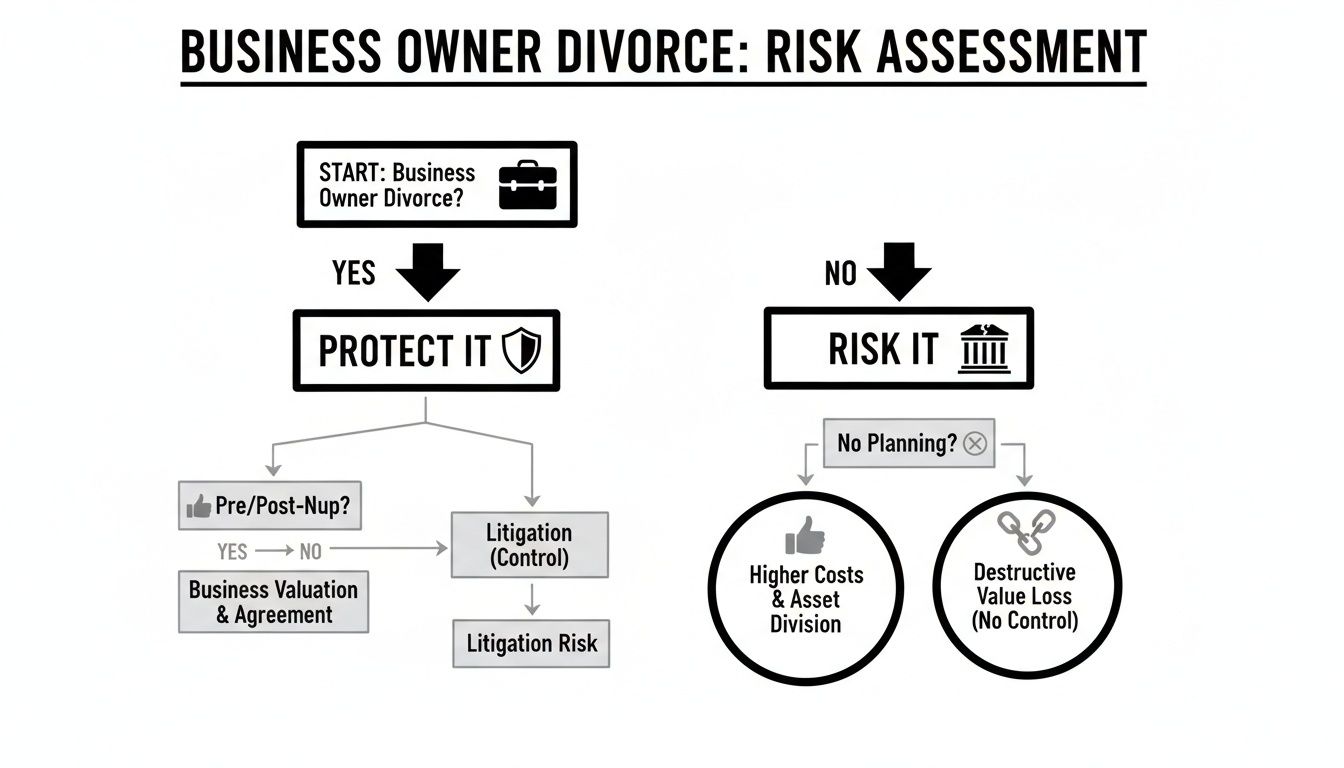
As the flowchart shows, ignoring these issues doesn't make them vanish. It just leads you down a path where your most valuable asset is more vulnerable.
Real-World Scenario: The Woodlands Boutique Owner
Sarah started a chic boutique in Market Street years before she met her husband. At the time of marriage, the business was valued at $100,000. Over their 15-year marriage, she worked tirelessly, pouring nearly all the profits back into the shop instead of taking a large salary. The business boomed, and its value grew to $1.2 million.
During the divorce, her husband’s attorney argued that the community was never properly paid for Sarah’s full-time labor. By taking a tiny salary, she invested the community's "time, toil, and effort" back into her separate property business. The court agreed, finding this effort was the primary driver of the $1.1 million in growth. A huge portion of that appreciated value was deemed community property and divided between them.
What to Do Next: A Quick Checklist
Figuring out your business's characterization is the bedrock of your divorce strategy. Here are your immediate action items:
- Trace the Origin: Dig up the documents that prove when your business was officially formed, like incorporation papers or LLC filings, to establish its "inception of title."
- Document Early Value: Find records that show the business's value around your wedding date. Old tax returns, balance sheets, or loan applications are invaluable.
- Identify Community Contributions: Be honest with your attorney about how marital funds or your spouse’s labor contributed to the business. A forensic accountant is the right professional to help trace these threads.
How Texas Courts Value a Business in a Divorce
Figuring out what your business is worth during a divorce is often the most complicated part of the process. It’s not like looking up a bank account balance. A business is a living entity with future earning potential and intangible value. If you're a business owner in The Woodlands, understanding how a Montgomery County court will tackle this is the first step toward a fair outcome.
Think of it like appraising a one-of-a-kind custom home in Carlton Woods. You can’t just look at what similar houses sold for. An appraiser must dig deeper. Valuing a business is much the same—standard formulas rarely tell the whole story.

The Three Main Valuation Methods
Texas courts don’t just pick one way to put a number on a business. Instead, valuation experts—typically forensic accountants—use one or a combination of three standard approaches. The right method depends on your business type, financial stability, and industry.
Asset-Based Approach: This is a balance sheet calculation: add up everything the business owns (equipment, cash) and subtract everything it owes (debts). The remainder is the "book value." This approach can work for businesses heavy on physical assets but often misses the real-world value of a company’s reputation.
Market-Based Approach: An expert looks for "comps"—recent sales of similar businesses. It's a great idea in theory, but finding a truly comparable business for a niche company in The Woodlands area can be next to impossible.
Income-Based Approach: For most profitable service businesses, this is the key method. An expert analyzes past earnings and cash flow to project future profits, then uses that forecast to calculate what the business is worth today.
The Role of Forensic Accountants and Valuation Experts
Because valuing a business is so complex, this is no time for a DIY approach. In nearly every divorce involving a business owner, both spouses hire their own valuation experts. These professionals dig into financial records to arrive at a solid, defensible number.
Their job is to give the court an objective opinion of value. But don't be surprised when two experts, looking at the same company, come up with different figures. To avoid a costly "battle of the experts," some spouses wisely agree to hire a single, neutral valuation expert. This can save time and money and helps ensure a fair, unbiased assessment.
The Intangible Value of Goodwill
One of the most debated concepts in business valuation is goodwill—the invisible value tied to your business's name, customer relationships, and brand reputation. For a trusted medical practice in Montgomery County, goodwill might be its most significant asset.
The Texas Family Code distinguishes between personal goodwill (tied to the owner's personal skill) and enterprise goodwill (belongs to the business itself). As a general rule, only enterprise goodwill is a community asset that can be divided. Separating these two is a job for a seasoned expert and is a crucial factor in any high-asset divorce in The Woodlands involving a professional practice.
Real-World Scenario: The Valuation Dispute
Mark owns a successful IT consulting firm in Spring. His wife's expert used an income-based approach and valued the company at $2 million. Mark's expert used an asset-based approach and valued it at just $500,000, arguing most of the value was tied to Mark’s personal client relationships (personal goodwill). That $1.5 million gap became the central fight of their divorce, leading to expensive litigation until a neutral third expert was brought in to reconcile the valuations.
This conflict helps explain why the divorce rate for entrepreneurs is high. A University of California study found that roughly 33% of married business owners get divorced—a rate nearly double that of non-founders. Researchers point to the chronic stress of 63-hour workweeks creating an "attention debt" at home. You can learn more about the unique pressures on entrepreneurial marriages and see how the demands of a business can strain a family.
What to Do Next: A Quick Checklist
- Hire the Right Expert Early: Retain a credentialed business valuation specialist or forensic accountant who has experience testifying in Montgomery County courts.
- Organize Your Financials: Ensure your financial statements are clean, accurate, and ready for review, going back at least five years.
- Understand Your Goodwill: Discuss with your attorney and valuation expert how much of your business's value is tied to you personally versus the business as a standalone entity.
Immediate Steps to Safeguard Your Business During Divorce
The moment a divorce petition is filed in Montgomery County, your business is on the line. You need to take protective action right now to shield your company from the chaos a divorce can cause. Being proactive is your single best defense.
In Texas, our most powerful tool for this is the Temporary Restraining Order (TRO). This is a standard court order at the start of a divorce that freezes the community estate. It stops either spouse from making sudden moves that could drain value from your shared assets—especially your business.
What a TRO Can Prevent
A TRO is an immediate financial ceasefire. According to the Texas Family Code, a standard TRO generally forbids both you and your spouse from doing any of the following without agreement or a judge's permission:
- Draining Bank Accounts: No large, out-of-the-ordinary withdrawals from business or personal accounts.
- Selling or Transferring Assets: Company equipment, vehicles, or property can't suddenly be sold off.
- Taking On New Debt: The business cannot be saddled with significant new loans or lines of credit.
- Destroying Records: All financial documents, from QuickBooks files to paper receipts, must be kept safe.
A TRO isn't meant to punish anyone. It's about protecting the entire marital pie—including the business—so it can be divided fairly. These protective orders are a common and necessary part of the process, which you can learn more about in a contested divorce in The Woodlands, TX.
The Danger of Commingled Funds
One of the easiest ways to endanger your business is by mixing personal and company money, or "commingling funds." If you've been paying your home mortgage from your business account or using the company credit card for family vacations, you've created a financial mess that’s expensive to sort out.
The solution is to create a clean break, starting today. Open a separate personal bank account. Pay yourself a reasonable, documented salary from the business into that personal account, and run all your household expenses from there. This simple discipline provides powerful, clear evidence for the court.
Real-World Scenario: The Creekside TRO Intervention
A business owner in Creekside Park filed for divorce. The next day, his spouse—a signatory on the company’s operating account—walked into the bank and tried to withdraw $50,000. She felt it was her "share." Luckily, we had filed a TRO with the divorce petition. The bank had been notified, and the transaction was immediately blocked. That TRO saved the company's operating cash and prevented a crisis that would have stopped them from making payroll.
What to Do Next: A Quick Checklist
Time is not on your side. Here are the immediate steps to take to secure your business:
- File a TRO Immediately: Instruct your attorney to file a Temporary Restraining Order with your divorce petition to freeze the estate.
- Separate All Finances: Today. Open distinct bank accounts for your business and personal life. Stop commingling funds completely.
- Hire a Forensic Accountant: A good forensic accountant can trace money and provide a clear financial picture, giving you credible evidence.
- Notify Key Stakeholders: Let your business partners, key managers, and your company's bank know that a TRO is in place.
Creative Strategies to Divide Your Business Without Destroying It

For any business owner in The Woodlands, the fear that divorce will force you to sell the company you’ve built can be overwhelming. But a forced sale is a worst-case scenario, not the typical outcome. Texas courts, especially in Montgomery County, would much rather find a way to preserve a healthy company.
The goal is to find a smart, practical way to divide its value without killing its ability to generate revenue. This means exploring creative settlements that keep the doors open. Knowing your options is the first step toward negotiating a resolution that protects your life's work.
Finding a Path Forward Without a Forced Sale
The best results almost always come from creative agreements between the spouses, not from a judge's order. A judge will only force the sale of a business as a last resort—usually when a couple can’t agree, or the business is the only significant asset. Fortunately, there are several better options.
One common solution is a buyout. One spouse, typically the one running the business, buys out the other spouse's share of the community interest. Since most business owners don’t have enough cash for a lump-sum payment, the buyout can be structured as a formal promissory note, with payments made over several years. This turns a crippling financial blow into a manageable business expense.
The Texas Family Code requires a "just and right" division, which doesn't automatically mean a strict 50/50 split. A judge has the discretion to divide the estate in a way they believe is fair, which opens the door for these kinds of business-saving settlements.
The Power of the Asset Offset
Another powerful strategy is the asset offset. Think of this as a trade. Instead of splitting the business, the spouse who owns the business keeps their 100% interest. In exchange, the other spouse receives different community assets of equal value.
For example, the non-owner spouse might receive:
- The equity in the family home in Alden Bridge.
- A larger portion of retirement accounts, like a 401(k) or IRA.
- Investment portfolios, vehicles, or other valuable property.
This approach creates a clean break, allowing you to maintain full control and avoid future disputes over business decisions.
Real-World Scenario: The Restaurant Offset
Maria and David co-owned a popular restaurant in Market Street. When they divorced, the business was valued at $800,000. A straight buyout would have gutted the restaurant's cash reserves. So, they got creative. David, who ran the day-to-day operations, kept full ownership of the restaurant. In return, Maria received their $500,000 family home (free and clear) plus $300,000 from their combined retirement accounts. David kept his business intact, while Maria walked away with secure assets.
Solutions like this are almost always achieved through negotiation. Collaborative methods like mediation offer a confidential and cost-effective way to explore these options. You can learn more by exploring our guide on divorce mediation in The Woodlands, which explains how the process works to protect valuable assets.
What to Do Next: A Quick Checklist
- Get a Realistic Valuation: Work with a neutral expert to get a fair, defensible business valuation. This number is the foundation of any negotiation.
- Inventory All Other Assets: Make a detailed list of every other community asset you both own—real estate, bank accounts, retirement funds—and their current values.
- Model Different Scenarios: Sit down with your attorney and a financial advisor to map out what a buyout looks like versus an offset and see which path is more viable.
- Consider Mediation: Propose using a mediator to your spouse. It’s a clear signal that you’re serious about finding a practical solution that doesn't involve destroying the business.
Frequently Asked Questions About Business Owner Divorces
If you own a business in The Woodlands and are facing divorce, you’re dealing with a high-stakes situation. Here are straightforward answers to the questions we hear most often from local entrepreneurs in Montgomery County.
Can my spouse force me to sell my business?
It’s the biggest fear, but a forced sale is rare. A Montgomery County judge can order a business to be sold to achieve a “just and right” division under Texas law, but they view this as a last resort. Courts understand the importance of keeping a profitable business running. A judge is far more likely to push for other solutions, like a buyout or an asset trade. A forced sale only happens when spouses are at a complete impasse or there aren't enough other assets to make a fair division.
Is my business safe if I started it before marriage?
Not necessarily. Even if your business was your separate property initially, any increase in its value during the marriage can be considered community property. Texas law recognizes that your hard work—your "time, toil, and effort"—or community funds invested during the marriage likely contributed to growth. This can give your spouse grounds for a reimbursement claim under the Texas Family Code. A forensic accountant is critical here to trace the company's appreciation and value.
What if my spouse is also my business partner?
This adds another layer of complexity. The first place to look is your company's governing documents, like a partnership or LLC operating agreement. These may contain buyout clauses that spell out what happens when a partner leaves. If not, you and your spouse will have to negotiate the business's future. You could have one partner buy out the other, sell the company, or try to keep working together. Regardless, a judge will still divide the community property interest you both own.
Real-World Scenario: Untangling Partnership and Marriage
A couple in Spring, Texas, co-owned a marketing agency. Their operating agreement was silent on divorce. After tense negotiations, they agreed one spouse would keep the agency and buy out the other’s 50% share over five years, secured by a promissory note. This solution kept the business running and ensured both partners received a fair share of their biggest asset.
How can I protect my business from my spouse’s debt?
In Texas, debt taken on during marriage is generally presumed to be community debt. This means a creditor could potentially come after community assets—including your share of the business—to get paid. This is where having a formal business entity like an LLC or corporation becomes a huge advantage, as it creates a liability shield. During the divorce, your final decree must clearly assign responsibility for every debt and include indemnification language to protect you and your business from debts assigned to your ex-spouse.
What to Do Next: A Quick Checklist
- Call an Attorney: Schedule a confidential meeting with a family law attorney who has deep experience with divorce involving business owners in The Woodlands.
- Preserve Everything: Do not delete emails, texts, or financial files. Texas law requires you to preserve all information relevant to the case.
- Go Silent on Agreements: Stop making financial promises or negotiating with your spouse about the business. All discussions should now go through your legal counsel.
- Lock Down Business Assets: Work with your attorney to implement temporary court orders to prevent a spouse from draining bank accounts, selling property, or running up debt.
Disclaimer: This article provides general information and does not constitute legal advice. The outcome of any legal matter depends on the specific facts of your case and applicable law.
Protecting a business through a divorce is one of the most complex challenges in family law. To get clear, actionable advice tailored to your specific situation and start building a strategy to secure your company and your future, Schedule a confidential consultation today.