
If you’re facing a divorce in The Woodlands, Conroe, or anywhere in Montgomery County, understanding the local court system is your first step toward gaining clarity and control. The process can feel overwhelming, but knowing the path forward makes a significant difference. This guide breaks down what you need to know about divorce court in Montgomery County, Texas.
Your First Look at the Montgomery County Divorce Process
Let's clear up a common point of confusion. There isn't a single building labeled "Divorce Court." Instead, your divorce case will be handled by one of Montgomery County's District Courts, which preside over all family law matters.
But first, does your case belong here? The Texas Family Code has a clear rule on jurisdiction. To file for divorce in Montgomery County, at least one spouse must have lived in the county for at least 90 days and in Texas for at least six months before filing. If you live in The Woodlands, Magnolia, or another local community and meet this requirement, you're in the right place.

Key People and Places in the Court System
Once you file, you’ll interact with a few key people. The District Judge makes the final decisions in your case. Just as important is the Court Coordinator, who manages the judge's busy schedule. They are a great resource for procedural questions, but remember, they cannot give legal advice.
Most divorce cases in Montgomery County are heard at courthouses located in Conroe:
- Montgomery County Courthouse at 301 N. Main Street
- Lee G. Alworth Building at 207 W. Phillips Street
Always double-check your official notices to confirm the correct court and building for your hearing.
Key Montgomery County District Courts for Divorce Cases
Your case will be randomly assigned to a specific District Court, like the 221st or 418th. Here are some of the key courts handling family law cases.
| Court Name | Presiding Judge | Courthouse Location |
|---|---|---|
| 9th District Court | Hon. Phil Grant | Montgomery County Courthouse |
| 221st District Court | Hon. Lisa Michalk | Lee G. Alworth Building |
| 418th District Court | Hon. Tracy A. Gilbert | Lee G. Alworth Building |
| 457th District Court | Hon. Vince Santini | Lee G. Alworth Building |
Knowing the judge and their courtroom procedures is a critical piece of legal strategy, which is why local experience is so valuable.
Real-World Scenario
Sarah and Mark lived in The Woodlands for five years. After they separated, Mark moved to an apartment in Harris County. Sarah, who stayed in their Alden Bridge home, filed for divorce. Because she still met the 90-day residency rule for Montgomery County, she filed her case locally. This was a relief, as it allowed her to navigate the process in a familiar court system close to home.
What to Do Next Checklist
- Confirm Residency: Double-check that you meet the 90-day county and 6-month state residency rules.
- Locate Courthouses: Get familiar with the courthouse addresses in Conroe so you know where you need to be.
- Gather Documents: Start pulling together financial paperwork like bank statements, tax returns, and pay stubs.
- Consult an Attorney: Discuss your situation with a lawyer who understands the Montgomery County courts.
Disclaimer: This article provides general information and is not legal advice. The law is complex and changes often. For advice specific to your situation, consult with a qualified attorney.
Going through a divorce is a major life event, but understanding the roadmap is the first step toward taking control. If you live in The Woodlands or the surrounding area and need help figuring out what's next, schedule a consultation to talk through the specifics of your case.
The Critical First Steps to Filing for Divorce
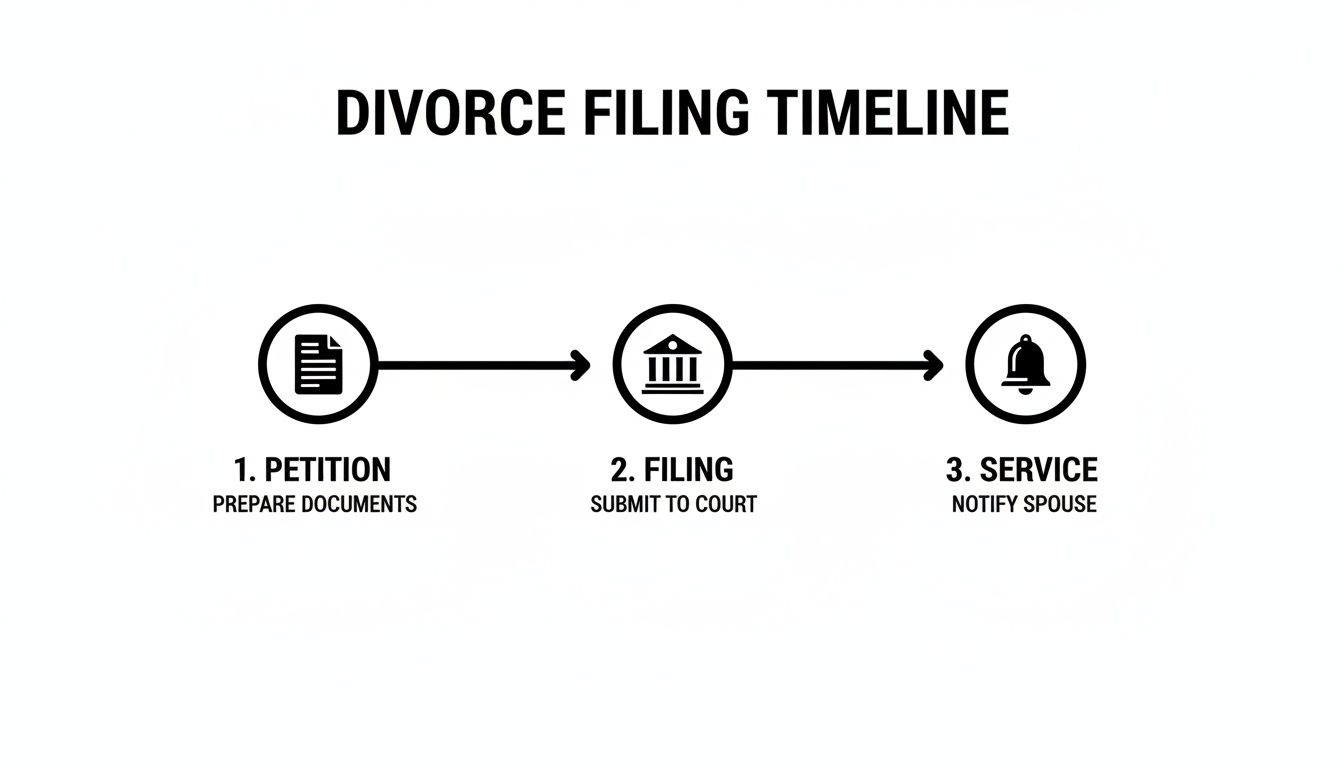
Every Texas divorce begins with one crucial document: the Original Petition for Divorce. This is what you file to officially open your case in the Montgomery County court system. Getting this step right is essential, as even small mistakes can create frustrating delays.
The Petition is a formal legal statement that outlines the basic facts of your marriage and why you are seeking a divorce. It must confirm that you meet the residency rules required by the Texas Family Code: living in Texas for at least six months and in Montgomery County for the last 90 days.
Filing the Petition and Notifying Your Spouse
Once drafted, the Petition is filed with the Montgomery County District Clerk's office in Conroe. You’ll pay a filing fee and receive a case number and court assignment.
Next, your spouse must be formally notified. This is called "service." You generally have two options:
- Personal Service: A constable or private process server hand-delivers a copy of the lawsuit to your spouse.
- Waiver of Service: If things are amicable, your spouse can sign a Waiver of Service form. This acknowledges they received the papers and saves time and stress.
This initial phase sets the tone for your divorce. Errors can lead to delays or even dismissal, adding stress to an already difficult situation.
Real-World Scenario
John, a resident of Sterling Ridge in The Woodlands, filed for divorce but forgot to include his children's full birthdates as required. The Clerk’s office accepted the filing, but the mistake wasn't caught until weeks later. The judge required him to file an Amended Petition, delaying his case by nearly two months and causing him to miss his first hearing date.
What to Do Next Checklist
- Gather Information: Collect full names, birthdates, and addresses for yourself, your spouse, and any children.
- Draft the Petition: Ensure all necessary details are accurate, especially residency information.
- File with the District Clerk: Take the Petition to the Montgomery County District Clerk, pay the fee, and get your case number.
- Arrange for Service: Choose how to notify your spouse, either through personal service or a Waiver of Service.
Disclaimer: This article provides general information and is not legal advice. The law is complex and changes often. For advice specific to your situation, consult with a qualified attorney.
These first steps are the foundation of your divorce. If you feel overwhelmed or want peace of mind, schedule a consultation to ensure everything is handled correctly from the start.
Understanding the Divorce Timeline from Filing to Final Decree
Knowing what to expect can lower your stress during a divorce. The legal process follows a fairly predictable series of steps, and understanding this timeline helps you prepare for each stage.
Under Section 6.702 of the Texas Family Code, there is a mandatory 60-day "cooling-off" period that starts the day after the divorce petition is filed. This means a judge cannot finalize your divorce until at least the 61st day, even if you agree on everything. Use this time to negotiate, attend mediation, or gather financial documents.
The Major Milestones in a Montgomery County Divorce
Most cases follow this general path:
Temporary Orders Hearing: This first court appearance happens quickly, often within weeks of filing. A judge makes temporary rulings on urgent issues like who stays in the house, who pays bills, and the initial schedule for the kids.
Discovery: This is the formal phase where both sides exchange information. It can take weeks or months. You’ll swap financial documents, answer written questions under oath (Interrogatories), and may give spoken testimony in a deposition.
Mediation: Montgomery County judges almost always require couples to try mediation before setting a final trial date. A neutral mediator helps you work through disagreements to find common ground. Most cases settle this way.
Final Hearing or Trial: If you can't agree, your case goes to trial, where a judge makes a final decision. If you do agree, you'll have a short "prove-up" hearing to present your signed Final Decree of Divorce to the judge for approval.
The cost of divorce can vary. An uncontested Texas divorce might cost around $12,500, but that can climb to $15,000-$40,000 or more for contested cases with property or custody disputes. You can learn more about the financial impact from Texas divorce statistics.
Real-World Scenario
Maria and David, a couple from Conroe, were in a difficult split. David changed the locks and cut off Maria's access to their joint bank account. Maria's attorney immediately requested a temporary orders hearing. In less than three weeks, a Montgomery County judge ordered David to give Maria a key and restore her access to funds for living expenses.
What to Do Next Checklist
- Calendar the 61st Day: Once the petition is filed, mark your calendar. That’s the earliest your divorce can be final.
- List Urgent Issues: Identify immediate problems a judge needs to address at a temporary orders hearing.
- Start Gathering Financials: Collect pay stubs, bank statements, and property deeds to prepare for discovery.
- Think About Mediation Goals: Go into mediation with a clear idea of what a fair settlement looks like to you.
Disclaimer: This article provides general information and is not legal advice. The law is complex and changes often. For advice specific to your situation, consult with a qualified attorney.
Understanding the divorce timeline gives you a sense of control. If you need help navigating these steps, schedule a consultation to create a strategy for your situation.
Resolving Key Issues in Your Divorce Case
A divorce resolves three main issues: arrangements for children, financial support, and property division. Every decision is guided by the Texas Family Code, so understanding how a Montgomery County court views these issues is crucial.

Arrangements for Your Children
When children are involved, their well-being is the court's only priority. Every decision is based on the "best interest of the child." Texas law presumes that having both parents involved is best, so most decrees name parents as Joint Managing Conservators.
This is a co-parenting plan where both parents share rights and duties. One parent is usually named the "primary" conservator with the right to determine where the children live (often within Montgomery County and surrounding areas). The other parent gets a possession schedule, like the Texas Standard Possession Order.
Financial Support for Your Family
Financial support breaks down into two categories:
Child Support: The non-primary parent typically pays child support. The amount is based on a formula in the Texas Family Code, using the paying parent's net monthly income. For one child, the guideline is 20% of net resources.
Spousal Support (Maintenance): This is not automatic. It may be awarded if a spouse lacks sufficient property to meet their basic needs and the marriage lasted 10 years or more, among other strict requirements.
The costs of divorce can be significant. While a simple case might cost $5,000 to $10,000, highly contested divorces in places like The Woodlands can be much more expensive. Discover more insights about divorce trends and costs in Texas.
Dividing Your Marital Property
Texas is a community property state. This means almost everything earned or acquired during the marriage belongs to the "community estate." This includes income, houses, retirement funds, and even debt.
The Texas Family Code requires a judge to divide this estate in a "just and right" manner. This doesn't always mean 50/50. A judge can award a larger share based on factors like fault in the breakup, different earning abilities, or the children's needs. To see how couples can resolve this themselves, you can learn more about divorce mediation in The Woodlands in our article.
Real-World Scenario
Imagine a couple in The Woodlands. One spouse was a high-earning executive while the other stayed home to raise the kids. During their divorce, the judge awarded the stay-at-home spouse 60% of the community estate. This was not a punishment; it was a "just and right" division to ensure the non-working spouse had the financial stability to get back on their feet.
What to Do Next Checklist
- List Parenting Goals: Think about what rights, duties, and schedule are best for your child.
- Create a Budget: Get a clear picture of your monthly income and expenses for support discussions.
- Inventory Your Property: List all assets and debts, noting when they were acquired.
- Consider Your Strategy: Know what your non-negotiables are and where you can compromise.
Disclaimer: This article provides general information and is not legal advice. The law is complex and changes often. For advice specific to your situation, consult with a qualified attorney.
Working through these core issues is what the divorce process is all about. If you need help protecting your rights and fighting for a fair outcome, schedule a consultation.
How to Prepare for Your Day in Court
Stepping into a Montgomery County courtroom can be intimidating, but preparation is the best way to calm your nerves. How you present yourself—your attitude, organization, and words—can influence the outcome.
Mastering Courtroom Etiquette and Attire
First impressions matter. Dress in business casual—no shorts, graphic t-shirts, or flip-flops. Address the judge as “Your Honor.” Stand when the judge enters or leaves and when you are speaking. Never interrupt the judge or the other attorney. These small signs of respect go a long way.
An attorney who practices in Montgomery County family courts daily will know each judge's preferences. This local knowledge is a huge strategic advantage.
Organizing Your Evidence and Testimony
You need to present a clear case backed by evidence. Your attorney will help you compile an exhibit binder with proof, such as:
- Financial Documents: Pay stubs, bank statements, and tax returns.
- Communication Records: Key text messages or emails that are relevant.
- Photographs and Videos: Visuals to prove property conditions or document interactions.
Practice what you are going to say with your lawyer. Stick to the facts and avoid emotional outbursts. Answer questions calmly and directly.
Real-World Scenario
Let's call our client Sarah. She was headed to a temporary orders hearing in Conroe. Her goals were to get a temporary custody schedule and stay in the family home in Panther Creek. Before court, we built a simple binder with her last three pay stubs, the mortgage statement, and a calendar tracking when her spouse missed time with the kids. In court, she calmly answered questions, pointing to the documents. The judge had a clear, evidence-based picture and ruled in her favor. Her preparation made the decision easy.
What to Do Next Checklist
- Choose Your Outfit: Pick out a conservative, business-casual outfit ahead of time.
- Organize Documents: Work with your lawyer to get your exhibit binder in order.
- Practice Testimony: Go over potential questions and practice giving short, factual, and calm answers.
- Review Courtroom Rules: Arrive early. Turn your cell phone completely off. Be prepared to wait.
Disclaimer: This article provides general information and is not legal advice. The law is complex and changes often. For advice specific to your situation, consult with a qualified attorney.
Walking into divorce court in Montgomery County doesn't have to be a source of anxiety. With the right preparation, it can be a moment of empowerment. If you need help building a strong, professional case, schedule a consultation to discuss a strategy for your unique situation.
Common Questions About Montgomery County Divorce
When you're facing a divorce, questions can feel endless. Getting clear, straightforward answers is a great way to regain control. Here are common questions from clients in The Woodlands and Montgomery County.
How Long Will My Divorce Take in Montgomery County?
It depends. The absolute fastest a divorce can be finalized is 61 days after filing, due to a mandatory "cooling-off" period in the Texas Family Code. This is only for truly uncontested cases.
A more realistic timeline is:
- Uncontested Divorce: 2 to 4 months.
- Contested Divorce (with disputes): 6 to 12 months.
- Highly Contested Divorce (headed to trial): 12 months or longer.
Complex issues like custody battles or high-asset property division, common in areas like The Woodlands, can extend the timeline.
Is Going to Court Mandatory to Get Divorced?
Yes, you must engage with the court system, but it's rarely a dramatic trial. Most cases in Montgomery County are settled without a contested trial.
Typically, after filing, you and your spouse negotiate a settlement, often through mediation. Once you have a signed agreement, one person attends a short, informal "prove-up" hearing where the judge signs the Final Decree of Divorce.
What Is Mediation and Why Is It Required Here?
Mediation is a private meeting where a neutral third-party mediator helps you and your spouse resolve disagreements. In Montgomery County, judges almost always require couples to try mediation before they will schedule a final trial. The courts believe you know your family best—far better than a judge who only sees a snapshot of your life.
Real-World Scenario
A couple from Magnolia was stuck on what to do with the family home. In mediation, they realized that neither keeping it was ideal. The solution they crafted was to sell the house and split the proceeds 55/45 in the wife's favor. This gave her the extra cash she needed to get a new home in the same school district. It was a win-win they wouldn't have reached in an adversarial court battle.
Can I File for Divorce If I Just Moved to The Woodlands?
To file for divorce in Montgomery County, you must meet residency rules from the Texas Family Code. At least one spouse must have:
- Lived in Texas for the last six months, AND
- Lived in Montgomery County for the last 90 days.
If you just moved from out of state, you'll have to wait until you meet both requirements. If you moved from another Texas county, you just need to hit the 90-day mark in Montgomery County before filing.
What to Do Next Checklist
- Review Your Timeline: Mark the 61st day on your calendar, but be mentally prepared for a more realistic timeframe.
- Evaluate Residency: Confirm you meet both the 6-month state and 90-day county residency rules.
- Prepare for Mediation: Think about your ideal outcomes and where you might be willing to compromise.
- Gather Your Questions: Keep a running list of questions for your attorney to get clear answers.
Disclaimer: This article provides general information and is not legal advice. The law is complex and changes often. For advice specific to your situation, consult with a qualified attorney.
Navigating a divorce in Montgomery County raises many questions, but you don't have to find the answers alone. The Law Office of Bryan Fagan is here to provide the clarity and guidance you need. If you're ready to discuss your situation and get personalized advice, schedule a consultation with our experienced team at The Law Office of Bryan Fagan.