
Life rarely stays the same, but a court order is frozen in time. If you're looking at a custody agreement that no longer makes sense for your family's life in The Woodlands, you're not alone. But changing it isn't as simple as asking. Texas courts want stability for children, so to modify a custody order, you have to clear a specific legal hurdle first.
When You Can Modify a Custody Order in The Woodlands

A judge in Montgomery County won't change an order just because it's inconvenient or because you and your ex are disagreeing. You have to prove two things: first, that there has been a material and substantial change in circumstances since the last order was signed, and second, that changing the order is in the child’s best interest.
Think of these as two keys needed to unlock the same door. You must have both for a judge to even consider your request.
What Is a Material and Substantial Change?
This is a legal term, but it’s not as complicated as it sounds. It simply means something big and significant has happened in the life of the child or one of the parents. It has to be a real, meaningful shift—not a temporary problem or a minor annoyance.
This is the event that gives you a valid reason to go back to court. A judge needs to see that the situation today is fundamentally different from when the original order was put in place. The bar for proving this is high. As outlined in the Texas Family Code, courts are designed to protect children from constant upheaval. You have to bring solid evidence to the table. Discover more insights about modifying child custody orders in Texas on bryanfagan.com.
To help you get a clearer picture, this table shows what kinds of situations might justify a custody change in Montgomery County versus those that likely won't.
Valid vs. Invalid Reasons for Custody Modification
| Potentially Valid Reason | Example Scenario | Typically Insufficient Reason |
|---|---|---|
| Parent Relocation | One parent moves from The Woodlands' Sterling Ridge to Dallas for a new job, making the current possession schedule impossible. | One parent moves to a new apartment in Conroe, just 15 minutes away. |
| Change in Lifestyle | A parent develops a substance abuse problem or engages in criminal activity that endangers the child. | A parent starts dating someone the other parent dislikes, but who poses no threat to the child. |
| Child's Preference (12+) | A teenager expresses a strong, mature desire to live with the other parent for valid reasons (e.g., better school program). | A child wants to move because the other parent has fewer rules or a newer video game console. |
| Change in Needs | A child is diagnosed with a medical condition that one parent is better equipped to manage due to their work schedule or proximity to specialists. | A parent wants to change the schedule to save money on after-school care. |
| Parental Alienation | One parent is actively and consistently trying to damage the child's relationship with the other parent. | The parents have a few disagreements over parenting styles or decisions. |
Remember, every case is unique, and a judge will look at the specific details of your situation.
The Best Interest of the Child
Even if you prove a major life change has happened, that’s only half the battle. The judge’s final decision will always boil down to one question: what is best for the child?
You must convince the court that the new arrangement you're proposing will actively benefit your child's emotional and physical well-being. The judge will look at everything—the stability of each home, the child's unique needs, and each parent's ability to provide a safe, nurturing environment. Your personal convenience or desires will always take a backseat to the child's welfare.
What to Do Next Checklist
- Look at Your Situation Honestly: Is the change in your life truly "material and substantial," or is it more of a frustration? Be objective.
- Start Gathering Proof: Collect any documents, emails, texts, or records that clearly show how circumstances have changed since your last order.
- Focus on Your Child: Frame your entire argument around how the change you want will benefit your child—not just you.
- Know Your Current Order: Pull out your existing custody order and read it carefully. Be clear on exactly which parts you want to modify.
Disclaimer: This article is for informational purposes only and does not constitute legal advice. Family law matters are complex, and you should consult with a qualified attorney to discuss your specific situation.
Navigating the legal standards for a custody modification in The Woodlands, Texas, requires a thoughtful and strategic approach. If you believe your family’s circumstances have hit this threshold, understanding these core rules is your essential first step. For guidance tailored to your specific case, our experienced team is here to help.
Building a Strong Case for Your Modification
When it comes to modifying your custody order in Montgomery County, winning isn't about telling the most emotional story. It's about presenting the most convincing evidence. A judge has to base their decision on hard facts, not just your personal frustrations or what you feel is right.
This means your most important job is to gather solid proof. You need to show the judge two things: that there has been a material and substantial change in circumstances, and that your proposed changes are truly in your child's best interest. Think of yourself as a detective building a case. Your goal is to create a clear, organized timeline of events that proves why the old order no longer works.
What Evidence Actually Matters in Court?
Judges here in The Woodlands are looking for objective, verifiable proof. While your own testimony is a piece of the puzzle, it becomes infinitely more powerful when you can back it up with documents and third-party accounts. You need to collect evidence that paints a picture the court simply can't ignore.
Here are the types of evidence that we find are most effective in these cases:
- Communication Records: Emails, text messages, and messages from parenting apps are often goldmines of information. They can reveal patterns of behavior, like a parent consistently denying visitation, making last-minute cancellations, or using hostile language.
- Official Documents: This kind of evidence is highly credible because it comes from neutral, official sources. Think report cards showing a sudden drop in grades, school attendance records flagging frequent tardiness, or medical reports detailing a child's new diagnosis or needs.
- Financial Records: If the reason for your modification is financial, you'll need the paperwork to prove it. Pay stubs, bank statements, or a termination letter are essential for showing a job loss or a significant change in income.
- A Detailed Log or Journal: This is simpler than it sounds. Just keep a calendar or a notebook to track every missed visit, late pickup, or other important incident. The key is to be factual—stick to dates, times, and a brief, objective description of what happened.
Remember, context is everything. A single angry text can be easily explained away. But a clear pattern of them over six months? That tells a much different story. One missed weekend might be an emergency, but a log showing ten missed weekends in a year points to a significant problem that the court needs to address.
The Texas Family Code doesn't give you a specific checklist of what to bring to court, but it does place the burden of proof squarely on your shoulders. You have to present a collection of evidence so clear and compelling that the judge can easily connect the dots between the "material change" and why a new order is necessary for your child's well-being.
Real-World Scenario: Last-Minute Changes in Alden Bridge
Imagine a mother living in the Village of Alden Bridge in The Woodlands. Her ex-husband has a new job requiring frequent, last-minute international travel. Their current custody order is a standard possession schedule, but he has missed six of the last eight weekends, often with less than 24 hours' notice. Their son, who attends a local Conroe ISD school, has become anxious, and his grades are starting to slip.
Here’s how she could build a powerful case for modification:
- Create a Visitation Log: She meticulously documents every single missed or rescheduled weekend, noting the date, time, and the reason the father gave.
- Save All Communications: She saves every text message and email where the father cancels, creating a clear record of his last-minute changes. When putting your case together, things like text messages can be vital, but you have to know how to properly prepare and present legally admissible text messages for court.
- Gather School Records: She gets copies of her son’s report cards to show the quantifiable drop in his grades. She also saves an email from his teacher expressing concern over his recent anxiety in the classroom.
- Involve a Neutral Third Party: She could ask the school counselor, who has been meeting with her son, if they would be willing to testify about the child's emotional state. Testimony from a neutral professional, like a counselor or even a coach from a local sports league, can be incredibly persuasive.
With this evidence, her argument shifts from a vague "he's just not reliable" to a documented pattern of instability that is directly and negatively impacting their child. If you find yourself in a similar high-conflict situation, exploring options like mediation for your divorce or custody case in The Woodlands can also be a constructive step toward a solution.
Your Next Steps Checklist
- Start a Digital Folder: Create a folder on your computer today. Start saving screenshots of texts, emails, and relevant social media posts.
- Keep a Factual Journal: Begin a daily or weekly log of events. Stick to the facts: who, what, when, and where.
- Request Official Records: Reach out to your child's school, doctor, or daycare to formally request documents like attendance and academic records.
- Identify Potential Witnesses: Make a list of neutral third parties (teachers, coaches, counselors) who have firsthand knowledge of the situation.
Disclaimer: This article is for informational purposes only and does not constitute legal advice. Family law matters are complex, and you should consult with a qualified attorney to discuss your specific situation.
Building a strong case for a custody modification in The Woodlands, Texas, takes time and methodical preparation. By focusing on collecting objective, factual evidence, you can present a clear and convincing argument to the court. If you feel overwhelmed or need help organizing your evidence, we can help you prepare a strong case.
The Legal Steps for Modifying Custody in Montgomery County
Changing a court-ordered custody arrangement in The Woodlands can feel like a maze, but there's a clear legal path to follow. Once you understand the process, it becomes much less intimidating. Every step is designed to give both you and the other parent a fair chance to present your case, all while keeping the child's best interest as the top priority.
It all starts with filing a Petition to Modify the Parent-Child Relationship. This is the official document that kicks things off at the Montgomery County Courthouse in Conroe. Think of it as your formal request to the court, outlining exactly what you want to change in the current custody order and—most importantly—spelling out the significant life changes that make this modification necessary.
Getting the Ball Rolling: Filing and Serving Papers
Once you've filed the petition, you can't just text the other parent to let them know. The law is very specific here. You have to ensure proper service of process, which means having a neutral third party, like a sheriff's deputy or a professional process server, personally hand-deliver a copy of the lawsuit to them.
This isn't just a formality; it's a non-negotiable requirement under the Texas Family Code. It guarantees that the other parent is officially aware of the case and has a fair opportunity to respond. Messing this step up can bring your case to a screeching halt, leading to major delays or even getting it dismissed entirely.
After being served, the other parent has a set timeframe to file their own legal document, called an Answer. This is where they'll either agree with your proposed changes or formally state their opposition. Their response is what officially determines if your case is "agreed" or "contested," which dictates everything that happens next.
This simple graphic breaks down the core of building your case for the judge.
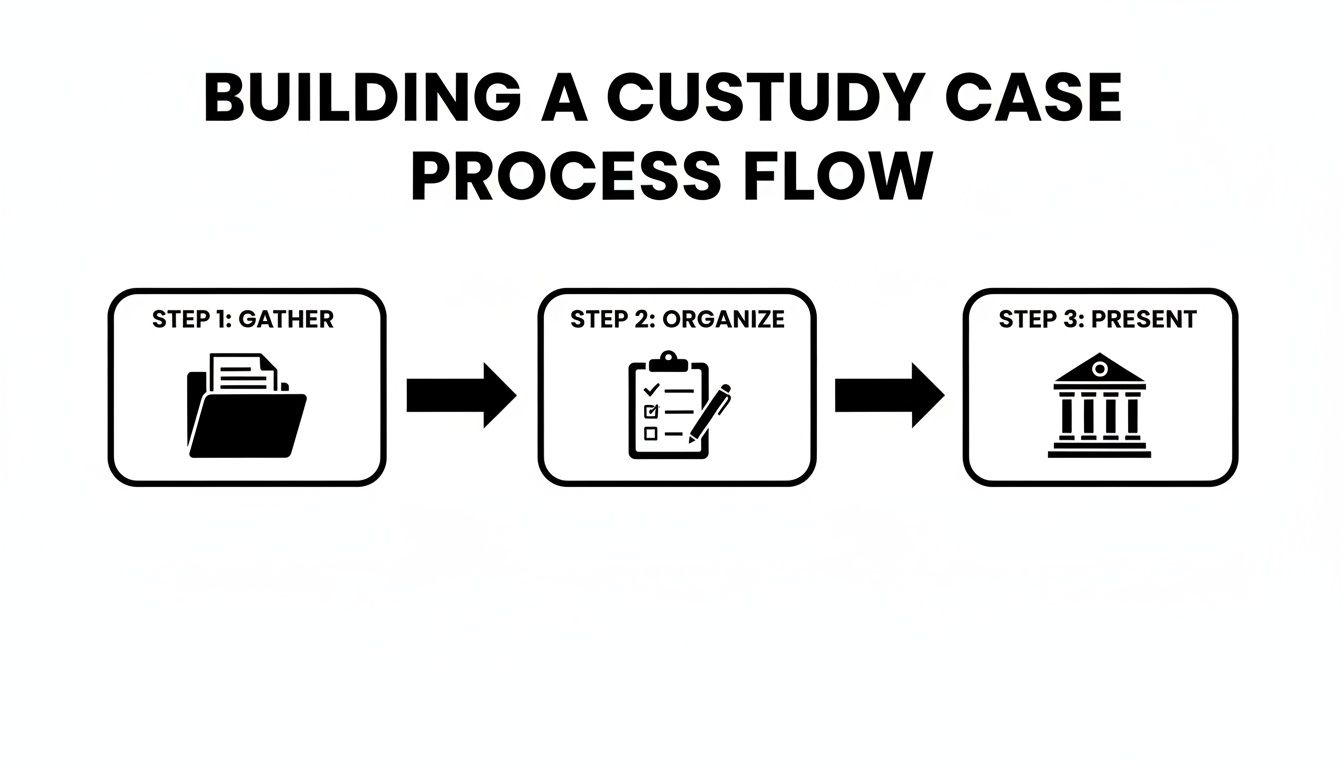
Before you ever step into a Montgomery County courtroom, you have to move from simply gathering evidence to weaving it into a compelling story for the judge.
Finding Middle Ground with Mediation and Temporary Orders
In Montgomery County, judges almost universally require parents in a dispute to try mediation before they'll schedule a final trial. Mediation is a confidential process where you, the other parent, and your lawyers meet with a neutral mediator. Their job isn't to take sides, but to help you find common ground and work toward an agreement you can both live with.
You’d be surprised how many seemingly impossible cases get fully resolved in mediation. It saves time, money, and stress, and it keeps the final decision in your hands, not a judge's.
Of course, life goes on while the legal process unfolds, which can take months. If you have pressing issues that can't wait, you can ask the court for temporary orders. A judge can hold a hearing to establish a temporary game plan for things like:
- A temporary visitation schedule
- Which parent the child will primarily live with for now
- Interim child support payments
- Rules for co-parenting communication
These orders create stability for your child and set the ground rules until a final decision is made.
When Emergencies Can't Wait: TROs
What happens if your child is in immediate danger? The Texas Family Code has a powerful tool for these urgent situations. You can ask for a Temporary Restraining Order (TRO) if you have evidence that your child is at risk of serious physical or emotional harm.
A TRO is an emergency court order that can be granted very quickly—sometimes without the other parent even being in the room—to stop a harmful action. It could, for example, prevent a parent from yanking a child out of their school in The Woodlands or taking them across state lines. These are not taken lightly and are reserved for genuine emergencies. After a TRO is granted, a hearing is set, usually within 14 days, where both parents can present their side of the story.
Real-World Scenario: An Emergency in Conroe
Imagine a father in Conroe discovers his ex-wife has relapsed into drug use and is leaving their young child alone. He can file his Petition to Modify along with an urgent request for a TRO, supported by statements from concerned relatives. A Montgomery County judge could sign that order the same day, granting him temporary custody and keeping the mother away until everyone can get back to court for a full hearing.
What to Do Next Checklist
- Talk to a Lawyer: Before you file a single form, speak with an attorney who knows the ins and outs of the Montgomery County courts. They can make sure your petition is solid from the start.
- Get Your Ducks in a Row: Make sure you have the other parent's current, correct address. Service of process depends on it.
- Prepare for Mediation: Go in with a clear idea of what you want, but also what you're willing to compromise on. Being prepared makes mediation far more effective.
- Assess the Urgency: If you genuinely fear for your child's safety, start gathering proof immediately. In an emergency, you need to be ready to move fast to get a TRO.
Disclaimer: This article is for informational purposes only and does not constitute legal advice. Family law matters are complex, and you should consult with a qualified attorney to discuss your specific situation.
Successfully modifying a custody order requires navigating the legal procedures with precision. If you're a parent in The Woodlands or anywhere in Montgomery County facing this challenge, understanding these steps is the first move toward protecting your child. To get advice tailored to your unique circumstances, schedule a consultation with our team.
Understanding the Child's Best Interest Standard

So, you’ve proven a major life change has occurred. That's a critical first step, but it’s only half the battle. Now comes the part that truly matters to a Montgomery County judge: showing that changing the custody order is in your child's best interest.
This isn't just legal jargon; it's the single guiding principle for every decision a judge makes about a child. Your convenience, your new job, or your personal wishes are secondary. The court’s entire focus is on what arrangement will best support your child's physical health and emotional well-being.
The Holley Factors: What Judges Look For
Judges in Texas don't just rely on a gut feeling. To determine what's in a child's best interest, they use a framework established by a landmark Texas Supreme Court case, Holley v. Adams. These are widely known as the Holley Factors.
Think of these factors as the lens through which the judge views your family's situation. They aren't a simple checklist where the parent with the most checkmarks "wins." Instead, the judge weighs them all together to get a complete picture.
Some of the key questions a judge will consider are:
- Needs: What does this specific child need emotionally and physically, both right now and in the future?
- Danger: Is the child in any immediate or potential physical or emotional danger in their current situation?
- Parental Fitness: What are the parenting skills and capabilities of each parent asking for custody?
- Stability: Which home environment offers more stability and consistency for the child?
- Parental Plans: What are the concrete plans each parent has for the child's upbringing, education, and care?
- Parental Conduct: Are there any actions (or failures to act) by a parent that suggest a poor parent-child relationship?
It’s all about the big picture. The court is looking to find the safest, most stable, and most nurturing environment where your child can truly thrive. The "best interest" standard is intentionally broad. It gives a judge the flexibility to consider every unique aspect of a family’s situation. This means your job is to present evidence that directly speaks to these factors, showing how your proposed change positively impacts your child's stability, safety, and happiness.
What About the Child’s Preference?
One of the most common questions we get from parents in The Woodlands is, "Can my child just tell the judge who they want to live with?" The answer is a qualified yes, but it's not the deciding factor.
In Texas, if a child is 12 years of age or older, the judge must meet with them privately if one of the parents requests it. This is called an "interview in chambers." The child gets to voice their preference, but that preference doesn't automatically control the outcome.
The judge will carefully consider the child's maturity level and the reasons behind their choice. A teenager wanting to move to attend a specific academic program at The Woodlands High School will carry a lot more weight than a 12-year-old who wants to move simply because the other parent has fewer rules about video games.
Real-World Scenario: A Request in Creekside Park
Let's put this into practice. Imagine a dad living in Creekside Park recently bought a larger home and got a promotion. That's his "material and substantial change." He now wants to be the primary parent, arguing he can provide a better lifestyle.
However, his child has lived with their mom in the Sterling Ridge neighborhood for the past five years. The child is doing great at their Conroe ISD school, has a close group of friends, and is the star of a local soccer team. While the mom's home is smaller, it's been a stable and loving environment for years.
In this situation, a judge would almost certainly deny the father's request. Even with his improved finances, uprooting the child from their established school, friends, and support system would disrupt their life. Stability almost always outweighs a material upgrade. This is a classic example of why proving a change in your own life isn't enough; you must prove the change benefits the child. If you want to dive deeper into this, you can learn more about Texas child custody standards in our comprehensive guide.
What to Do Next Checklist
- Review the Holley Factors: Look at the list and honestly assess how your proposed change stacks up. Where are your arguments strongest? Where are they weakest?
- Think Like a Judge: Remove your own emotions and ask, "Why is my plan truly better for my child's well-being, not just for my own?"
- Document Stability: If you're opposing a modification, start gathering evidence that shows your child is happy, healthy, and successful in the current arrangement (think report cards, awards, photos with friends).
- Document Instability: If you're the one asking for the change, you need evidence showing how the current situation is failing your child (emails from concerned teachers, poor grades, therapy notes, etc.).
Disclaimer: This article is for informational purposes only and does not constitute legal advice. Family law matters are complex, and you should consult with a qualified attorney to discuss your specific situation.
The best interest standard is the heart and soul of every custody modification in The Woodlands, Texas. If you're ready to discuss how these factors apply to your family's unique circumstances, schedule a consultation with our experienced team.
The Real Costs of a Custody Modification Lawsuit

Let's be blunt: filing to modify your custody order is a significant investment. It costs money, of course, but it also costs a tremendous amount of emotional energy. The path you take—whether you and the other parent can find common ground or have to fight it out in court—will ultimately determine how high those costs go.
The most straightforward and cost-effective route is an agreed modification. If you and the other parent can hammer out the new terms, your expenses are mostly limited to attorney's fees for drafting the legal paperwork correctly and the court's filing fees. This path can save you thousands of dollars and an incredible amount of stress.
But when you can't agree, you’re looking at a contested modification. This is a whole different ballgame, and the costs can escalate quickly as the legal battle unfolds.
The Dollars and Cents of a Contested Case
Once a case becomes contested, several expenses are pretty much unavoidable. Here's what you can realistically expect to pay for in a Montgomery County custody modification:
- Court Filing Fees: You have to pay the county just to open the case. These initial fees usually run a few hundred dollars.
- Service of Process Fees: The other parent needs to be formally notified of the lawsuit. This is done by a sheriff's deputy or a private process server, which typically costs between $75 and $150.
- Mediator Fees: Before you ever get to a final trial, a Montgomery County judge will almost certainly order you to mediation. Mediators charge by the hour, and parents usually split the cost. Expect to pay anywhere from $800 to $2,000 or more for a full day of mediation.
- Attorney's Fees: This is, by far, the biggest piece of the financial puzzle. Lawyers bill for their time, which covers everything from drafting documents and communicating with you and the other attorney to preparing for hearings and arguing your case in the courtroom.
A contested modification that goes all the way to a final trial can easily cost tens of thousands of dollars in attorney's fees. It's why we, and the courts, push so hard for a resolution through negotiation or mediation first.
Don't Forget About Child Support
Another financial curveball to prepare for is the automatic review of child support. Any time you ask the court to change the possession schedule, the judge will re-evaluate the child support arrangement based on the guidelines in the Texas Family Code.
If the modification makes you the primary parent, you may start receiving child support. But if the change means you'll have less time with your child, your support obligation could go up. It’s a factor that many parents overlook.
The Price That Isn't on the Invoice
Beyond the bank account, the emotional cost of a long, drawn-out legal fight can be staggering. The constant conflict creates a tense, stressful home life for your children, who often feel stuck in the middle. The process can drain your energy, impact your performance at work, and put a strain on your relationships with friends and family. Honestly, this emotional toll is often the highest price paid.
Real-World Scenario: A Cautionary Tale from The Woodlands
We saw this happen with a client whose ex-husband’s job schedule had become erratic. They just couldn't agree on a new pickup and drop-off schedule, and what should have been a simple change dragged on for a year. The constant back-and-forth caused their daughter’s grades to plummet. By the end, the client had spent over $15,000 in legal fees, and the judge's final order wasn't that different from what they could have agreed to in mediation a year earlier. The damage, both financial and emotional, was already done.
What's Your Next Move Checklist
- Take the Temperature: Be brutally honest with yourself. Is an agreement with the other parent truly possible? Even a small compromise now could save you thousands later.
- Plan Your Budget: Get a realistic picture of the potential costs and prepare for the financial commitment, especially if you think the case will be contested.
- Keep Your Child Front and Center: Always think about how a court battle will affect your child. A bitter, year-long fight is almost never in their best interest.
Disclaimer: This article is for informational purposes only and does not constitute legal advice. Family law matters are complex, and you should consult with a qualified attorney to discuss your specific situation.
Understanding the real-world costs helps you make a clear-eyed decision about whether pursuing a custody modification in The Woodlands, Texas, is the right move for your family. If you want to get a clearer picture of potential costs and strategies tailored to your situation, schedule a consultation with our team.
Taking the Next Step in Your Woodlands Custody Case
So, you've learned the basics of what it takes to modify a custody order in The Woodlands. Now what? It can feel overwhelming, but moving forward is all about taking deliberate, well-planned steps. Before you ever set foot in a courthouse, the most important work begins right now, with you.
Honestly, the success of your case often comes down to the groundwork you lay before filing a single piece of paper. It’s about building a solid foundation based on facts and a clear-eyed assessment of your family's new reality. Getting this part right can make all the difference.
Real-World Scenario: A Move Announced in Panther Creek
Imagine a dad living in the Panther Creek village of The Woodlands. He gets an email from his ex-wife announcing she's accepted a job offer in another state and plans to move with their daughter in 60 days. The initial shock gives way to panic. Instead of just getting angry, he starts to act.
He immediately saves that email, puts the proposed move-out date on his calendar, and starts pulling information about his daughter’s current school, her friends, and her activities. He's gathering proof of the stable life she'd be leaving behind. This kind of immediate, fact-based response gives his attorney a powerful head start. When you're thinking about the potential costs of a contested modification, it's worth noting how a law firm operates. A well-run office using specialized family law software can manage a case more efficiently, which often translates into lower overall costs for the client.
What to Do Next Checklist
- Document Everything. Starting Today. Keep a detailed, factual journal of every relevant conversation, event, or change. Dates, times, direct quotes—it all matters.
- Be Brutally Honest with Yourself. Look at the legal standard from the Texas Family Code. Does your situation truly represent a "material and substantial change"? A judge will see right through a weak argument.
- Can You Talk It Out? If your relationship with the other parent is safe and civil, consider having a conversation. An agreed modification is always the fastest, cheapest, and least stressful path forward.
- Get a Local Expert's Opinion. You need to speak with a family law attorney who knows the Montgomery County courts inside and out. They can give you crucial advice on your specific circumstances and walk you through the entire legal process, from the initial filing to finalizing your new orders—a process that is also central for those navigating a divorce in The Woodlands.
Disclaimer: This information is for educational purposes only and does not constitute legal advice. You should consult with a qualified attorney about your unique situation.
If your family is facing a complex custody issue, our team is here to help you understand your options. We invite you to schedule a consultation with us to talk through your next steps.
Answering Your Questions About Modifying Custody
When parents in The Woodlands or anywhere in Montgomery County think about changing their custody order, the same questions often come up. Let's walk through some of the most common ones we hear in our practice.
Can My Child Tell the Judge Who They Want to Live With?
This is a big one for parents of older kids. In Texas, once a child turns 12 or older, they have the right to speak privately with the judge to express their preference.
It’s crucial to understand, however, that their preference isn't the deciding factor. A judge in Conroe will certainly listen and give the child's wishes serious consideration, but their final ruling will always come down to what is in the child's overall best interest. The child gets a voice, not the final vote.
What if We Both Agree on the Changes?
Reaching an agreement with the other parent is the best-case scenario. It saves everyone time, money, and a tremendous amount of stress. But a handshake deal or a signed note won't cut it.
Even if you're in complete agreement, you still have to go through the official court process. This means filing a formal petition and submitting an Agreed Order for the judge to sign. Only when the judge’s signature is on that paper do the changes become legally binding and enforceable.
Real-World Scenario: The Unofficial Agreement
Imagine two parents agree their teenager should move in with the other parent to attend a better school. They write it down and both sign it. Six months later, one parent has a change of heart and demands the teen move back, pointing to the original court order. Because their private agreement was never made official by a judge, the old order is the only one that matters legally.
Do I Have to Follow the Old Order While My Modification Case is Pending?
Yes, absolutely. This is a point of confusion that can get parents into serious trouble. The current court order remains in full force until the moment a judge signs a new one.
You must continue to follow every single detail of the existing possession schedule, child support payments, and any other provisions. Failing to do so can negatively impact your modification case and could even lead to enforcement actions against you.
What to Do Next Checklist
- Review Your Current Order: Pull out your current custody order and get crystal clear on exactly what needs to change.
- Document Any Agreement: If you can, try to document any agreement you have with the other parent in writing, even in an email.
- Draft Proper Legal Documents: The most critical step is to have an attorney draft the proper legal documents to reflect your agreement.
- File with the Court: That paperwork must be filed with the Montgomery County District Clerk’s office to get it in front of a judge for a final signature.
Disclaimer: This article is for informational purposes only and does not constitute legal advice. Family law matters are complex, and you should consult with a qualified attorney to discuss your specific situation.
Navigating even an agreed custody modification requires careful attention to legal detail. If you are in The Woodlands and need assistance making your new agreement official, the team at The Law Office of Bryan Fagan is here to help. Schedule a consultation to ensure your new custody order is handled correctly from the start.