
When your relationship with your child is on the line, the legal process can feel overwhelming. For parents in The Woodlands, Conroe, and across Montgomery County, just starting is often the hardest part. Finding the right custody attorney in Montgomery County, TX—someone who truly understands local family law—is the most important step you can take to protect your rights and your child's future.
This guide will walk you through the process using plain English, so you can feel more confident and in control.
Starting Your Search in Montgomery County

Trying to understand a custody dispute on your own often feels like trying to read a map in a foreign language. The jargon is confusing, and the stakes couldn't be higher. A good local attorney acts as your translator, turning complex legal ideas into a practical game plan for your family.
Getting a handle on a few key terms is the first step toward regaining a sense of control.
Learning the Lingo: Key Texas Custody Terms
In Texas, the court system has its own vocabulary. What most people call "custody" is officially known as conservatorship. This legal term defines who has the right to make major decisions for your child—things like where they go to school or what medical care they receive.
The other piece of the puzzle is the possession order. Think of this as the detailed visitation schedule. It's a calendar that dictates when each parent has the child, mapping out weekdays, weekends, holidays, and summer break. A specific possession order is your best tool for creating stability and preventing future arguments.
The North Star of Every Custody Case: The Best Interest of the Child
Every decision a Montgomery County judge makes comes back to one guiding principle from the Texas Family Code: the best interest of the child.
This isn’t just a legal catchphrase; it's the standard used to measure every argument in court. Your attorney’s most critical job is to show the judge how your requests support your child’s physical and emotional well-being. This is why having someone familiar with comprehensive family law services is so valuable.
Real-World Scenario
A couple from The Woodlands, Maria and David, kept fighting over summer plans for their son. Their lawyer helped them create a possession order that not only alternated weeks but also guaranteed each parent an uninterrupted two-week vacation block. This simple provision in their final orders put an end to their recurring last-minute conflicts and gave them both peace of mind.
What to Do Next: A Checklist
Before you even make the first call, you can start getting organized. This will save you time and money.
- Document Everything: Start a simple journal. Note key interactions, missed visitations, or any significant events. Dates and times are your friends.
- Gather Your Paperwork: Collect any existing court orders, your child's birth certificate, and relevant financial documents.
- Define Your Goals: Think about what you believe is the best outcome for your child. What does an ideal schedule look like?
- Research Local Attorneys: Focus your search on lawyers who specialize in family law right here in Montgomery County. Local experience matters.
Disclaimer: This article provides general information and is not legal advice. The outcome of any legal matter depends on the specific facts and circumstances. You should consult with a qualified custody attorney to discuss your individual situation.
Navigating a custody case is a challenge, but you don't have to face it alone. If you're ready for clear advice on your case, a consultation is the best way to start.
How to Find and Vet the Right Local Attorney

Choosing a lawyer can feel overwhelming, but you can narrow your options. While an online search is a good start, your goal is to find three to five qualified professionals who truly specialize in family law here in Montgomery County.
First, do a quick background check. Visit the State Bar of Texas website to confirm any potential attorney is licensed and in good standing. Then, look at legal directories that provide peer ratings and client reviews.
These sites give you a good overview. For example, Montgomery County is a busy area for family law, with many dedicated custody attorneys and thousands of reviews from local parents in places like The Woodlands and Conroe. You can explore the Montgomery County legal market data to get a feel for the attorneys practicing in the area.
Looking Beyond the Reviews
Client reviews are a great starting point, but they don't tell the whole story. A five-star rating is nice, but you should read the details. Look for reviews that get specific about the lawyer's communication style, strategic thinking, and how they handled tense situations. Did clients feel heard? Did the attorney explain things clearly?
Peer endorsements—where other local lawyers vouch for an attorney's skills—add another layer of trust. When other family law attorneys respect someone's work, it’s a powerful sign of their expertise.
Real-World Scenario
A father in Sterling Ridge was struggling to choose between two lawyers. One had a perfect rating but gave vague advice in the consultation. The other had fewer reviews, but they were detailed, praising his specific knowledge of the judge assigned to the father’s case. He went with the second attorney, and that local insight made all the difference during negotiations.
The Importance of Local Courtroom Experience
An attorney's familiarity with the Montgomery County court system is a huge advantage. Every judge has their own way of doing things—the kind of evidence they prefer, how they manage their courtroom, and their take on issues like 50/50 possession schedules.
A seasoned custody attorney in Montgomery County, TX, knows these tendencies because they've stood in front of these judges countless times. This local knowledge isn't something learned in a book; it helps them anticipate problems and build a better case strategy. Since custody is often part of a divorce, it's smart to find someone who understands how local courts handle both. Seeing how an expert can help you prepare for a divorce in The Woodlands is very helpful.
What to Do Next: A Checklist
As you create your list, use this simple checklist to stay organized.
- Check Their State Bar Status: Verify that every lawyer is licensed and has a clean disciplinary record in Texas.
- Read Reviews with a Purpose: Look for patterns in what clients say. Is the attorney known for being aggressive, compassionate, or a sharp strategist? Find a style that fits your goals.
- Look for Board Certification: An attorney who is Board Certified in Family Law by the Texas Board of Legal Specialization has passed a tough exam and shown a high level of expertise. It's a significant credential.
- Schedule Consultations: Plan to meet with at least two or three attorneys. Think of it as an interview—you're hiring them for a very important job.
Disclaimer: This article provides general information and is not legal advice. The outcome of any legal matter depends on the specific facts and circumstances. You should consult with a qualified custody attorney to discuss your individual situation.
Finding the right legal partner is your first big win. When you're ready to talk through your options with a team that knows the Montgomery County courts, scheduling a consultation is the best way to get practical guidance.
How to Get the Most Out of Your First Attorney Meeting
That first meeting with a potential custody lawyer is more than an interview—it’s your first strategy session. To make that hour count, you need to come prepared.
Honestly, nothing shows an attorney you're serious like walking in with an organized folder. When you've done your homework, we can give you much more specific, valuable advice from the start.
What to Bring to Your Consultation
Think of this as your first briefing. The clearer the picture you can paint, the faster an attorney can begin to form a strategy.
- Existing Court Orders: If you have any previous orders for custody, divorce, or child support, these are the legal starting point.
- A Simple Timeline: Type up a clean, bulleted list of major events. Include the date of separation, any moves, or specific incidents you’re concerned about.
- A Few Key Documents: Bring your child's birth certificate and your last couple of pay stubs. If there are one or two critical text or email chains, bring those, but just the highlights.
- Your Questions: The meeting can be overwhelming. Write down your questions so you don’t forget anything.
Real-World Scenario
A mother from Conroe was about to meet with a custody attorney in Montgomery County, TX. She worried about which judge she might get. She wrote down her questions, including one keeping her up at night: "What's your experience in front of Judge Smith in the 418th District Court?" The attorney’s immediate, detailed answer about that judge’s specific preferences for parenting plans showed he had the local insight she needed and gave her instant confidence.
Key Questions and Talking About Fees
Your questions should cover three areas: their experience, their strategy, and how they work. This is your chance to understand not just what they’ll do, but how they do it.
Use this checklist to make sure you cover the most important ground.
Key Questions to Ask a Custody Attorney
| Category | Question to Ask |
|---|---|
| Experience & Local Knowledge | How many of your cases are focused on Montgomery County child custody? |
| Which local judges have you appeared before most often? | |
| Case Strategy | Based on what I've told you, what are your initial thoughts on a strategy? |
| What are the biggest potential strengths and weaknesses you see in my situation? | |
| Communication & Logistics | Who will be my main point of contact at your firm? |
| What is your policy on returning phone calls and emails? | |
| Costs & Fees | What is your hourly rate? What about other staff? |
| What is the amount of the initial retainer, and when would I need to add more? | |
| Can you estimate the total cost if this case settles versus if it goes to trial? |
A good attorney will welcome these questions and give clear, direct answers.
Finally, talk about money directly. Most family lawyers bill by the hour against an initial retainer. This is a lump sum you pay upfront. As they work, they bill their time against that fund. Get clear answers on the hourly rate, the retainer amount, and how billing works.
What to Do Next: A Checklist
You'll probably leave the meeting with your head spinning. That's normal. Use this checklist to process everything.
- Review Your Notes: While it’s fresh, go over your notes. Did they answer your questions clearly? Did their strategy make sense?
- Compare the Financials: Put the retainer and hourly rate information side-by-side. Make sure you're comfortable with the cost.
- Trust Your Gut: Did you feel heard and respected? You'll be working closely with this person. Rapport matters.
- Confirm No Conflicts: The attorney's office will run a formal "conflict check" to ensure they haven't worked with the other parent. It's a standard and crucial step.
Disclaimer: This article provides general information and is not legal advice. The outcome of any legal matter depends on the specific facts and circumstances. You should consult with a qualified custody attorney to discuss your individual situation.
Choosing your lawyer is the most important decision in this process. When you feel ready to talk through your situation with a team that knows the local courts, scheduling a consultation is the right next step.
Navigating Emergency Custody and Support
Sometimes, you can't wait for the standard court process. When a child's safety or your family's financial stability is at risk, you need to act fast. The Texas Family Code provides a tool for these situations: a Temporary Restraining Order (TRO).
A TRO is a fast-tracked court order meant to stop a bad situation from getting worse. But Montgomery County judges don't grant them lightly. You and your attorney must prove there's a real emergency, like a credible threat of physical harm, severe emotional abuse, or one parent trying to flee with the child.
When You Need Urgent Protection
To get a TRO, it's all about evidence. Your attorney must present a compelling case that immediate and irreparable harm will happen if the court doesn't step in. This isn’t for disagreements over parenting styles; it’s for serious crises where a child is in real danger.
Real-World Scenario
Imagine a mother in Conroe finds text messages where her ex is planning to take their child out of state and hide. Her attorney didn't hesitate. They immediately filed for a TRO, using the texts as proof. A Montgomery County judge granted the order, which legally blocked the father from taking the child out of the county and scheduled a full hearing within 14 days. This quick legal action was critical for the child's safety.
Securing Emergency Financial Support
Emergencies can also be financial. If the other parent suddenly cuts off money for your child’s basic needs, you can ask a judge for temporary orders that include immediate child support and health insurance. This ensures your child’s needs are met while the larger case moves forward.
Having an attorney is crucial here. While many parents get support orders, actually receiving payment can be a challenge. In areas like The Woodlands, the rules can get specific. For instance, the Texas Family Code (Sec. 154.125(a)) has specific guidelines for calculating support for high-earners. A good custody attorney in Montgomery County, TX will understand this nuance. You can read more on these family law statistics to get a clearer picture.
The flowchart below shows the essential steps for getting legal help in these situations.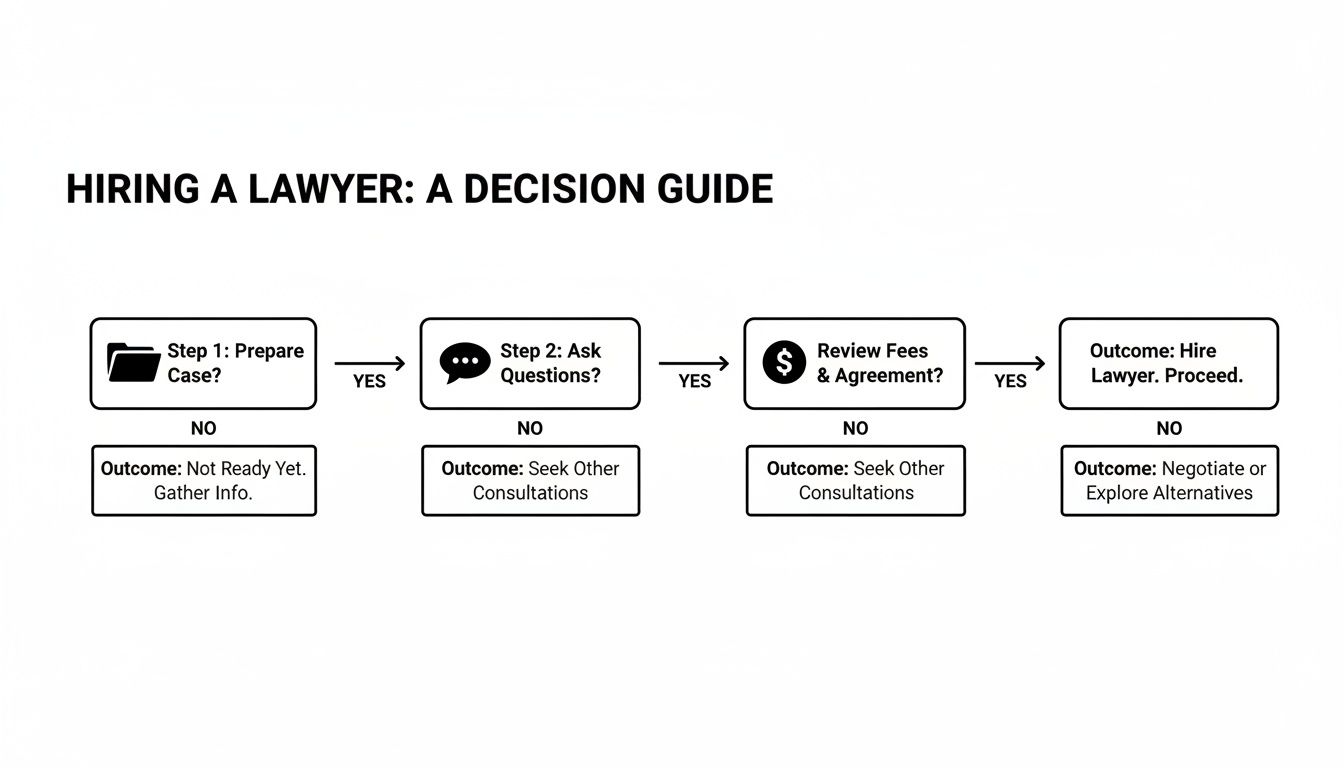
As you can see, the path is clear: gather your facts, know what to ask, and understand the costs before you hire anyone.
What to Do Next: A Checklist
If you believe your child is in immediate danger or you're in a financial crisis, you have to move quickly.
- Gather Proof: Save everything. Screenshot texts, save emails, and download voicemails that prove the emergency.
- Do Not Engage: It's tempting to confront the other parent, but it often makes things worse. Let your attorney handle communication.
- Contact an Attorney: Find a local family lawyer who knows how to handle emergency orders in Montgomery County.
- Be Ready to Act: You might have to appear in court with very little notice. Be prepared to clear your schedule.
Disclaimer: This article provides general information and is not legal advice. The outcome of any legal matter depends on the specific facts and circumstances. You should consult with a qualified custody attorney to discuss your individual situation.
When you're facing an emergency, you need decisive action. If you need immediate help, scheduling a consultation is the best way to get urgent, focused guidance.
Building a Strong Case with Your Attorney

You’ve hired your attorney—a huge step. Now, your role shifts from finding a guide to becoming their most valuable partner. The strength of your case depends on this partnership.
Your custody attorney in Montgomery County, TX, knows the law and strategy. You know the facts of your daily life. Weaving those two parts together is how you build a strong case.
Organizing Your Evidence
Soon after your case is filed, you’ll enter "discovery," the formal process for exchanging information. To get ahead, you need to become organized. Think in three main categories: communication, involvement, and finances.
Start saving important texts and emails. Instead of printing everything, create a digital folder on your computer and organize files by date or topic. Screenshots are your best friend.
Real-World Scenario
I represented a father in The Woodlands who was worried his ex would falsely claim he was never involved with their kids. We had him start a simple digital calendar where he logged every school pickup, doctor's visit, and soccer practice he coached. When the accusation came up in mediation, we presented his detailed log. The argument was immediately shut down and completely changed the negotiation.
Documenting Your Daily Life
The most powerful evidence is a record of your life as it happens now. A simple, fact-based journal is very effective in court.
Focus on noting things like:
- Parenting Time: Keep a log of when you have the children. Factually document when the other parent is significantly late or misses their time.
- Your Involvement: Did you go to the parent-teacher conference? Chaperone a field trip? Take your child to the orthodontist? Write it down.
- Health and Wellness: Make a note of every doctor or dentist visit, including who scheduled and who attended.
This isn't about building a case against the other parent. It's about building a solid case for you by proving you are the stable, consistent, and loving parent the court is looking for.
Drafting a Detailed Parenting Plan
The Standard Possession Order in the Texas Family Code is just a template. Your family is unique, and your final orders should reflect that. Work with your attorney to get ahead of future problems.
Brainstorm specific details you'd want in your final order, like:
- Communication Rules: How and when will you communicate about the kids? Many Montgomery County judges now order parents to use co-parenting apps to keep conversations documented and business-like.
- Travel Rules: How much notice is needed for out-of-state trips? Who holds the child's passport?
- Holiday Specifics: Get specific. Detail the exact schedule for Spring Break, Thanksgiving, and the child’s birthday. The more detail now, the less you'll argue about later.
A proactive parenting plan is one of the best investments you can make. You can see more examples by reviewing information on child custody arrangements and their structures.
What to Do Next: A Checklist
Your partnership with your attorney is active. Here’s how you can be an effective client.
- Start a "Communications" Folder: Create a digital folder for all relevant texts and emails. Name files chronologically (e.g., "2024-05-20 Text from Jane").
- Begin a Parenting Journal: Use a simple calendar or notebook. Stick to objective facts: "Picked up Johnny at 6:05 PM. Scheduled dentist appt for 6/15."
- Outline Your Ideal Parenting Plan: Think about the small details for communication, travel, and holidays that would provide clarity.
- Be Responsive: When your lawyer asks for a document, make it a top priority. Getting them what they need quickly keeps your case moving.
Disclaimer: This article provides general information and is not legal advice. The outcome of any legal matter depends on the specific facts and circumstances. You should consult with a qualified custody attorney to discuss your individual situation.
Building a persuasive case is a team effort. When you’re ready to discuss your situation and start forming a strategy with an experienced local attorney, scheduling a consultation is your next step.
Your Top Questions About Montgomery County Custody Cases, Answered
If you’re like most parents in The Woodlands and Conroe, you have a lot of questions. Getting straight answers, grounded in real-world experience in our local courts, can make a big difference.
Let's walk through some of the most common concerns.
How Long Will This Actually Take?
This is usually the first question people ask. The honest answer is: it depends on the level of conflict.
In a perfect world, an uncontested case where you agree on everything can wrap up in as little as 60 to 90 days. But that requires a full agreement on conservatorship, the possession schedule, and child support.
If you can't agree, you have a contested case, and the timeline stretches out. It’s not uncommon for these cases to take a year or longer to resolve.
What Does "Best Interest of the Child" Really Mean in Court?
You'll hear the phrase “best interest of the child” constantly because it’s the guiding principle for every judge under the Texas Family Code. It’s not a vague concept; it’s a specific checklist of factors a judge must consider.
A judge will look at things like:
- Your child's emotional and physical needs.
- Which parent can provide a more stable home.
- Any evidence of danger, like a history of family violence or substance abuse.
- The child's own preference, if they are 12 years or older.
My job as your attorney is to present a compelling story that shows the judge how your goals support your child’s well-being according to these exact factors.
Is a Big Courtroom Battle Inevitable?
Most parents picture a dramatic trial, but that’s rare. The vast majority of custody cases in Montgomery County are settled before a judge makes a final ruling.
Mediation is a required step in almost every contested case here. It’s a powerful tool where you, the other parent, and your lawyers sit down with a neutral third-party mediator to find a compromise.
Real-World Scenario
I worked with a client from Spring who was deadlocked with her ex over who got the kids for Thanksgiving each year. It seemed small, but it was holding up their entire case. In mediation, the mediator helped them brainstorm a creative schedule they hadn't considered. They signed a binding settlement agreement right there, avoiding the stress and expense of a trial over a single holiday. A trial is the absolute last resort.
What to Do Next: A Checklist
As you move through the process, keep these practical tips in mind.
- Embrace the Court's Pace: The legal system has its own rhythm. Rushing rarely helps. Trust your attorney to guide you.
- Stick to the Facts: Emotion is high, but facts matter in court. When talking to your lawyer, focus on objective details.
- Be Open to Solutions: Don’t dig your heels in just for the sake of it. Being open to solutions in mediation can save you time, money, and heartache.
- Shield Your Children: This is the most important tip. Never use your kids as messengers or bad-mouth the other parent in front of them.
Disclaimer: This article provides general information and is not legal advice. The outcome of any legal matter depends on the specific facts and circumstances. You should consult with a qualified custody attorney to discuss your individual situation.
Navigating a custody case is challenging, but you don't have to do it alone. If you're ready for clear, strategic guidance tailored to the local courts in The Woodlands, Conroe, and across Montgomery County, schedule a consultation with our team today.