
When you learn you have a child custody hearing in Montgomery County, it's easy to feel a knot in your stomach. These are formal court proceedings where a judge will make crucial decisions about your family's future, from parental rights (conservatorship) and visitation schedules to child support. Whether you're in The Woodlands, Conroe, or anywhere else in the county, the process can seem intimidating.
But let's demystify it in plain English.
What Really Happens at a Custody Hearing?
Think of a child custody hearing less as a battle and more as a structured conversation with the judge. The court’s single, guiding mission isn't to pick a "winner" or "loser." Instead, as outlined in the Texas Family Code, every decision is made through the lens of one guiding principle: the best interest of the child.
The judge's job is simply to gather the information needed to create a stable, safe, and supportive life for your child.
To do this, a few key people will be in the room:
- You and Your Co-Parent: You are the main sources of information. You'll provide testimony about your home life, parenting style, and relationship with your child.
- Your Attorneys: If you've hired lawyers, they act as your advocate. They will present your evidence, question witnesses, and make legal arguments to protect your rights and present your case effectively.
- The Judge: As the neutral decision-maker, the judge listens to everyone, reviews all the evidence, and then issues a legally binding court order.
A Look Inside the Courtroom: A Real-World Example
Imagine Sarah, a mother from The Woodlands, preparing for her hearing. She was incredibly nervous, thinking she had to prove she was a "better" parent. Her attorney reframed it for her: the judge just needs to understand her son's daily life.
How does she help with homework? Who takes him to the doctor? How does she support his soccer practice in the local league? By focusing on showing her consistent, positive involvement—rather than just pointing fingers at her ex—Sarah painted a clear picture of a stable, child-focused parent. That's what resonates with a Montgomery County court.
The Key Stages of a Hearing
Navigating the hearing process is much easier when you know what to expect. The following table breaks down the typical phases you'll go through from the moment you step into the courtroom.
Key Stages of a Montgomery County Custody Hearing
| Hearing Stage | What Happens | What You Should Do |
|---|---|---|
| Opening Statements | Attorneys (or you, if self-represented) give the judge a brief overview of the case and what they intend to prove. | Listen carefully. This is the roadmap for the entire hearing. |
| Presenting Evidence & Testimony | The parent who filed the case (the Petitioner) goes first, calling witnesses and presenting documents. The other parent (the Respondent) then gets their turn. | When testifying, speak clearly, stick to the facts, and address the judge as "Your Honor." |
| Cross-Examination | The opposing attorney gets to ask questions of you and your witnesses. | Stay calm and answer truthfully. It’s okay to say "I don't know" or "I don't recall." |
| Closing Arguments | Each side summarizes their evidence and argues why the judge should rule in their favor based on the child's best interest. | This is your attorney's final chance to connect all the dots for the judge. |
| The Judge's Ruling | The judge will either make a decision from the bench or take the case "under advisement" to decide later. | Remain composed regardless of the outcome. The ruling becomes a legally binding order. |
Understanding this flow helps you mentally prepare for each step, reducing anxiety and allowing you to focus on presenting your case.
Getting Your Ducks in a Row
As you prepare, you'll be handling sensitive information. It’s absolutely vital to have open and honest conversations with your lawyer. This is where understanding the attorney-client privilege rules comes into play. This legal protection ensures that what you say to your attorney in confidence stays confidential, allowing you to build the strongest case possible without fear.
At the end of the day, the judge in that Montgomery County courtroom will take everything they've heard and seen to make those life-altering decisions about conservatorship and possession schedules. Your job is to give them the clear, honest information they need.
Disclaimer: This article provides general information and is not legal advice. The law is complex, and you should consult with a qualified family law attorney for guidance on your specific situation.
What To Do Next Checklist
- Gather Your Documents: Start a folder with your child's report cards, medical records, and photos of you with your child.
- Create a Parenting Timeline: Jot down a log of your involvement over the past 6 to 12 months—think school events, doctor visits, and extracurriculars.
- List Your Witnesses: Think about neutral people like teachers, coaches, or family friends who can speak factually about your parenting.
- Audit Your Social Media: Remove any posts, photos, or comments that could be taken out of context and used against you.
If you are facing a custody dispute in Montgomery County, our team can help you understand your rights and options. Schedule a consultation to discuss your case.
Understanding the 'Best Interest of the Child' Standard
If you walk into a child custody hearing in Montgomery County, you're going to hear one phrase over and over: the best interest of the child. This isn't just a guideline. It's the absolute, number one rule that every judge must follow, as required by the Texas Family Code. So, what does this actually mean for you as a parent in The Woodlands or Conroe?
Think of it as the judge’s job to build a complete picture of your child's life. To do this, they use a set of criteria known as the "Holley Factors." These factors, established by the Texas Supreme Court, are like a checklist the judge uses to evaluate each parent's ability to create a healthy, stable environment for their child. Everything from your daily routine to your long-term stability gets measured against this standard.
The Holley Factors in Real Life
Legal lists can be pretty dry. Let's break down what these factors actually look like day-to-day for a Montgomery County family. A judge isn't just looking for a "good parent"—they need to see concrete proof.
Emotional and Physical Needs: Can you provide a safe, loving, and consistent home? This is about showing the court that your child has a stable place to live, whether it’s in Creekside Park or Sterling Ridge, with routines they can count on.
Parental Abilities: This is all about your skills as a caregiver. It’s the proof that you’re on top of things—like attending parent-teacher conferences at a Conroe ISD school, making sure dental appointments are scheduled, and being involved in their day-to-day life.
Stability of the Home: Judges want to see predictability. A steady job, living in the same home for a while in a community like Alden Bridge, and having a consistent daily schedule all signal a secure environment for a child.
Acts or Omissions: This is where the court looks at your behavior, both good and bad. Any actions that could harm the child will be scrutinized. On the flip side, positive things—like working cooperatively with the other parent—carry a lot of weight.
This diagram shows how all the key players fit into this process.
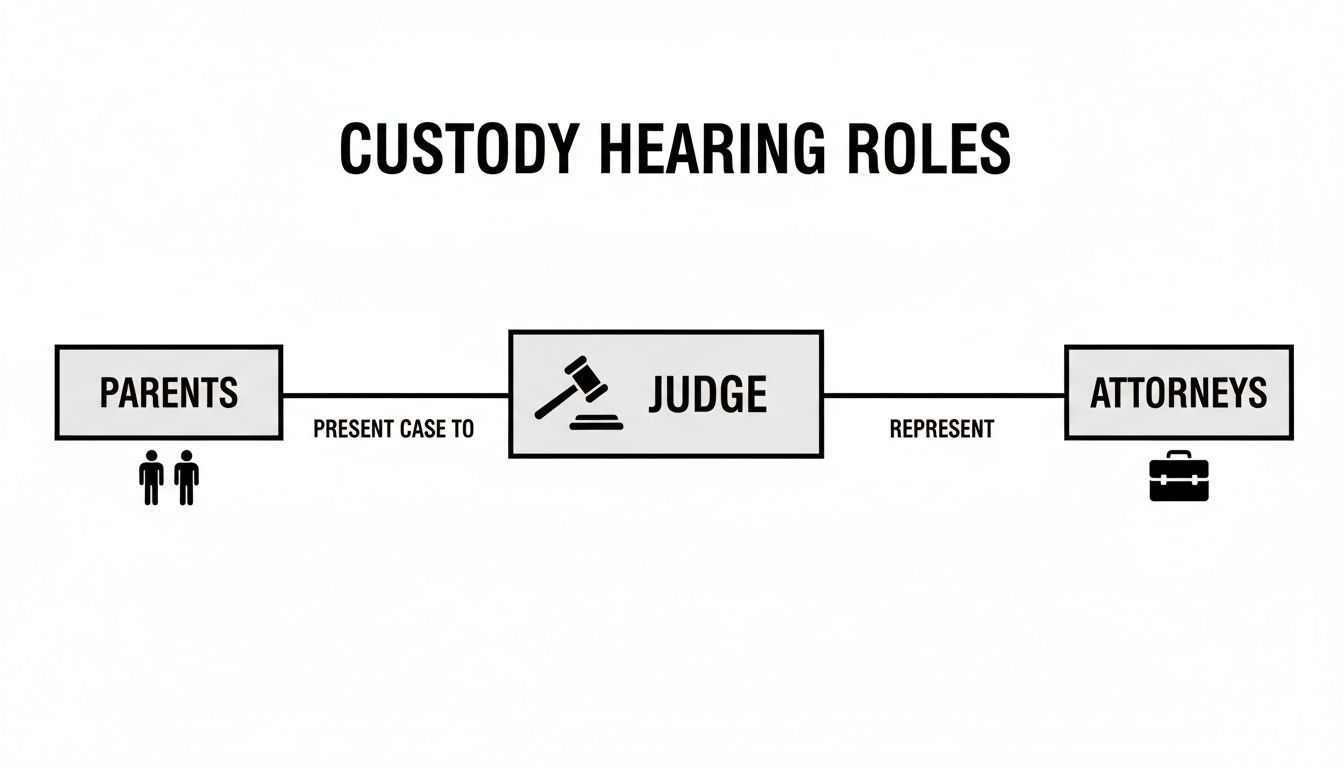
As you can see, the parents present their evidence and arguments, usually through their attorneys. The judge then takes all of that information and makes a final decision based solely on what's best for the child.
The court's primary goal is to piece together a full-360-degree view of the child's world. Every bit of evidence you bring—from school reports to testimony about your morning routine—helps the judge see your role in that world and your fitness as a parent.
How Local Montgomery County Courts View Stability
The specifics of our local courts definitely play a role. The District Courts in Conroe see a huge number of family law cases. Given the explosive growth in areas like The Woodlands, the number of family law filings has gone through the roof. This means judges are more focused than ever on clear, well-presented cases that directly address the child's best interest. It’s crucial to come prepared.
Real-World Scenario: Proving Stability
We once worked with a father, Mark, who lived in Panther Creek. He was concerned because his ex-wife claimed his work hours were too long. Instead of just arguing, we helped him build a case that highlighted his "parental abilities." He put together a calendar showing he never missed a single one of his daughter's softball games, printed out emails showing consistent communication with her teacher, and brought photos of his organized, child-friendly home. This tangible proof directly addressed the Holley Factors and showed the judge, in no uncertain terms, that he was a stable and deeply involved parent.
When you understand how to frame your life and actions through the lens of these legal standards, you’re in a much stronger position. For a more in-depth look at these cases, check out our comprehensive guide on Texas child custody.
What To Do Next Checklist
- Document Your Involvement: Keep a running calendar or journal. Track every school event, doctor's visit, and activity you handle for your child.
- Gather Stability Evidence: Collect documents like pay stubs, your lease or mortgage statement, and photos of your child's room.
- Showcase Co-Parenting: Save texts and emails where you communicate respectfully with the other parent. This demonstrates a key "parental ability."
- List Your Support System: Who in your community can speak to your parenting? Make a list of friends, neighbors, or family members who have seen you in action.
Disclaimer: This article is for informational purposes only and is not legal advice. Family law is complex, and you should consult with an experienced attorney about your specific circumstances.
Preparing for a custody hearing in Montgomery County is about building a case that proves you can meet your child’s needs. If you need help telling your story effectively, our team is here. Schedule a consultation to discuss how we can protect your parental rights.
Navigating Different Types of Custody Hearings
Getting a notice for a court date can be nerve-wracking, especially when your kids are involved. The first thing to figure out is: what kind of hearing is it? A child custody hearing in Montgomery County isn't a one-size-fits-all event. The purpose of your court appearance will change dramatically depending on where you are in the legal process.
Think of it like different stages in a project. Each hearing has a very specific goal, from setting temporary ground rules to making a final, lasting decision. Knowing which one you’re walking into is the key to preparing effectively and focusing on what matters most at that moment.
Temporary Orders Hearings
A Temporary Orders Hearing is often the first, and arguably one of the most critical, hearings you’ll have. The goal here is to put a stable plan in place for your family while the main divorce or custody case moves forward. It's about creating a "new normal" for your children right away.
These hearings are designed to be quick and decisive. The judge's priority is bringing predictability and calm to a child's life during what is often a chaotic time. The court will make temporary rulings on a few core issues:
- Which parent the child will primarily live with.
- A possession schedule (visitation) for the other parent.
- Who pays temporary child support and in what amount.
- Geographic restrictions, which usually require the child to continue living in Montgomery County or a nearby county.
Don't underestimate the importance of these orders. While they aren't permanent, they absolutely set the tone for the rest of the case. If a temporary arrangement is working well for the child, a judge might be hesitant to change it later, making this initial hearing incredibly significant.
Final Trials
The Final Trial is exactly what it sounds like—the main event where a permanent decision is made. Here, the judge listens to all the evidence from both sides to issue a final, legally binding order on conservatorship (custody), possession schedules, and child support.
Unlike a temporary hearing, this is a much deeper and more detailed process. You and your attorney will present your entire case. This involves calling witnesses, submitting documents, and presenting any other evidence that helps prove your position on what is in your child's best interest. Because the outcome is meant to last for years, the stakes are as high as they get.
Real-World Scenario: The Need for Temporary Orders
Imagine Sarah, a mother from The Woodlands, just separated from her partner. They’d verbally agreed their son would split time between their homes, but her ex suddenly starts blocking her from seeing him. The inconsistency is making their son anxious and confused.
Sarah’s attorney immediately files for a Temporary Orders Hearing. In court, she explains how their informal agreement fell apart. The judge, focused on creating immediate stability for the child, issues a temporary order with a clear, enforceable schedule. This ensures Sarah has consistent time with her son while the larger issues of the case are sorted out.
Post-Order Hearings
The legal journey doesn't always stop once the final order is signed. Life happens, circumstances change, and sometimes, one parent doesn't hold up their end of the bargain. That’s when you might find yourself back in court for a different kind of hearing.
- Enforcement Hearings: If a parent is violating the court order—like not paying child support or refusing to follow the possession schedule—the other parent can file an Enforcement action. The point of this hearing is to ask the judge to force the non-compliant parent to follow the rules.
- Modification Hearings: Custody orders can be changed, but you need a very good reason. To modify an order, the Texas Family Code requires you to prove that a "material and substantial change" in circumstances has occurred since the last order was put in place. This could be anything from a parent needing to relocate for a job to a significant shift in a child's needs.
Of course, not every disagreement has to end in a courtroom battle. Many parents find success with alternatives like mediation. You can learn more about how these collaborative approaches work in our guide to divorce mediation in The Woodlands. It's often a more peaceful and cost-effective way to resolve issues.
Disclaimer: This article is for informational purposes only and does not provide legal advice. You should consult with a qualified attorney to discuss the specifics of your case.
What to Do Next Checklist
- Identify Your Hearing Type: Look closely at your court notice. Does it say "Temporary Orders," "Final Trial," or something else? Knowing this tells you how to prepare.
- Clarify Your Goals: What specific outcome do you want from this hearing? Be clear and focused on what's achievable at this stage.
- Gather Relevant Evidence: For a temporary hearing, concentrate on immediate needs. For a final trial, you'll need to build a much more comprehensive case file.
- Consult an Attorney: Talk to a family lawyer about the specific purpose of your hearing. They can help you build a strategy that’s targeted and effective.
Each type of child custody hearing in Montgomery County demands a unique approach. If you have a court date on your calendar and feel unsure about the next steps, scheduling a consultation can provide the clarity and practical guidance you need for your situation.
How to Prepare Your Evidence and Witnesses

When you step into a Montgomery County courtroom for a child custody hearing, what you say is important, but what you can prove is what truly matters. Judges can't just take your word for it; they need concrete proof to make decisions that are in your child’s best interest, which is the guiding principle of the Texas Family Code.
Think of it this way: you’re building a case, brick by brick. Each piece of evidence—every text message, report card, or photograph—is a brick that helps the judge see the full picture of your life as a parent. Your job is to gather these materials and organize them into a solid, convincing structure.
Gathering Your Documents and Records
This is where you put on your detective hat. Start collecting every piece of paper and digital file that supports your position as a stable, loving parent. Judges in Conroe appreciate when a parent comes prepared with an organized, factual presentation.
Focus on documents that speak directly to your child's well-being and your own stability.
- Communication Records: Print out texts and emails with the other parent. The goal is to show a pattern of respectful co-parenting, where you’re working together on schedules, homework, and doctor's visits.
- School and Medical Records: A child's report cards, attendance records, and notes from their doctor are powerful. They show you are an involved parent who stays on top of their health and education.
- Proof of Financial Stability: Pay stubs, bank statements, and even your work schedule can demonstrate that you have a steady income and can provide for your child. Consistency here is key.
- Photos and Videos: Don’t underestimate the power of visuals. Photos of your home, your child’s bedroom, and videos of you two doing everyday activities help the judge visualize your child’s happy life with you.
It's also worth noting that Texas family law isn't static. Keeping current on evolving standards makes having well-organized evidence more crucial than ever. You can discover more insights about recent Texas child custody law updates here.
Choosing Witnesses Who Can Help Your Case
The right witness can be a game-changer. A Montgomery County judge will almost always give more weight to testimony from a neutral, third-party observer than from someone personally invested, like your mom or your new partner.
Look for people who have seen your parenting skills in action:
- Teachers or daycare staff
- Coaches or tutors
- Neighbors or neutral family friends
- A counselor or therapist
You want people who can speak to specific facts, not just give vague compliments. A teacher testifying that you never miss a parent-teacher conference is far more persuasive than a friend simply saying you're a "great parent."
Real-World Scenario: A Witness Makes the Difference
A father in a difficult custody battle in The Woodlands was concerned his ex-wife’s portrayal of him as a workaholic would damage his case. His lawyer brought in the child's soccer coach as a witness. The coach testified that the father hadn't just attended every game but was also the parent who organized team snacks and often gave other kids a ride home. That objective, factual testimony completely dismantled the ex-wife's narrative and proved to the judge how deeply involved the father was in his child's life.
What to Do Next Checklist
- Create an Evidence Binder: Get a simple three-ring binder. Use dividers to sort your documents into logical categories like "Financial," "School," and "Communications."
- Draft a Witness List: Jot down names of potential witnesses. Next to each name, list three specific, positive things they could say about your parenting.
- Connect Evidence to "Best Interest" Factors: For each document, add a small note explaining how it proves one of the Holley Factors (e.g., "Pay stubs prove my ability to provide for the child’s physical needs").
- Review and Organize Communications: Go through all texts and emails. Highlight the positive, collaborative conversations and be ready to provide context for any that seem negative.
Putting together your evidence is a cornerstone of preparing for any hearing, especially in a contested divorce in The Woodlands, TX where custody is on the line. Strong preparation also involves understanding the different types of legal evidence, such as a transcript of deposition, which is the official written record of out-of-court testimony.
Disclaimer: This information is for educational purposes only and is not legal advice. You should consult with an attorney for advice regarding your individual situation.
Building a compelling case for your Montgomery County child custody hearing is all about careful, deliberate preparation. If you feel overwhelmed by the process of gathering evidence and preparing witnesses, schedule a consultation to get help building your strategy.
Navigating the Courthouse and Courtroom Rules

The morning of your child custody hearing in Montgomery County is bound to be stressful. For many, the most nerve-wracking part isn't even the hearing itself—it's the simple act of walking into the Montgomery County Courthouse in Conroe for the first time. Knowing the little things, like where to park, how security works, and how to find your courtroom, can make a world of difference.
But your preparation doesn’t stop at the courthouse steps. How you conduct yourself inside the courtroom is just as critical as any piece of evidence you bring. Courtroom etiquette is a powerful, non-verbal way to show the judge that you respect the legal process. Your demeanor speaks volumes about your character and maturity—two qualities a judge is absolutely looking for when deciding what is in a child’s best interest.
Core Rules of Courtroom Conduct
Think of the courtroom as the most formal setting you can imagine. The judge is in complete control, and showing respect for that authority is not optional. It’s a sign that you’re a responsible adult who can follow rules—a key trait for any parent.
- Address the Judge Correctly: Without fail, always address the judge as "Your Honor." Never use "sir," "ma'am," or the judge's last name.
- Stand When Required: Show respect by standing whenever the judge enters or leaves the room. You should also stand any time you are speaking directly to the judge.
- Dress the Part: Your clothing should be, at minimum, business casual. Treat it like a crucial job interview. This means no jeans, t-shirts with logos, shorts, or anything revealing.
- Never Interrupt: This one is tough, especially when emotions are high. Do not speak when someone else is talking—especially not the judge or the other party's attorney. Wait for your turn, even if you passionately disagree.
Keeping your composure is everything. An outburst, an eye-roll, or a sarcastic sigh can undo months of careful legal preparation and instantly damage your credibility with the judge.
Real-World Scenario: How Demeanor Can Tip the Scales
I once had a case where the facts were fairly balanced. Parent A stayed calm, listened to every word, and answered questions respectfully, always using "Your Honor." Parent B, on the other hand, was a different story—constantly sighing, rolling their eyes when the other parent testified, and even trying to interrupt their own lawyer.
When the judge made the final ruling, they specifically mentioned it. They pointed out that Parent A’s calm and respectful behavior showed the maturity needed for effective co-parenting. That simple observation played a huge part in the final custody orders.
Practical Steps for Your Hearing Day
Your conduct on hearing day starts long before you step foot in the courtroom. Getting the logistics right helps you walk in feeling prepared and focused, not flustered and rushed.
A judge’s perception of you is formed by everything you do and say in their courtroom. Your composure is a silent piece of evidence that can either build up your case or tear it down.
This includes the small stuff. Turn your cell phone off completely—don't just set it to vibrate. Leave your coffee and snacks in the car. Every detail adds to the impression you’re making as a parent who takes this responsibility seriously. While the Texas Family Code gives the judge the legal rules to follow, your actions give them the human context to make their decision.
What to Do Next Checklist
- Do a Dry Run: If you can, visit the Montgomery County Courthouse in Conroe a week before your hearing. Find out where to park and get a feel for the building's layout.
- Plan Your Attire: A few days before your court date, pick out a conservative, professional outfit. Make sure it's clean and ironed.
- Arrive Early: Plan to get to the courthouse at least 30-45 minutes before your hearing is scheduled. This gives you time to park, get through security, and find your courtroom without panicking.
- Review Etiquette Rules: The night before, do a quick mental review of these rules. Remind yourself to breathe, listen carefully, and be respectful, no matter what happens.
Disclaimer: This article provides general information and does not constitute legal advice. You should consult with a qualified family law attorney for guidance on your specific situation.
How you present yourself in a child custody hearing truly matters. If you are preparing for a court date in Montgomery County and want to be sure you are putting your best foot forward, schedule a consultation to discuss your case and strategy.
What Happens After the Judge Makes a Decision
Hearing the judge's decision feels like the finish line, but there’s one critical step left. While that ruling is a huge moment in your Montgomery County child custody case, the work isn’t quite done until those spoken words are translated into a formal, written court order.
Think of the judge's words as the plan; the written order is the legally binding contract that everyone has to follow. Nothing is truly official until that document is drafted, signed by the judge, and filed with the court clerk. It’s this paper that will govern everything from possession schedules to child support.
From Spoken Words to a Legal Document
So, who actually writes this all-important document? Usually, the judge will assign one of the attorneys to draft the final order. Their job is to make sure the written text perfectly captures everything the judge said in court.
This is where you and your attorney need to be laser-focused. You must review every single word of that draft before it’s signed. A simple typo or a poorly worded sentence can create massive headaches and open the door to future conflict. Make sure all dates, pickup times, and responsibilities are exactly as the judge ordered.
Many child custody hearings in Montgomery County also involve setting child support, which follows specific state guidelines. The Texas Family Code provides a formula for this. The official Texas child support calculator can give you a ballpark figure, but Montgomery County judges can adjust the final amount based on a family’s unique needs.
Modifying or Appealing the Order
What if you get the final order and it’s confusing, or you feel the judge made a major legal mistake? If a section is just unclear, you can file a "Motion for Clarification" to ask the court for a more precise explanation.
If you believe there was a significant legal error in the proceedings, you might have the option to appeal. But be warned: appeals are a tough road. They are complex, costly, and can only address errors of law—not just the fact that you disagree with the judge’s decision.
Real-World Scenario: The Importance of Accurate Drafting
A Conroe mother’s final order stated her possession time began "after school on Friday." Her ex-husband insisted this meant 5:00 PM, while she believed it meant the 3:00 PM school bell. That two-hour gray area led to arguments every weekend until they had to spend more time and money going back to court for a clarification—all over a detail that should have been precise from the get-go.
Enforcing and Changing the Order in the Future
Once the ink is dry, both parents are legally bound to follow the order to the letter. If your co-parent doesn't comply, you can file an "Enforcement" action, which asks the judge to step in and enforce the rules.
Of course, life is always changing. If you need to make a permanent change to the custody order down the road, you can't just agree to it informally. You must file a "Modification" lawsuit. The Texas Family Code has a high standard for this, requiring you to prove a "material and substantial change" in circumstances has happened since the last order was made.
What to do next Checklist
- Review the Draft Order: Go over the proposed order with a fine-tooth comb. Read every line with your attorney to confirm it perfectly matches the judge's ruling.
- Clarify Ambiguities Immediately: If any part of the order seems vague, have your attorney request clarification before it becomes a problem.
- Keep a Signed Copy: Get a certified copy of your final order and keep it in a safe, accessible place.
- Document Everything: Keep a detailed calendar or journal to track when exchanges happen and note any issues with compliance. This documentation is crucial if you ever need to enforce or modify the order.
Disclaimer: This guide provides general information for educational purposes and is not a substitute for professional legal advice. Consult a qualified family law attorney about your specific situation.
After a decision is made, ensuring the final order is accurate and enforceable is the final, crucial step. If you are navigating the post-hearing process in Montgomery County and need guidance, schedule a consultation with our team to protect your family’s future.
Your Top Questions About Montgomery County Custody Hearings
When you're preparing for a child custody hearing, the questions can feel overwhelming. I've spent years helping parents in The Woodlands, Conroe, and across Montgomery County, and I've found that the same worries tend to surface. Let's tackle some of the most common questions head-on.
How Should I Dress for Court?
Think of it like the most important job interview of your life. The way you present yourself speaks volumes about how seriously you're taking this. Business casual is the absolute minimum.
Honestly, a suit is even better if you have one. Your goal is to show the judge you respect them, the courtroom, and the gravity of the situation. Steer clear of anything casual—no jeans, t-shirts, shorts, or flashy clothing.
Can My Child Tell the Judge Who They Want to Live With?
This is a huge question, and the answer isn't a simple yes or no. Under the Texas Family Code, once your child is 12 or older, they have the right to talk to the judge privately in their chambers. It’s a chance for them to say who they’d prefer to have as their primary parent.
But here’s the critical part: the judge is not bound by your child’s preference. It's just one piece of a much larger puzzle. The judge’s final decision must be based on the child's overall best interest, and they will weigh the child’s maturity and their reasons against every other piece of evidence presented.
What if My Ex Ignores the Court Order?
It's an incredibly frustrating situation when your co-parent doesn't follow the possession schedule or other parts of the order. The good news is, you have a powerful tool: you can file a "Petition for Enforcement." This brings the issue back in front of the judge.
If the judge finds your ex in contempt of court, they have several options to enforce the order, which can include:
- Ordering them to pay fines.
- Making them pay your attorney’s fees for having to file the enforcement.
- Granting you make-up time with your child.
- In serious or repeat-offender cases, a judge can even order jail time.
Do I Really Need a Lawyer for My Custody Hearing?
Legally, no. You are allowed to represent yourself, which is called going "pro se." But from a practical standpoint, it's highly recommended that you hire an experienced family law attorney.
The reality is that Montgomery County courtrooms have complex rules of evidence and procedure. An attorney who knows the local judges and their tendencies can help you present your case effectively, protect your parental rights, and navigate the complexities of the Texas Family Code. In a contested case, having that expertise on your side can make all the difference.
Disclaimer: This information is for educational purposes only and is not legal advice. The law is complex, and the outcome of any case depends on its specific facts. You should consult with a qualified attorney for advice regarding your individual situation.
Facing a child custody hearing in Montgomery County is a serious challenge, but you don't have to go through it alone. At The Law Office of Bryan Fagan, our team is committed to helping parents in The Woodlands protect their children and their rights. If you're dealing with a custody dispute, schedule a consultation with us to talk about your case and start building a solid strategy.