
Facing a divorce in The Woodlands can bring a wave of financial uncertainty, making spousal support a top concern for many. An alimony lawyer in The Woodlands, Texas, can be your guide through this complex process, helping you understand your rights whether you're looking at court-ordered payments or a private agreement. It's important to know from the start that Texas law views this support as a temporary financial bridge—not a permanent source of income. Knowing the rules is the first step toward securing your future.
Understanding Your Rights to Spousal Support in The Woodlands
When a marriage ends, one of the biggest worries is almost always financial stability. How will I pay the mortgage? Can I afford the bills on my own? For many people right here in Montgomery County, from Creekside Park to Sterling Ridge, these questions are front and center.
Texas law provides for two very different types of post-divorce financial support. It’s critical to understand the distinction between them, as laid out in the Texas Family Code.

Court-Ordered Spousal Maintenance
The first type is spousal maintenance, which a judge can order in a divorce decree. Think of this as a structured, temporary safety net. The Texas Family Code lays out very strict rules for who qualifies, how much they can receive, and for how long. It's designed to be rehabilitative, giving a spouse who earns less a short period to get the skills or education needed to support themselves.
Privately Negotiated Contractual Alimony
The second type is contractual alimony. This isn't something a judge orders but rather a private agreement negotiated between you and your spouse as part of your overall divorce settlement. Unlike court-ordered maintenance, contractual alimony is all about flexibility. You and your spouse can agree to terms that a judge simply doesn't have the authority to impose, like longer payment periods or different payment amounts.
To make the differences clearer, let's compare the two side-by-side.
Spousal Maintenance vs. Contractual Alimony in Texas
| Feature | Court-Ordered Spousal Maintenance | Contractual Alimony |
|---|---|---|
| Source | Ordered by a judge under the Texas Family Code. | Privately negotiated between spouses in a contract. |
| Eligibility | Strict legal requirements must be met (e.g., marriage duration, lack of earning ability). | No legal requirements; based entirely on what spouses agree to. |
| Flexibility | Very little. Amount and duration are capped by state law. | Highly flexible. Can be structured in any way the parties agree. |
| Enforcement | Enforceable by the court through contempt actions (including jail time). | Enforced like any other contract; you sue for breach of contract. |
| Modification | Can be modified or terminated by the court if circumstances change. | Generally cannot be modified by a court unless the contract allows it. |
| Purpose | To provide for "minimum reasonable needs" on a temporary basis. | Can be used for any purpose, such as property equalization or long-term support. |
As you can see, contractual alimony offers more freedom, but court-ordered maintenance provides a stronger enforcement mechanism if payments are missed. The right path depends entirely on your specific circumstances in The Woodlands.
A Real-World Scenario
Imagine a wife in Panther Creek who has been a homemaker for 18 years, raising the kids while her husband built a successful career in the oil and gas industry. They decide to divorce. She has no recent work history and is terrified about how she'll support herself in The Woodlands. Because they've been married longer than 10 years and she currently lacks the ability to support her "minimum reasonable needs," she is eligible to ask the court for spousal maintenance. An experienced alimony lawyer becomes essential to navigate the Texas Family Code and fight for a fair outcome.
What to do next
If you're facing a divorce and have questions about financial support, here are the first steps you should take:
- Gather Financial Documents: Start collecting recent pay stubs, tax returns, and bank statements for both you and your spouse.
- Create a Budget: Detail your estimated monthly expenses to establish your "minimum reasonable needs," a key legal term.
- Document Your Marriage History: Note your marriage date and any contributions you made as a homemaker or caregiver that allowed your spouse to advance their career.
- Consult an Attorney: Talk to a lawyer who knows the Montgomery County courts before making any agreements.
Disclaimer: This article provides general information and is not legal advice. The law is complex and changes frequently. For advice specific to your situation, you must consult with a licensed attorney.
Divorce and the financial decisions that come with it are deeply personal and require careful planning. An experienced local attorney can help you understand all your options and fight for a fair outcome. If you're ready to discuss your case, the next step is to schedule a consultation.
Getting Spousal Support in a Montgomery County Divorce
In Texas, spousal maintenance (what many people call alimony) isn't a given. Our state laws are some of the strictest in the country. A judge in Conroe isn't just going to grant support because you asked. The law views it as a temporary safety net, meant to help a spouse get back on their feet in very specific situations.
Before a Montgomery County court will even consider the request, you have to prove you are eligible.
The 10-Year Marriage Rule
The most common path to eligibility starts with the length of your marriage. If your marriage lasted a decade or longer, the door to spousal maintenance is at least unlocked.
But just being married for ten years isn't enough. You also have to prove that you don't have enough property—including your own separate property—to cover your "minimum reasonable needs" after the divorce. This is where things get subjective, and where having a seasoned attorney really matters.
The Texas Family Code doesn't provide a neat checklist for "minimum reasonable needs." A judge decides based on the evidence. Generally, it's the basics you need to live a modest, stable life in your community, like:
- Housing: Reasonable rent or mortgage in a neighborhood like Creekside Park or Cochran's Crossing.
- Utilities: Lights, water, and gas.
- Transportation: A car payment, insurance, and gas.
- Food and Clothing: The everyday cost of groceries and necessities.
- Healthcare: Insurance premiums and expected medical costs.
Your job, with your lawyer's help, is to build a detailed budget that paints a clear, honest picture of your expenses.
Other Ways to Qualify
What if you haven't been married for 10 years? The Texas Family Code recognizes a few other specific situations where maintenance might be awarded, usually involving significant personal hardship.
A judge may award spousal maintenance if the spouse seeking support is unable to earn a sufficient income because of an incapacitating physical or mental disability. This applies regardless of the marriage duration.
Another key exception is for spouses who are caring for a child of the marriage—of any age—who has a physical or mental disability. If that child requires substantial care that prevents you from holding a job, the court can award maintenance.
The Family Violence Exception
The law also provides a crucial exception for victims of domestic violence. You may be eligible for spousal maintenance, regardless of marriage length, if your spouse was convicted of (or received deferred adjudication for) an act of family violence.
The act must have been committed against you or your child within two years before filing for divorce or while the divorce is pending. You'll need to provide certified court records, which an attorney can help you secure. This protection is a critical part of the Texas Family Code but is not automatic.
These strict rules may contribute to revealing Texas divorce statistics, which show our state has a lower divorce rate than many others. In a state with tight alimony laws, making a compelling, evidence-backed case is more important than ever.
What to do next
If any of this sounds like your situation, your next steps are all about preparation:
- Confirm Your Marriage Date: Nail down the exact length of your marriage. The 10-year mark is often the starting line.
- Document Your Financial Needs: Start building a detailed monthly budget. Every expense needs to be accounted for.
- Assess Your Earning Capacity: Be honest about your ability to work. What's your education, work history, and what’s holding you back from earning a living wage?
- Consult a Lawyer: Talk to an alimony lawyer in The Woodlands, Texas, who knows the Montgomery County courts and can give you a realistic assessment.
Disclaimer: This article provides general information and is not legal advice. The law is complex and changes frequently. For advice specific to your situation, you must consult with a licensed attorney.
Qualifying for spousal maintenance hinges on the specific facts of your case and a deep understanding of the Texas Family Code. If you're worried about your financial stability, being proactive is the best thing you can do. The next step is to schedule a confidential consultation.
How Texas Courts Calculate Support Payments and Duration
Once a Montgomery County judge agrees you’re eligible for spousal maintenance, the next question is: how much, and for how long? The system is less about a gut feeling of "fairness" and more about strict rules.
A Texas judge doesn't just pick a number out of thin air. They work within a rigid framework laid out in the Texas Family Code. This law puts a firm cap on both the monthly payment amount and how long those payments can last.
The Statutory Caps on Payment Amounts
When it comes to the dollar amount, Texas law is very direct. A judge can't order maintenance payments that are more than the lesser of two specific figures:
- $5,000 per month, or
- 20% of the paying spouse's average monthly gross income.
Let's break that down. Even if your spouse is a high-earner, the absolute maximum a court can order is $5,000 a month. More often, the 20% rule dictates the final number.
"Gross income" includes just about everything: salary, commissions, bonuses, overtime pay, interest, dividends, and even retirement benefits. In the high-asset divorce in The Woodlands cases we often see, just pinning down the total gross income can be a massive challenge.
The infographic below shows some of the initial factors a court looks at to even get to the calculation stage.
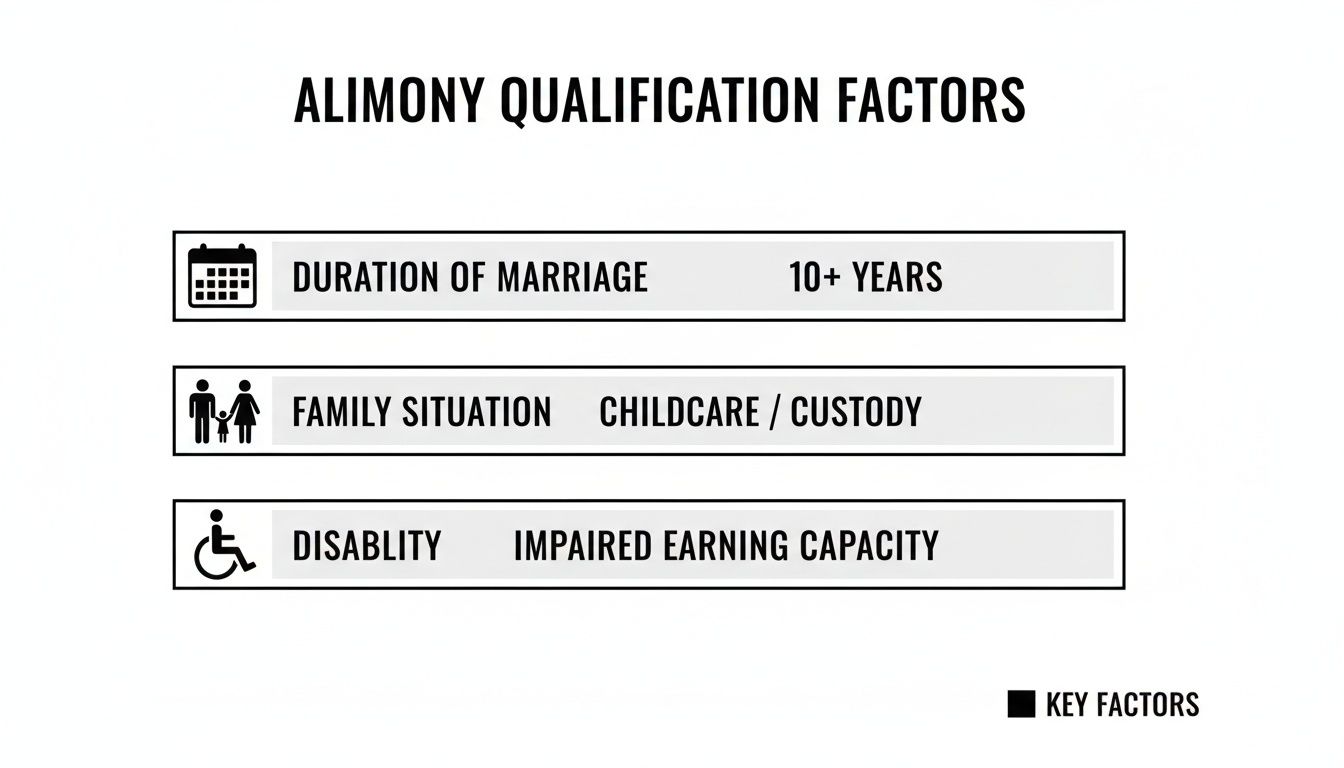
As you can see, eligibility itself is tied to very specific circumstances, which then influences how a judge approaches the amount and duration of support.
The Limits on Payment Duration
Just as the law caps the payment amount, it also puts a time limit on how long you can receive it. The maximum duration is tied directly to how long you were married. The core idea is that spousal maintenance in Texas is meant to be rehabilitative—a temporary bridge to help a spouse get the training or education they need to become financially independent.
Here’s a quick guide to the maximum timeframes a judge can order, based on the length of your marriage.
Texas Spousal Maintenance Duration Limits
The Texas Family Code sets clear maximums for how long spousal maintenance can be paid. This table outlines those limits.
| Length of Marriage | Maximum Duration of Maintenance |
|---|---|
| 10 up to 20 years | 5 years |
| 20 up to 30 years | 7 years |
| 30 years or more | 10 years |
It's important to remember that a judge can grant maintenance for a shorter period, but not longer than these statutory caps, unless specific circumstances like a qualifying disability or family violence are involved.
A Real-World Scenario
Let’s imagine a couple in The Woodlands divorcing after a 22-year marriage. The husband's average monthly gross income is $15,000. The wife has been a stay-at-home parent and qualifies for maintenance. Here’s how the math could work:
- Maximum Payment: 20% of $15,000 is $3,000. Since this is less than the $5,000 cap, the maximum she could receive is $3,000 per month.
- Maximum Duration: Because they were married for 22 years, the payments can last for a maximum of 7 years under the Texas Family Code.
The judge will then look at other factors—like her budget and work history—to decide the final amount and duration within those legal limits.
What to do next
If you are facing a spousal support calculation, here are your next steps:
- Calculate Gross Income: Gather all documents showing income for both spouses (pay stubs, tax returns, bonus statements).
- Determine Marriage Length: Confirm the exact number of years you were married to identify the correct duration cap.
- Prepare Your Budget: A detailed budget of your monthly needs is critical for the judge’s final decision.
- Speak with an Attorney: An alimony lawyer can help you accurately calculate potential outcomes and build the strongest case.
Disclaimer: This article provides general information and is not legal advice. The law is complex and changes frequently. For advice specific to your situation, you must consult with a licensed attorney.
The Texas spousal support system is structured and unforgiving. Building a solid, evidence-backed case is the only way to seek a fair result.
Navigating the Legal Process for Spousal Support
Knowing your rights is the first big step. The next is figuring out how to navigate the legal system to get there. Whether you're asking for support or needing to change an order, the process follows a clear path—one an experienced alimony lawyer in The Woodlands, Texas, knows well.

It all officially starts by filing a formal request with the court, usually as part of the initial divorce petition. This requires specific legal language and solid evidence to back up your claim from the beginning.
Initiating and Negotiating Support
The first phase is all about preparation and negotiation. Once the paperwork is filed, both you and your spouse enter the "discovery" phase. This is where you formally exchange all crucial financial information—bank statements, tax returns, pay stubs, and documentation of assets and debts.
Here in Montgomery County, many spousal support cases are resolved without ever seeing a courtroom. This often happens through mediation, a structured negotiation where a neutral professional helps you find common ground. A successful mediation can save time, money, and emotional strain.
But going into these talks alone can be a huge risk, especially in a contested divorce in The Woodlands where emotions are already high.
Enforcement and Modification After the Order
Once a judge signs a spousal maintenance order, it has the full force of law. But what happens if your ex stops paying? Or if your own financial situation changes?
If payments stop, you can file a Motion for Enforcement. This asks the judge to force your ex-spouse to pay up. Under the Texas Family Code, courts have serious tools for this, including wage garnishment or even finding the non-paying spouse in contempt of court, which can lead to fines or jail time.
On the other hand, if there has been a "material and substantial change" in the circumstances of either spouse, you can file a Motion to Modify to ask the court to change or end the payments.
A Real-World Scenario
Mark, an engineer in The Woodlands, was ordered to pay his ex-wife $2,000 per month in spousal maintenance. Two years later, his company has massive layoffs, and he loses his job. He can’t make the payments. His attorney immediately files a Motion to Modify, showing proof of his job loss. The Montgomery County court agrees his unemployment is a material and substantial change and temporarily reduces his obligation while he gets back on his feet. This is a perfect example of why these orders aren't always set in stone.
What to do next
Facing the legal system can feel overwhelming, but breaking it down into clear tasks makes all the difference. Here’s a practical checklist:
- Organize Your Financials: Gather at least two years of financial records: tax returns, bank statements, and investment summaries.
- Create a Detailed Budget: Document every single monthly expense to clearly demonstrate your "minimum reasonable needs."
- Document Any Changes: If modifying an order, keep a detailed log of what changed (a job loss, promotion, medical issue) and when it happened.
- Consult a Local Lawyer: Don't go it alone. Get advice from an alimony lawyer who knows the ins and outs of the Montgomery County courts.
Disclaimer: This article provides general information and is not legal advice. The law is complex and changes frequently. For advice specific to your situation, you must consult with a licensed attorney.
The legal process for spousal support is detailed and unforgiving. Protecting your financial future means being prepared. If you're ready to explore your options, our team is here to help you understand the path forward.
Why an Experienced Woodlands Alimony Lawyer Is Essential
The Texas Family Code lays out the rules for spousal maintenance, but it doesn’t give you a formula for winning your case. The law is filled with terms open to interpretation, like **”minimum reasonable needs”** and **”good faith efforts.”** This leaves a lot of room for a judge to decide.The strength of your case—whether you’re asking for support or being asked to pay it—boils down to how well you argue the facts.
Trying to navigate an alimony claim on your own in Montgomery County is a huge risk. The legal standards are high and the deadlines are firm. This is where having an experienced alimony lawyer in The Woodlands, Texas, on your side makes all the difference.
Protecting Your Rights in a Complex System
A good attorney does more than just fill out forms. They build a solid case based on the details of your marriage and finances. Their role is critical in a few key areas:
- Proving Eligibility: They know what evidence is needed to prove you meet the strict 10-year marriage requirement or qualify under an exception.
- Defining "Minimum Reasonable Needs": They help translate your monthly bills into a detailed, defensible budget that shows a judge why you need support.
- Uncovering Hidden Income: In the high-asset divorces we often see in The Woodlands, an attorney can use discovery tools like depositions and subpoenas to make sure every source of income—from bonuses to stock options—is on the table.
Without a professional advocate, it's easy to miss crucial evidence or get pushed into an unfair settlement.
Navigating the Nuances of Montgomery County Courts
Every courthouse has its own local culture. A lawyer who practices regularly in the Montgomery County family courts knows the local judges and how they tend to rule on spousal maintenance. That on-the-ground insight is priceless when you're deciding whether to settle or go to trial.
This local knowledge is especially important for residents in communities like Alden Bridge or Panther Creek who may be facing a "gray divorce." A divorce after 50 presents unique financial puzzles involving complex retirement funds and a real need for support, requiring a lawyer who knows how to protect a lifetime of hard work.
A Real-World Scenario
Take Sarah, who was facing divorce after a 25-year marriage in The Woodlands. Her husband offered what looked like a generous lump-sum payment to avoid alimony. She was tempted to accept it. Fortunately, her lawyer ran the numbers. He showed her that the one-time offer was significantly less than what she was likely to receive over the seven-year period she was eligible for court-ordered maintenance. Armed with this analysis, her lawyer negotiated a much better contractual alimony agreement that gave her true long-term financial security.
What to do next
Finding the right legal partner is the most important decision you'll make. Here’s a quick checklist to get started:
- Research Local Lawyers: Focus on attorneys who specialize in family law right here in Montgomery County.
- Ask About Their Experience: During your consultation, ask specifically about their track record with spousal maintenance cases.
- Clarify Their Strategy: A good lawyer should outline a potential game plan for your case. Learn more by checking out our guide on finding the right divorce lawyer for your needs in The Woodlands.
- Understand the Fees: Make sure you're clear on how their billing works before you sign anything.
Disclaimer: This article provides general information and is not legal advice. The law is complex and changes frequently. For advice specific to your situation, you must consult with a licensed attorney.
Your financial future is too important to leave to chance. If you are dealing with a spousal support issue, we provide the focused, experienced representation you need. To take the next step, schedule a consultation with our team.
Common Questions About Spousal Support in Texas
When you're looking at divorce in The Woodlands, money is often the biggest source of stress. Spousal support comes with a lot of questions and misconceptions. We hear these same concerns from clients across Montgomery County every day.
Can I Still Get Alimony If I Was at Fault for the Divorce?
Yes, you might still qualify for spousal maintenance even if your actions contributed to the divorce. A judge in a Montgomery County court can consider something like adultery when dividing your property. However, under the Texas Family Code, it won't automatically bar you from receiving support if you meet the strict eligibility rules.
The real impact of "fault" often comes down to the judge's discretion on the amount and duration of payments. This is where an experienced alimony lawyer in The Woodlands, Texas, is crucial to frame your situation in the best possible light.
Do Bonuses and Retirement Accounts Count as Income?
Yes, they almost always do. The Texas Family Code uses a very wide net to define “gross income” for maintenance calculations. It’s not just base salary. It includes wages, commissions, bonuses, overtime, interest from investments, and even payouts from retirement accounts.
In the high-asset divorces we often see in The Woodlands, tracking down every income source is non-negotiable. A good attorney uses formal legal discovery to get a complete and truthful financial picture for the court.
A Real-World Scenario
Imagine a woman in Sterling Ridge files for divorce after a 15-year marriage. To show she can't meet her "minimum reasonable needs," her lawyer helps her build a detailed monthly budget. Her mortgage, car payment, utilities, and insurance add up to $4,500. Her part-time job only brings in $2,000. That clear $2,500 shortfall, backed up by bills and bank statements, becomes the foundation of her request for spousal maintenance.
What Happens to My Payments If I Remarry?
For court-ordered spousal maintenance, the rules are black and white: the payments stop if the receiving spouse remarries. The Texas Family Code also states the obligation ends automatically if you start living with a new romantic partner in a marriage-like relationship. Of course, payments also cease if either you or your ex-spouse passes away.
This is a mandatory part of Texas law for any maintenance ordered by a judge. The only way around it is through a private agreement called "contractual alimony," which can be structured with more flexible termination rules.
What to do next
If these questions are hitting close to home, it’s time to get organized. Here’s a practical checklist:
- Build Your Budget: Start a spreadsheet of all your essential monthly living costs. This is your proof of need.
- Gather Income Documents: Collect pay stubs, tax returns, and bonus statements for both you and your spouse if you have them.
- Note the Key Facts: Write down a timeline of important events, especially anything related to fault grounds or a new living situation.
- Talk to a Lawyer: The most important step is to sit down with an attorney to see how these laws apply to your specific life.
Disclaimer: This article provides general information and is not legal advice. The law is complex and changes frequently. For advice specific to your situation, you must consult with a licensed attorney.
The answers to your spousal support questions are completely tied to the unique facts of your life and marriage. We provide the focused, experienced guidance you need to protect your financial future. If you’re ready to discuss your case in The Woodlands, schedule a consultation with our team today.