
When parents in The Woodlands hear "50/50 custody," they often picture a perfect, even split of their child’s time. While this is a common goal, it’s important to understand this is not the default arrangement in Texas. Montgomery County courts start with a different framework that separates a parent's decision-making authority from their physical time with the child.
This guide uses plain English to explain what 50/50 custody means in our community, what a judge looks for, and what practical steps you can take next.
Understanding 50/50 Custody in The Woodlands, Texas

In a Texas custody case, the first concept to grasp is the difference between your rights and your time. The Texas Family Code presumes it’s best for the child to name both parents Joint Managing Conservators. This is the legal "custody" part, and it gives both parents shared rights and duties to make key decisions.
Think of it like being co-CEOs of your child's life. It means you both have the authority to make important decisions about:
- Education: Where your child goes to school.
- Healthcare: Choosing doctors and approving non-emergency medical care.
- Psychological Needs: Agreeing on counseling or therapy.
- Religious Upbringing: Deciding on your child’s religious life.
But here’s the key point: being joint decision-makers does not automatically mean you get a 50/50 possession schedule. The schedule, which outlines the physical time the child spends with each parent, is a separate issue.
The "Best Interest of the Child" Standard
Every decision a Texas judge makes is filtered through one guiding principle: the "best interest of the child," as outlined in the Texas Family Code. A court won’t approve a 50/50 schedule just because it seems "fair" to the parents. The judge must be convinced that an equal time-sharing plan genuinely serves the child’s needs for stability and well-being.
Real-World Scenario: Fairness vs. Stability
Let's consider a real-world scenario. Sarah and Tom, who both live in The Woodlands, agreed to be Joint Managing Conservators for their 8-year-old son. Tom pushed for a week-on, week-off 50/50 schedule, arguing, "It's only fair that we each get equal time."
However, Sarah was able to show the Montgomery County court that their son was struggling with the constant back-and-forth. Additionally, Tom's demanding work schedule meant the child was often with a babysitter during his weeks. The judge denied the 50/50 request, opting for a schedule that gave the child a more stable home base during the school week. This case shows how fairness to the parents takes a backseat to the child's well-being. You can explore how judges weigh these factors in our guide on child custody arrangements in Texas.
What to Do Next: A Checklist
If you are aiming for a 50/50 custody schedule in The Woodlands, you need to build a case for it.
- Check Your Proximity: How close do you and the other parent live? Can you realistically manage school runs and activities from both homes without chaos?
- Assess Your Co-Parenting Relationship: Can you communicate respectfully? A 50/50 plan requires constant coordination, and high-conflict relationships can make it unworkable.
- Document Your Involvement: Gather proof of your active role in your child's life, like emails with teachers or logs of doctor's appointments you attended.
- Talk to a Local Attorney: Get advice from an attorney who knows the tendencies of judges in Montgomery County. You need a strategy tailored to your situation.
Disclaimer: This article provides general information and is not legal advice. The law is complex and changes frequently. For advice on your specific situation, you should consult with a qualified attorney.
How Montgomery County Courts View 50/50 Custody Requests
If you’re asking a Montgomery County court for 50/50 custody, you need to know that judges don't just split the days down the middle. Their entire decision is guided by a single principle from the Texas Family Code: the best interest of the child.
For parents in The Woodlands, Spring, or Conroe, this means a judge will look past your desire for "equal" time and analyze how a 50/50 plan will actually work in your child's daily life.
Key Factors a Judge Considers
A judge's decision comes down to a few practical, real-world factors. They need to be convinced your proposed schedule will truly benefit your child.
- Can You Co-Parent Effectively? This is huge. How well do you and the other parent communicate? A true 50/50 schedule requires teamwork on homework, doctor's visits, and weekend plans. If every text message turns into a fight, a judge will hesitate to approve a schedule that forces that much interaction.
- Geographic Proximity. For families in our area, this is critical. Do you both live close enough to make the school run work? No judge will approve a plan that has a child spending hours in the car or being rezoned to a different school in Conroe ISD or Tomball ISD.
- History of Involvement. A judge will want to know who has historically been the primary caregiver. This isn't about gender; it's about actions. Who handled school paperwork? Who went to parent-teacher conferences? Who took the child to the doctor? A parent who was less involved before the separation and is now suddenly demanding equal time faces an uphill battle.
A Montgomery County judge will almost always choose a stable, predictable routine for a child over a schedule that is mathematically equal but practically disruptive.
Real-World Scenario: A Father's Push for Equal Time
Let's look at a common situation. Mark lives in the Alden Bridge village of The Woodlands. His ex-wife, Jessica, lives a few miles away in Sterling Ridge. Mark is asking for a week-on, week-off schedule with their 10-year-old daughter, arguing it’s only fair.
In court, however, Jessica shows the judge that Mark's job requires frequent travel, often leaving their daughter with his new partner. She also has records showing Mark missed most parent-teacher conferences that year. The judge, while seeing that Mark is a loving dad, recognizes that his schedule is less predictable. The court orders a possession schedule making Jessica the primary parent to give the child a consistent routine during the school week, ruling that this stability was in the child's best interest. You can learn more about the statistical realities and the chances of a father getting 50/50 custody here.
The Gap Between Rights and Your Schedule
The law can feel contradictory. The Texas Family Code presumes both parents should be named Joint Managing Conservators, sharing the right to make major decisions.
However, sharing decision-making power does not automatically mean you get equal physical time. The reality is that even when parents are joint conservators, the primary parent often has the child for a larger percentage of the time. This gap exists because courts see the right to make decisions as separate from the day-to-day schedule. That schedule is based purely on the child's best interest, as defined in Texas Family Code Section 153.002.
What to Do Next: A Checklist
If you are serious about pursuing a 50/50 schedule, you need to build your case now.
- Be Honest About Co-Parenting: Can you truly collaborate without conflict? If not, work on improving communication before going to court.
- Map Out the Logistics: Don't just talk about a 50/50 plan—show it. Create a detailed mock calendar with school drop-offs and exchange times to prove it's practical.
- Gather Your Proof: Start collecting emails, texts, and school communications that show you are a consistently involved parent.
- Consider Your Child's Age: A week-on, week-off schedule might be great for a teenager but overwhelming for a toddler. Tailor your request to what your child can handle.
Disclaimer: This article provides general information and is not legal advice. The law is complex and changes frequently. For advice on your specific situation, you should consult with a qualified attorney.
The Texas Standard Possession Order Explained
If you're aiming for 50/50 custody in The Woodlands, you first have to understand the court's default plan. When parents can't agree on a schedule, a Montgomery County judge will almost always implement the Texas Standard Possession Order (SPO).
The SPO is the legal blueprint for child custody in Texas. It’s a predictable schedule found in the Texas Family Code, designed to give children stability while minimizing parental conflict.
What Does the Standard Order Look Like?
The SPO creates two roles: a primary parent (whose home is the child's main residence) and a non-primary parent. The non-primary parent’s time is clearly defined.
It typically includes:
- Possession on the first, third, and fifth weekends of a month.
- Alternating major holidays like Thanksgiving and Christmas each year.
- A 30-day block of time during the summer.
This schedule is the default because it's consistent and doesn't require constant court intervention. It sets clear expectations for everyone.
Why the SPO Is Not a 50/50 Schedule
The Standard Possession Order does not create a 50/50 split. When you do the math, the SPO usually results in a 60/40 or even 65/35 division of time, with the primary parent having the child for most of the year.
The SPO is deeply ingrained in the Texas family court system. Because it is predictable and easy for courts to manage, it remains the default unless you can convince a judge that a different plan is better for your child. For a deeper dive, you can learn about custody arrangements in Texas.
Real-World Scenario: A Father's Experience with the SPO
Imagine a dad living in the Panther Creek village of The Woodlands. He and his ex-wife couldn't agree on a schedule. He pushed for 50/50, but she insisted on being the primary parent. Seeing the deadlock, the Montgomery County judge defaulted to the Standard Possession Order.
Now, this father gets his kids on the first, third, and fifth weekends. While he treasures that time, he quickly feels the sting of missing the weekday routine—homework, soccer practices, and just being present for small, everyday moments. His reality under the SPO becomes the baseline he must argue against to get more time.
The Standard Possession Order is legally presumed to be in the child's best interest. To win a 50/50 schedule, you must prove your proposed schedule is even better for your child.
What to Do Next: A Checklist
Understanding the SPO is your first strategic move. It's the standard you must prove your 50/50 proposal can beat.
- Map Out the SPO Calendar: Get a calendar and plot out an entire year under the SPO. Count the overnights to see the time disparity you are fighting.
- Pinpoint the SPO's Flaws for Your Child: Does the exchange schedule interfere with their activities or your work? Identify the specific problems it causes for your family.
- Create a Side-by-Side Comparison: Draft your ideal 50/50 schedule and put it next to the SPO calendar. Show how your plan provides more stability and fosters a stronger parent-child bond.
- Gather Your Proof: Start collecting documents, emails, and calendars that support your argument that an equal schedule serves your child better.
Disclaimer: This article provides general information and is not legal advice. The law is complex and changes frequently. For advice on your specific situation, you should consult with a qualified attorney.
Common 50/50 Custody Schedules for The Woodlands Families
So, you’ve decided a 50/50 custody arrangement is right for your family. Now comes the practical part: what does an equal possession schedule actually look like?
For families in The Woodlands and across Montgomery County, several common schedules provide a framework for a balanced split. The Texas Family Code gives you the flexibility to choose a schedule that fits your unique situation. The key is finding a rhythm that puts your child’s needs first.
This chart helps visualize the shift from a traditional, unbalanced schedule toward an equal, optimized one.
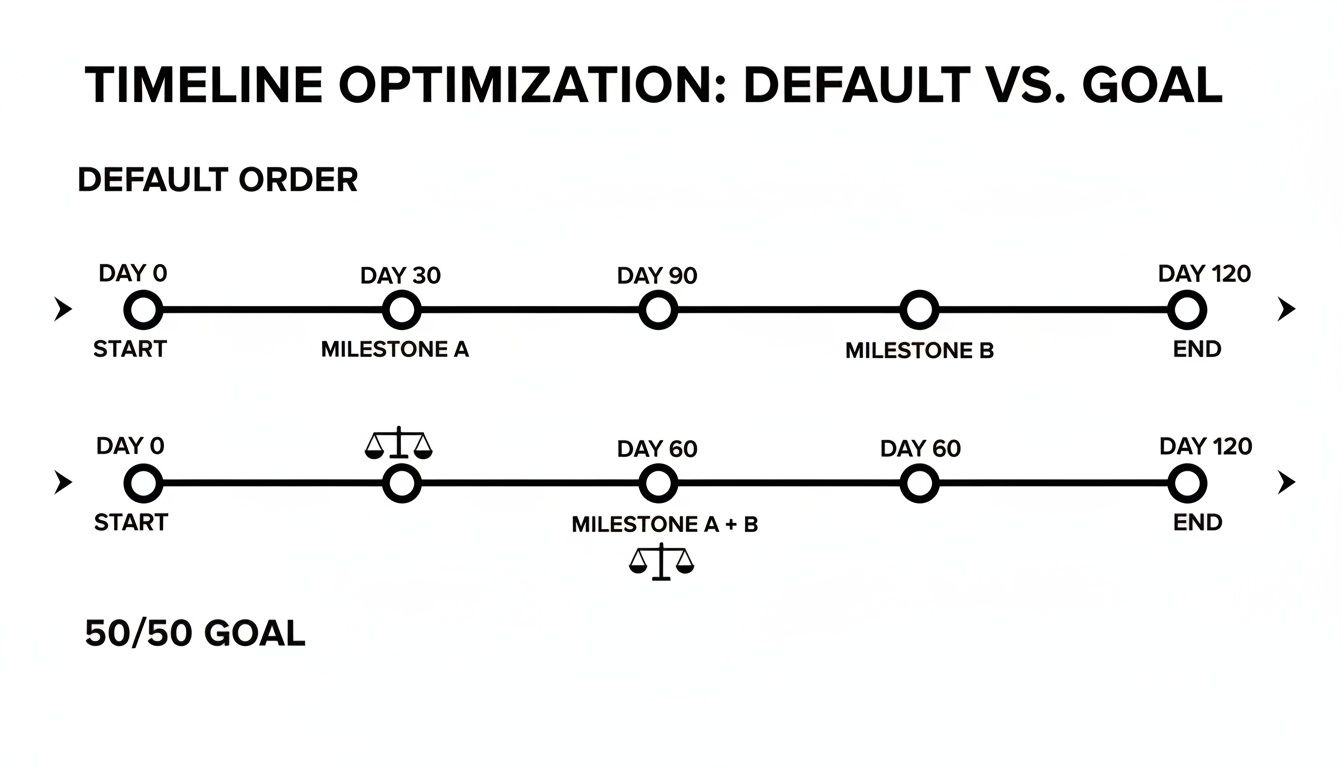
A true 50/50 schedule is all about getting as close to an equal distribution of time as possible.
The Week-On/Week-Off Schedule
The Week-On/Week-Off schedule is the most straightforward 50/50 arrangement. Your child spends one complete week with you and the next with their other parent. Exchanges usually happen on a consistent day, like a Sunday evening.
This schedule often works well for older kids and teenagers who are more independent. It also minimizes handoffs, which means less logistical hassle and fewer opportunities for conflict, especially if you live in different parts of The Woodlands, like Creekside Park and Alden Bridge. The downside is that a full week can feel long for younger children.
The 2-2-5-5 Schedule
The 2-2-5-5 schedule offers more weekly consistency. Here’s the breakdown: Parent A has the kids for two set days (e.g., Monday-Tuesday), and Parent B has them for the next two (Wednesday-Thursday). You then alternate who gets the long three-day weekend (Friday-Sunday).
This schedule is a great middle ground. It gives each parent consistent weekday time and ensures no one goes more than a few days without seeing the children. The main challenge is that it requires excellent communication to manage the mid-week exchanges.
The 2-2-3 Schedule
For families with very young children, the 2-2-3 schedule is often a good fit. In this rotation, Parent A has the child for two days, Parent B has them for the next two, and then Parent A gets a three-day weekend. The next week, the roles flip.
The benefit is that a toddler never goes more than three days without seeing each parent. But that benefit comes with a trade-off: frequent exchanges. This schedule demands a high level of cooperation.
Comparing Popular 50/50 Custody Schedules
Choosing a schedule isn't about finding a "perfect" one, but the best one for your children and co-parenting dynamic.
| Schedule Type | Best For | Potential Challenges |
|---|---|---|
| Week-On/Week-Off | Older children/teens; minimizing exchanges. | Can be too long for young children; requires parents to stay engaged on "off" weeks. |
| 2-2-5-5 Schedule | School-aged children; parents who want consistent weekdays and longer weekends. | Can feel complex at first; requires tracking rotating weekends. |
| 2-2-3 Schedule | Toddlers and preschoolers; parents who want frequent contact with the child. | High number of exchanges; requires excellent co-parenting communication. |
Real-World Scenario: Proximity and Communication
We worked with a couple in The Woodlands, John and Lisa, who made a week-on/week-off schedule work for their 12-year-old son. The key to their success was foresight. They intentionally found apartments less than two miles apart, keeping their son in the same school zone. They also used a shared digital calendar for everything—from baseball games in Cochran's Crossing to orthodontist appointments. A Montgomery County judge happily approved their agreed order because their success was built on two pillars: proximity and communication.
What to Do Next: A Checklist
Picking the right schedule is one of the most important decisions you'll make.
- Assess Your Child's Age and Temperament: Be honest about what your child can handle.
- Evaluate Your Co-Parenting Relationship: Can you handle frequent, friendly exchanges? If not, a schedule with fewer handoffs might be wiser.
- Consider Logistics: Think about school drop-offs, extracurriculars, and your work commutes.
- Create a Mock Calendar: Before you agree to anything, map out an entire month to spot potential problems.
If you need help creating a possession order and parenting plan that a judge will approve, schedule a consultation with our experienced team.
Disclaimer: This article provides general information and is not legal advice. The law is complex and changes frequently. For advice on your specific situation, you should consult with a qualified attorney.
Crafting Your Strategy for a 50/50 Custody Agreement
If you’re pursuing a 50/50 custody arrangement in The Woodlands, Texas, the surest path to success is through mutual agreement, not a courtroom battle. A Montgomery County judge is far more likely to approve a 50/50 plan you’ve both agreed to than to force one on a parent who is fighting against it.
Your strategy should be to build a powerful case for cooperation. You need to show the court—and the other parent—that you can work together for your child’s well-being.
The Power of Agreement Through Mediation
For most parents in Montgomery County, mediation is a required step before a final trial can happen. It’s a game-changer. Mediation gives you and the other parent a neutral setting to sit down with your attorneys and build a parenting plan together.
Instead of putting your family's future in a judge's hands, you control the outcome. You can design a custom 50/50 custody schedule that genuinely fits your family’s life. To see how this works, you can learn more about divorce mediation in The Woodlands.
Real-World Scenario: A Father’s Strategic Approach
Think about a father from The Woodlands I worked with. He was determined to get a 50/50 schedule for his two school-aged kids. Instead of filing aggressive motions, he played the long game by proving he was a cooperative co-parent.
He started a shared calendar with his ex-partner to track school events and doctor’s appointments. His communication was always respectful and child-focused. When they got to mediation, he came prepared with a detailed 2-2-5-5 schedule that showed exactly how it would work. Because he had spent months laying a foundation of trust, his ex was willing to listen. They walked out with a signed agreement that the judge approved without hesitation.
The single most persuasive piece of evidence you can bring to a judge is a signed agreement with the other parent. It proves you can put your child’s needs ahead of your conflict.
Gathering Evidence to Support Your Goal
Even when you aim for a peaceful agreement, you must prepare as if you’re headed to trial. Your job is to create a clear picture of you as a stable, deeply involved parent.
Start collecting proof now. This includes:
- Communication Logs: Keep records of texts, emails, and co-parenting app messages to show you are polite, responsive, and child-focused.
- School and Medical Records: Gather report cards, notes from teachers, and records of doctor visits you attended.
- A Detailed Calendar: Maintain a calendar documenting your involvement in everything from school drop-offs to homework help.
While Texas law favors joint managing conservatorship (shared decision-making), this is not the same as a 50/50 possession schedule. To get true 50/50 custody in The Woodlands, you must provide overwhelming evidence of your hands-on involvement and ability to co-parent.
What to Do Next: A Checklist
If you’re ready to build your case for a 50/50 custody agreement, here is your action plan.
- Propose Mediation: Approach the other parent about using mediation as a positive, cost-effective way to create a plan that works for everyone.
- Start Documenting Everything: Begin organizing your emails, calendars, and other records today to build a library of evidence.
- Draft a Proposed Schedule: Don't just ask for 50/50. Show what it looks like with a detailed sample schedule (like a week-on/week-off or 2-2-5-5).
- Consult with a Local Attorney: Talk to an attorney who knows the Montgomery County courts and can help you prepare for mediation or court.
Disclaimer: This article provides general information and is not legal advice. The law is complex and changes frequently. For advice on your specific situation, you should consult with a qualified attorney.
Navigating Your Custody Case With Experienced Guidance

Achieving a 50/50 custody schedule in The Woodlands, Texas, isn't just about telling a judge you want one. It’s about proving that an equal schedule is truly the best thing for your child. This requires a smart game plan, solid evidence, and a deep understanding of how Montgomery County judges view these cases.
Working with an attorney who is in these courtrooms regularly can make all the difference. A good lawyer is your personal strategist, someone who knows the system and can help you navigate it effectively.
The attorneys at The Law Office of Bryan Fagan have spent years in the family courts serving The Woodlands. We know what it takes to build a compelling case showing why a 50/50 split serves your child's best interests—the only standard that matters under the Texas Family Code.
How We Can Help You
Our job is to turn your goals into a concrete legal strategy. We walk alongside parents through every step, from the first planning session to the final court order.
- Drafting Detailed Parenting Plans: We help you craft a rock-solid parenting plan that doesn't just split time but also anticipates future disagreements.
- Gathering Persuasive Evidence: It's not enough to say you're a great parent; you have to show it. We'll show you exactly what documentation you need to demonstrate your positive involvement.
- Effective Advocacy: We make sure your story gets told, whether in a private mediation room or in front of a judge.
Real-World Scenario: The Power of Preparation
Imagine a father in The Woodlands who wants a 50/50 schedule, but the child’s mother is pushing back. By working with an attorney, he was able to walk into mediation completely prepared. His lawyer helped him build a powerful presentation with a detailed week-on/week-off calendar, communication logs showing his cooperative spirit, and notes from teachers. Faced with such a well-organized case, his ex-partner agreed to the 50/50 schedule.
From Information to Action
While articles about strategies for family law visibility explain how clients find firms like ours, no online guide can replace advice tailored to your unique family situation.
This is especially true when other complex issues are at play, like a high-asset divorce. You can read more about our approach to divorce cases in The Woodlands to see how these critical areas often overlap.
What to Do Next: A Checklist
Here are a few immediate, practical steps you can take.
- Gather Key Documents: Begin collecting pay stubs, your child’s report cards, and communication records with the other parent.
- Outline Your Ideal Schedule: Think through the real-world logistics of a 50/50 arrangement. Write it down.
- Avoid Direct Conflict: Keep your communication with the other parent focused on the child. Never argue about legal matters over text or email.
- Schedule a Consultation: The most important step. Sit down with an experienced family law attorney to get a clear, honest assessment of your situation.
Disclaimer: This article provides general information and is not legal advice. The law is complex and changes frequently. For advice on your specific situation, you should consult with a qualified attorney.
Answering Your Questions About 50/50 Custody in Texas
When parents in The Woodlands explore a 50/50 custody arrangement, many practical questions come up. It’s one thing to talk about equal time, but another to understand how Texas law, child support, and your child’s age will shape the outcome.
Does a 50/50 Custody Schedule Eliminate Child Support?
No, and this is the biggest myth out there. It’s a common assumption that if time is split evenly, no one pays child support. That’s not how it works in Texas.
The Texas Family Code requires judges to calculate child support based on both parents' incomes and the child's needs. The court wants to ensure the child has a consistent standard of living in both homes. Even with a 50/50 schedule, if there's a significant gap in what you and the other parent earn, a Montgomery County judge will likely order "offset" child support. This payment from the higher-earning parent helps bridge the financial gap.
Is It Harder to Get 50/50 Custody for a Toddler?
Yes, it can be. When it comes to infants and toddlers, Montgomery County judges are focused on routine and stability. They are often hesitant to approve schedules that involve long stretches away from a primary caregiver, like a week-on/week-off plan.
For very young children, a judge's primary concern is attachment and consistency. Instead of a 50/50 split from day one, a judge might order a "stair-step" possession plan. This approach gradually increases one parent's time as the child gets older, eventually leading to a true 50/50 split.
Real-World Scenario: The Power of an Agreed Order
Mark and Jennifer, a couple in The Woodlands with a 9-year-old daughter, both believed a 50/50 plan was right. Instead of fighting, they sat down in mediation and hammered out a 2-2-5-5 schedule that worked with their jobs and their daughter's soccer practice. They walked into court with a detailed, agreed-upon parenting plan.
The judge saw their united front and the thought they put into the plan and approved it on the spot. By turning their agreement into a legally binding court order, they created a clear roadmap that has prevented countless arguments.
What to Do Next: A Checklist
If you're considering a 50/50 split, you need to get organized.
- Look at the Finances: Be realistic. Child support is likely still part of the equation.
- Think About Your Child’s Age: What works for a teenager won't work for a three-year-old. Tailor your expectations to your child's developmental stage.
- Aim for Agreement: Your best shot at getting the 50/50 schedule you want is to create a plan with the other parent.
- Get It in Writing: A verbal agreement won't hold up. Make sure your final parenting plan is signed by a judge and becomes an official court order.
Disclaimer: This article provides general information and is not legal advice. The law is complex and changes frequently. For advice on your specific situation, you should consult with a qualified attorney.
Your family's future is too important to leave to chance. If you have questions about 50/50 custody in The Woodlands, Texas, the experienced team at The Law Office of Bryan Fagan can provide the clarity and guidance you need. To discuss your specific circumstances and goals, please schedule a consultation.